
Introduction: Moving Beyond a Single Insulation Resistance Value
For decades, insulation testing has relied heavily on a single insulation resistance reading expressed in megaohms or gigaohms. While this approach provides a quick snapshot, it often fails to reveal early-stage insulation deterioration caused by moisture, contamination, or aging materials.
Modern electrical maintenance is shifting from simple spot checks to trend-based insulation diagnostics, where the behavior of insulation over time is just as important as the absolute resistance value. This is where PI (Polarization Index) and DAR (Dielectric Absorption Ratio) testing becomes essential.
Understanding PI and DAR
Polarization Index (PI) evaluates how insulation resistance changes over a 10-minute period. It is calculated as the ratio between the resistance measured at 10 minutes and at 1 minute:
PI = R(10 min) / R(1 min)
A healthy insulation system continues to increase in resistance as polarization stabilizes, resulting in a higher PI value.
Dielectric Absorption Ratio (DAR) is a shorter-duration test, calculated as the ratio between insulation resistance at 1 minute and at 15 or 30 seconds:
DAR = R(1 min) / R(15 s or 30 s)
DAR is particularly useful for quick on-site assessments when time constraints prevent longer PI tests.
How to Interpret PI and DAR Results
PI and DAR values provide clear guidance on insulation condition:
- PI > 4: Very good insulation
- PI 2–4: Good condition
- PI 1–2: Deterioration starting
- PI < 1: High risk of insulation failure
For DAR testing:
- DAR > 1.4: Very good insulation
- DAR 1.25–1.4: Acceptable
- DAR < 1.0: Serious insulation issues
These ratios allow engineers to move from guesswork to data-driven maintenance decisions.
Why PI & DAR Are Critical for Predictive Maintenance
Unlike a single MΩ reading, PI and DAR measurements reveal insulation behavior over time. This makes them powerful indicators of:
- Moisture ingress
- Surface contamination
- Thermal aging
- Chemical degradation
By detecting these issues early, maintenance teams can schedule repairs proactively, reducing unexpected outages and extending equipment life—key goals of predictive maintenance programs.
Where PI & DAR Testing Is Commonly Applied
PI and DAR testing is widely used in:
- Power transformers
- Motors and generators
- Medium- and high-voltage cables
- Industrial electrical equipment and appliances
These assets are critical to operations, making early insulation diagnosis especially valuable.
How HK505 Makes PI & DAR Testing Practical

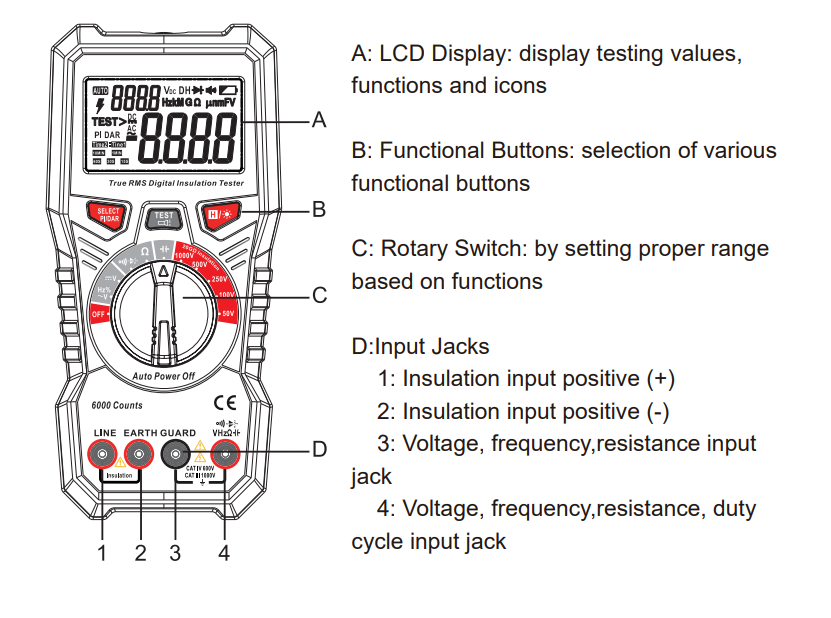
The HK505 Handheld Insulation Resistance Tester integrates PI and DAR testing into a simple workflow:
- One-button selection for PI or DAR mode
- Automatic timing and calculation
- Multiple insulation test voltages from 50V to 1000V
- Insulation resistance measurement up to 20 GΩ
- Safety design suitable for industrial and field environments
This allows engineers to perform advanced insulation diagnostics without complex setup or manual calculations.
MΩ-Only Testing vs PI/DAR Testing
Relying solely on a single insulation resistance value can be misleading. A cable or motor may pass an MΩ test yet fail under real operating conditions. PI and DAR testing provide deeper insight, transforming insulation testing from a basic measurement into a diagnostic tool.
Conclusion
PI and DAR testing are no longer optional techniques reserved for specialists. They are essential tools for modern insulation diagnostics and predictive maintenance. With instruments like the HK505, electrical professionals can move beyond simple resistance readings and gain a clearer, more reliable understanding of insulation health.
Contact Honeytek today to learn more about our testing instruments
You may like these:
