
A non-contact voltage tester is often the first tool an electrician reaches for when checking an unfamiliar circuit. It is compact, convenient and capable of detecting AC voltage without direct electrical contact.
But does a silent NCV pen mean that a circuit is safe to touch?
No. A non-contact voltage pen can provide an initial warning of electrical hazards, but a suitable two-pole voltage tester is the preferred choice for conventional absence-of-voltage verification in low-voltage installations.
Understanding the difference between these instruments is especially important when working with industrial control cabinets, electrical distribution boards and three-phase equipment.
Two-Pole Voltage Tester vs. NCV Pen: How Do They Work?
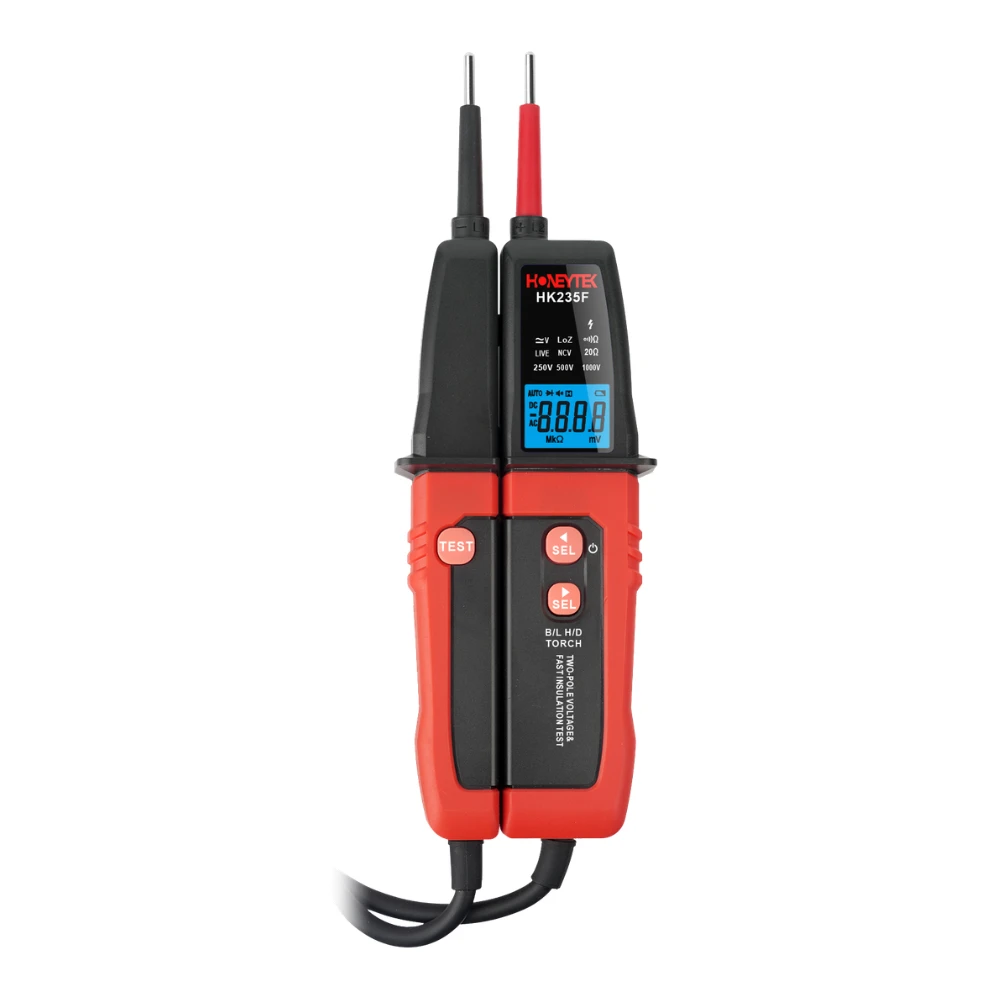

Although both instruments are designed to detect electrical voltage, their underlying detection technologies are fundamentally different.
How Does a Non-Contact Voltage Tester Work?
A non-contact voltage tester, commonly called an NCV pen or voltage stick, detects the alternating electric field surrounding an energized conductor through capacitive coupling.
When the detected field exceeds the instrument’s sensitivity threshold, the tester typically activates an LED indicator or audible alarm.
The main advantages are portability, rapid screening and the ability to detect AC voltage through certain insulating materials.
However, an NCV pen detects an electric field rather than directly measuring the potential difference between two electrical points.
How Does a Two-Pole Voltage Tester Work?
A two-pole voltage tester uses two interconnected probes to detect the electrical potential difference between two test points.
Depending on its design, it can identify AC voltage, DC voltage, polarity and other electrical conditions.
Because the detection is based on direct electrical contact, it is less dependent on surrounding electric fields than a conventional NCV pen.
This makes a suitable two-pole tester more reliable for confirming the electrical condition of specific conductors.
Two-Pole Voltage Tester vs. Non-Contact Voltage Tester: Comparison Table
| مقال مميز | Two-Pole Voltage Tester | NCV Voltage Pen |
|---|---|---|
| Detection principle | Direct electrical contact | Capacitive electric field detection |
| AC voltage detection | Yes | Yes |
| DC voltage detection | Yes, within rated range | Generally no |
| Voltage level indication | Yes, model dependent | Generally no |
| Phase-to-phase testing | Yes | No |
| DC polarity indication | Available | No |
| Detection through insulation | No | Possible |
| Susceptibility to nearby electric fields | Lower | Higher |
| Shielded cable detection | At accessible test terminals | Often unreliable |
| Continuity testing | Available | Generally no |
| Proving absence of voltage | Suitable when properly rated and used | Not suitable as sole verification |
| Best application | Safety verification and diagnostics | Preliminary voltage screening |
Neither instrument replaces every function of the other. The key is understanding which tool provides the information required for each electrical task.
Why Do NCV Pens Give False Readings?
False readings are one of the most frequently misunderstood limitations of non-contact voltage testers.
An NCV pen can produce both false-positive and false-negative indications depending on the electrical environment.
False Positive: Nearby Energized Conductors
In a crowded industrial control cabinet, multiple cables may run alongside each other.
An NCV pen positioned near a disconnected wire may respond to the electric field generated by an adjacent energized conductor.
This can make it difficult to identify which specific cable is actually energized.
False Negative: Shielded Cables and Metal Enclosures
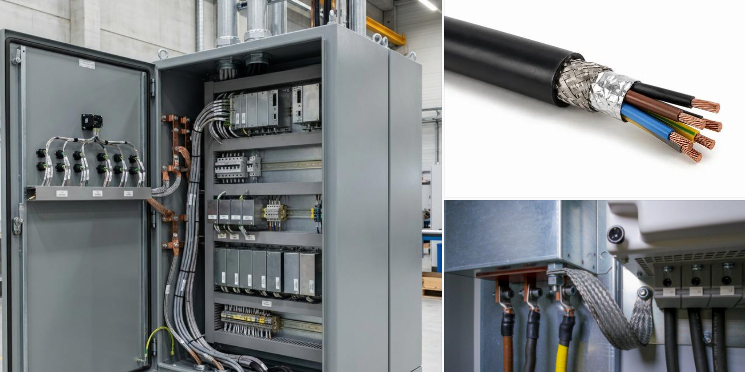
Metal shielding can weaken or block the electric field that an NCV sensor relies on.
Common examples include shielded motor cables, grounded metal conduits and industrial metal enclosures.
As a result, a conductor may remain energized even when the NCV pen produces no indication.
False Negative: Voltage Below the Detection Threshold
Every NCV pen has a specified voltage detection range.
A voltage below its sensitivity threshold may not activate the sensor. Detection can also depend on insulation thickness, distance and the instrument’s operating frequency range.
This is particularly relevant in control systems containing multiple voltage levels.
Environmental and Operator Effects
The reliability of capacitive voltage detection can also be affected by the operator’s coupling to ground, cable geometry and surrounding conductive materials.
Fluke’s electrical safety guidance specifically identifies these limitations when discussing the use of proximity voltage detectors in industrial environments. Fluke Media
An NCV alarm does not necessarily identify the exact energized conductor, and the absence of an alarm does not prove that voltage is absent.
Which Tool Is Better for Live-Dead-Live Testing?
Live-dead-live testing is an instrument verification method used as part of establishing an electrically safe working condition.
Its purpose is to confirm that the voltage detector functions correctly both before and after absence-of-voltage testing.
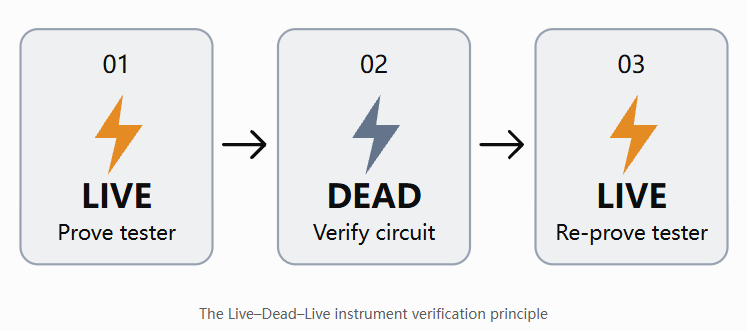
| Stage | Purpose |
|---|---|
| Live | Confirm that the voltage detector operates correctly using a suitable known voltage source or compatible proving unit. |
| Dead | Verify the absence of voltage as required by the approved isolation procedure. |
| Live | Confirm that the instrument remains functional after testing. |
An NCV pen may be useful during preliminary hazard identification, but it cannot replace the direct-contact verification required by conventional low-voltage safe isolation procedures.
The UK’s Health and Safety Executive explicitly distinguishes preliminary voltage detection from proving dead in its GS38 electrical test equipment guidance.
Electrical testing must be performed by qualified personnel using appropriately rated equipment and applicable safety procedures, including isolation and lockout/tagout requirements.
Why Two-Pole Voltage Testers Are Essential for Industrial Control Cabinets
Монтаж и пIndustrial electrical systems present challenges that are rarely encountered in simple residential wiring.
A single control cabinet may contain AC power circuits, DC power supplies, variable frequency drives, contactors and multiple independent power sources.
| Industrial Scenario | NCV Pen Limitation | Two-Pole Tester Advantage |
|---|---|---|
| Three-phase distribution | Cannot verify phase-to-phase voltage | Detects voltage between two conductors |
| 24V DC control circuits | Conventional NCV cannot detect DC | Supports DC voltage detection within range |
| Shielded VFD cables | Shielding may prevent detection | Direct terminal voltage verification |
| Crowded terminal blocks | Adjacent wiring can affect indications | Identifies voltage between specific points |
| Multiple power supplies | May miss independent DC sources | Supports verification of individual circuits |
| Motor control circuits | Limited diagnostic information | Supports voltage and phase sequence checks |
For maintenance engineers, these differences are particularly important when diagnosing electrical faults or verifying isolation in complex equipment.
Special attention must also be paid to stored energy, backup power supplies and potential backfeeds.
When Should You Use an NCV Pen or a Two-Pole Voltage Tester?
The best electrical testing tool depends on the task rather than the number of functions it offers.
Choose an NCV Pen for:
- Preliminary AC voltage screening.
- Identifying potentially energized cables.
- Quick external inspections.
- Initial electrical hazard awareness.
Choose a Two-Pole Voltage Tester for:
- AC/DC voltage verification.
- Approved low-voltage safe isolation procedures.
- Three-phase electrical system testing.
- Industrial distribution cabinet maintenance.
- Electrical installation and commissioning.
- Troubleshooting circuits with multiple voltage levels.
For professional electricians, carrying both instruments can provide a practical combination of preliminary detection and direct-contact verification.
Frequently Asked Questions (FAQ)
Is a two-pole voltage tester safer than an NCV pen?
For conventional absence-of-voltage verification, a properly rated two-pole voltage tester provides more dependable information than an NCV pen because it detects the potential difference directly between two test points.
NCV pens remain useful for preliminary screening.
Why does my non-contact voltage tester beep on a disconnected wire?
Nearby energized conductors can generate electric fields that activate the NCV sensor. Capacitive coupling and instrument sensitivity may contribute to unexpected indications.
The actual electrical condition must be verified using an appropriate contact tester.
Can an NCV tester detect DC voltage?
Most conventional NCV pens detect alternating electric fields and cannot reliably identify steady DC voltage.
A suitable AC/DC two-pole voltage tester is a better choice for DC control circuits and other DC electrical applications.
What is the best tool for live-dead-live testing?
A suitable direct-contact voltage detector, such as an appropriately rated two-pole voltage tester, used with a compatible voltage proving unit and approved electrical safety procedures.
Can a non-contact voltage tester detect voltage through metal?
Grounded metal enclosures, conductive shielding and metal conduits can significantly reduce the electric field reaching the NCV sensor.
Consequently, an NCV pen may fail to detect energized conductors inside these structures.
What is the difference between single-pole testing and NCV testing?
Single-pole phase testing typically involves one probe making electrical contact with a conductor, while NCV testing detects alternating electric fields without direct conductor contact.
Neither function should be used independently to prove the absence of voltage.
Is the Honeytek HK235A suitable for three-phase electrical systems?
Yes. Within its specified operating limits, the HK235A supports AC/DC voltage detection, phase rotation testing and single-pole phase identification, making it suitable for various three-phase electrical installation and maintenance applications.
Conclusion: Choose the Right Tool for Electrical Safety
Non-contact voltage pens offer convenience, portability and rapid preliminary hazard detection. However, their dependence on surrounding electric fields introduces limitations that cannot be ignored.
Two-pole voltage testers provide direct electrical verification and broader diagnostic capabilities, making them an essential instrument for professional low-voltage electrical safety testing.
The Honeytek HK235A combines two-pole voltage detection, single-pole phase testing and practical diagnostic functions in one professional instrument.
Use an NCV pen for preliminary screening. Use an appropriate contact voltage tester for reliable absence-of-voltage verification.
Honeytek – Professional Test and Measurement Instrument Manufacturer
Honeytek is a professional manufacturer of electrical test and measurement instruments, with 28 years of industry experience and OEM/ODM manufacturing capabilities.

 English
 Português
 Español
 Français
 Deutsch
 العربية
 Русский