
Every repair technician eventually hits the same wall: the multimeter in your kit can confirm voltage is present, but it can’t tell you why a transformer is running hot or why a filter circuit isn’t doing its job. When the fault sits inside a coil rather than across a resistor, a standard meter simply runs out of answers.
That gap is exactly where an LCR digital multimeter earns its place on the bench. This article looks at why inductance measurement has become essential for component-level repair, and what to look for in the best digital multimeter with inductance for the job.
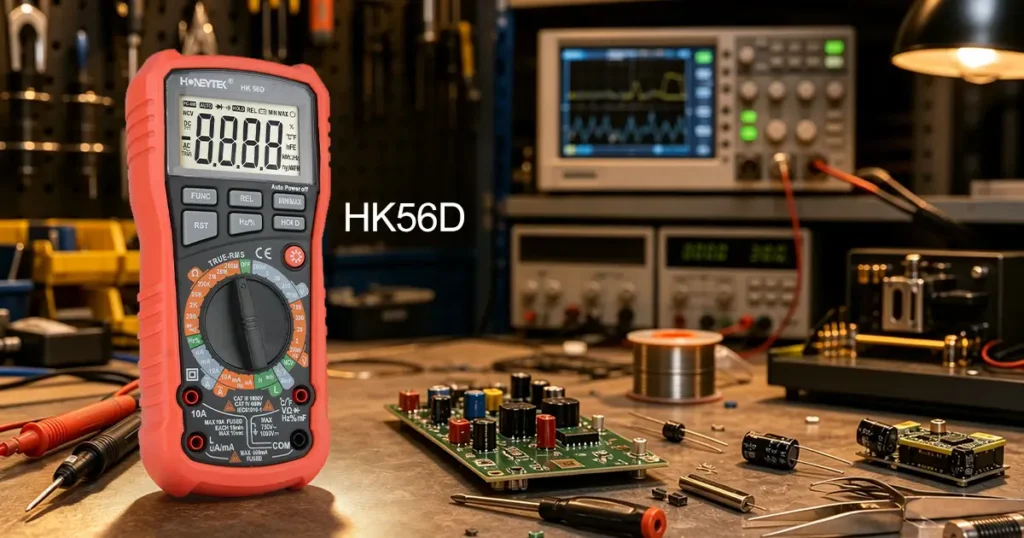
The Limitation of Standard Multimeters in Electronic Diagnostics
A typical digital multimeter is built around three functions: voltage, current, and resistance. For general electrical work, that’s usually enough. But the moment a fault involves a transformer winding, a choke, a motor coil, or an EMI filter, resistance alone stops being a reliable indicator.
A winding can measure perfectly fine in ohms and still be defective. A partial turn-to-turn short, a saturated core, or a degraded inductor often shows almost no change in DC resistance — the fault only reveals itself as a shift in inductance. Without an inductance function, a technician is left guessing, swapping parts on suspicion rather than confirming the fault directly.
This is why so many repair shops end up carrying a second, dedicated LCR meter just to check inductors and transformers — extra cost, extra bench space, and one more tool to keep charged and calibrated.
What Makes an “LCR Multimeter” a Game-Changer?
An LCR multimeter folds inductance (L), capacitance (C), and resistance (R) testing into the same handheld unit used for everyday voltage and current checks. Instead of switching between two separate instruments mid-repair, a technician can trace a fault from the power supply all the way down to a single suspect coil without putting one meter down and picking another up.
This matters more than it might first appear. Modern electronics — power supplies, motor drives, LED drivers, filter networks — rely heavily on inductive components, and intermittent inductance-related faults are notoriously hard to catch with resistance testing alone. A meter that measures inductance directly turns a guessing game into a measurable comparison against a known-good value.
For repair businesses, this consolidation is also a practical differentiator: offering component-level diagnostics that a resistance-only multimeter simply cannot perform is a meaningful edge over shops still relying on basic testing tools.
Spotlight: HK56D Professional LCR Digital Multimeter with Inductance & Resistance Tester
The HK56D is built specifically around this gap — pairing full LCR functionality with the ruggedness and simplicity of a standard field multimeter.
2mH to 20H Inductance Range
The HK56D’s inductance range runs from 2mH up to 20H, which is wide enough to cover small signal inductors and chokes on one end, and heavy industrial coils, motor windings, and transformer secondaries on the other. Rather than needing a separate low-range LCR meter for electronics work and a separate high-range clamp tester for industrial coils, a single instrument spans both use cases.
Up to 200MΩ Ultra-High Resistance
Most general-purpose multimeters top out at 20MΩ to 60MΩ — a ceiling that becomes a real limitation the moment insulation resistance or high-impedance circuit testing is involved. The HK56D extends resistance measurement up to 200MΩ, which puts it in line with what’s expected for preliminary insulation checks and high-impedance diagnostic work, rather than the entry-level range found in typical consumer meters.
Together, the extended inductance and resistance ranges mean the HK56D isn’t a stripped-down “multimeter with an L function” — it’s built to handle the actual measurement range that component-level and industrial repair work demands.
Conclusion: Stop Carrying Two Meters, Switch to HK56D
Diagnosing a transformer or motor winding shouldn’t require switching between a multimeter and a separate LCR meter. The HK56D combines True RMS voltage and current, resistance up to 200MΩ, and inductance from 2mH to 20H in one handheld instrument — enough range to move confidently from small electronic components to industrial-grade coils without changing tools.
About Honeytek
Honeytek is a measurement instrument manufacturer specializing in clamp meters, digital multimeters, and related test equipment for industrial and electrical applications. In addition to standard product lines like the HK56D, Honeytek supports OEM and ODM customization for distributors and project buyers with specific range, accuracy, or branding requirements.
If your team is comparing LCR digital multimeters for component-level repair work — or considering a customized instrument for your product line — reach out to Honeytek to discuss your requirements.
Related Products & Resources
- HK68C 5,999 Counts PC-Link Digital Multimeter — product page, datasheet, and USB driver download
- HK56D 1,999 Counts Inductance Digital Multimeter — product page, inductance accuracy chart
- All HONEYTEK Digital Multimeters
- Contact HONEYTEK for OEM/ODM
