
As commercial and utility-scale solar installations increasingly adopt 1500V DC system architectures, selecting the right solar PV clamp meter has become an important consideration for photovoltaic installation, maintenance, and electrical troubleshooting.
Traditional clamp meters designed for 600V or 1000V electrical systems may not meet the measurement and safety requirements of high-voltage solar arrays.
Whether you are a solar O&M engineer, electrical contractor, instrument distributor, or renewable energy equipment supplier, understanding voltage ranges, measurement categories, DC current capabilities, and diagnostic functions is essential when choosing a professional solar clamp meter.
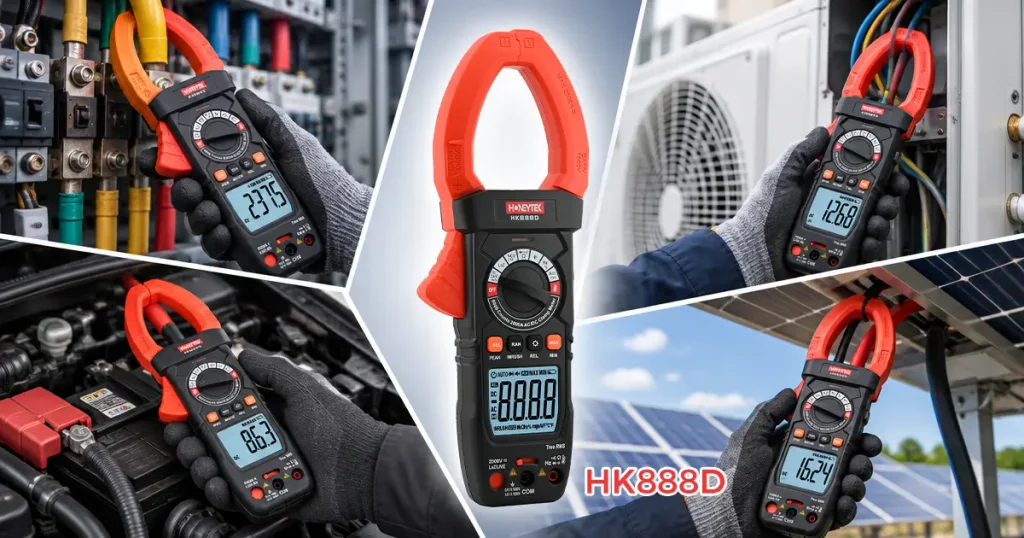
This guide explains the key selection criteria and introduces the Honeytek HK888D 2000V/2000A True RMS Solar PV Clamp Meter as an alternative for solar and industrial electrical testing.
1. Why Do 1500V Solar PV Systems Require Specialized Pinzas amperimétricas?
Modern utility-scale photovoltaic systems increasingly utilize 1500V DC architectures to improve system efficiency, reduce resistive power losses, and optimize balance-of-system (BOS) costs.
However, higher system voltages also introduce more demanding electrical measurement and safety requirements.
PV module open-circuit voltage (Voc) increases as cell temperature decreases. Consequently, technicians must consider the maximum expected string voltage under cold-weather conditions rather than relying solely on nominal operating voltage.
Using an inadequately rated clamp meter may result in:
- Electrical insulation breakdown.
- Instrument damage and measurement failure.
- Increased risk of electrical shock and arc flash.
- Unreliable voltage readings.
- Equipment downtime and maintenance delays.
For high-voltage photovoltaic applications, choose a clamp meter with an appropriate DC voltage range, measurement category, and compatible test leads.
Important: A 2000V DC measurement range provides additional measurement capacity, but it does not automatically authorize testing at 2000V in every measurement category.
2. Understanding CAT III 1500V and CAT IV 1000V Safety Ratings
When purchasing a high-voltage solar clamp meter, the measurement category is just as important as its maximum voltage range.
The IEC 61010 series establishes safety requirements for electrical measurement instruments, including current clamps and handheld measuring equipment.
| Índice de seguridad | Typical Application |
|---|---|
| CAT II | Appliances and receptacle-connected equipment |
| CAT III | Fixed electrical installations and distribution equipment |
| CAT IV | Origin of low-voltage electrical installations and utility service connections |
| CAT III 1500V | High-voltage measurement locations within the instrument’s specified CAT III limits |
| CAT IV 1000V | High-energy measurement locations within the specified CAT IV limits |
The Honeytek HK888D features a published CAT III 1500V / CAT IV 1000V safety rating and a DC voltage measurement range of up to 2000V.
Always verify the applicable measurement category, terminal-to-earth voltage limits, test lead ratings, and manufacturer instructions before conducting high-voltage measurements.
3. Seven Essential Features of a Professional Solar PV Clamp Meter
3.1 High-Voltage DC Measurement
A professional photovoltaic clamp meter should support the voltage range required by the PV system being tested.
For commercial and utility-scale solar installations, high-voltage DC measurement is particularly important for PV string voltage testing, solar combiner box diagnostics, inverter DC input inspection, photovoltaic system commissioning, and electrical maintenance.
The Honeytek HK888D supports DC voltage measurements up to 2000V within its specified operating limitations.
3.2 AC/DC Current Measurement
Unlike AC-only clamp meters, an AC/DC clamp meter can measure direct current generated by photovoltaic modules.
DC current measurement allows technicians to compare string operating currents, investigate abnormal output, and identify potential performance issues.
The HK888D supports AC and DC current measurements up to 2000A through its integrated clamp jaw, making it suitable for compatible solar and industrial electrical applications.
3.3 True RMS Measurement
Solar inverters and modern power electronic equipment can generate distorted AC waveforms.
True RMS clamp meters provide more representative RMS measurements of non-sinusoidal AC signals than conventional average-responding meters, provided the signals remain within the instrument’s specified bandwidth and crest factor limits.
This capability is particularly useful for inverter troubleshooting, industrial electrical maintenance, and renewable energy equipment diagnostics.
3.4 Relative Measurement and DC Zero Function
DC clamp meters may experience residual magnetic offsets that affect measurement accuracy. A relative measurement or zero function helps compensate for these offsets before measuring DC current.
This feature is especially useful when comparing the operating currents of multiple PV strings, where current differences may indicate shading, connection problems, or module performance variations.
3.5 Inrush Current Measurement
Inrush current measurement helps capture short-duration current increases during equipment startup.
- Solar inverter startup diagnostics.
- Industrial motor testing.
- Transformer energization analysis.
- Electrical equipment troubleshooting.
The measurement mode must be suitable for the type and duration of the startup event being investigated.
3.6 LoZ Low-Impedance Voltage Measurement
Long parallel electrical conductors may develop apparent voltages through capacitive coupling, commonly known as ghost voltages.
LoZ measurement applies a lower input impedance to help distinguish induced voltages from energized sources. However, LoZ mode is not suitable for every circuit. Technicians should confirm that the circuit can tolerate the additional measurement load and follow the instrument manufacturer’s instructions.
3.7 Large Clamp Jaw and Field-Friendly Design
A larger jaw opening improves access to thick electrical conductors, particularly in industrial distribution equipment.
The Honeytek HK888D combines a 60.5mm jaw opening with a 6000-count display and integrated work light for versatile field applications.
4. Fluke 393 FC vs. Honeytek HK888D: Solar PV Clamp Meter Comparison
When comparing professional solar clamp meters, buyers should consider measurement capacity, safety ratings, diagnostic capabilities, environmental protection, and total procurement costs.
The Fluke 393 FC and Honeytek HK888D represent two different approaches to high-voltage electrical testing.
| Especificaciones | Fluke 393 FC | Honeytek HK888D |
|---|---|---|
| Maximum DC Voltage Range | 1500V | 2000V |
| Maximum AC Current (Jaw) | 999.9A | 2000A |
| Maximum DC Current (Jaw) | 999.9A | 2000A |
| AC Current with Flexible Probe | 2500A | Not specified |
| True RMS | Sí | Sí |
| CAT III Rating | 1500V | 1500V |
| CAT IV Rating | 600V | 1000 V |
| Jaw Opening | 34mm | 60.5mm |
| Temperature Measurement | Not specified | Sí |
| Wireless Data Logging | Fluke Connect | Not specified |
| Ingress Protection | IP54 | Not specified |
| OEM/ODM Customization | Not specified | Available for B2B orders |
Sources: Fluke 393 FC official specifications y Honeytek HK888D product specifications. Specifications are subject to manufacturer documentation. A higher measurement range does not necessarily indicate a higher safety rating.
Why Consider the Honeytek HK888D?
The Honeytek HK888D is particularly attractive for buyers seeking a combination of high DC voltage measurement capacity, large-jaw AC/DC current measurement, and multifunction electrical diagnostics.
- DC voltage measurement range up to 2000V.
- Approximately twice the integrated-jaw current capacity of the Fluke 393 FC.
- Large 60.5mm jaw opening for industrial conductors.
- Temperature, frequency, and capacitance measurement.
- Inrush current and low-impedance voltage measurement.
- Factory-direct procurement and OEM/ODM opportunities.
The Fluke 393 FC offers advantages such as wireless reporting, IP54 protection, a slim jaw, and flexible-probe AC current measurement. Buyers should select the instrument that best matches their technical and commercial requirements.
5. How to Use a Clamp Meter for Solar PV Troubleshooting
Solar PV troubleshooting requires more than simply checking voltage and current. Technicians must understand the relationship between electrical measurements, environmental conditions, and expected system performance.
| Measurement | Diagnostic Purpose |
|---|---|
| Open-Circuit Voltage (Voc) | Investigate abnormal string voltage |
| DC Operating Current | Compare PV string performance |
| AC Output Voltage | Evaluate inverter output conditions |
| AC Output Current | Assess inverter operating loads |
| Temperatura | Investigate abnormal equipment temperatures |
| Inrush Current | Evaluate compatible equipment startup events |
| Frecuencia | Check AC output frequency |
When performing solar PV measurements, qualified technicians should observe the following precautions:
- Verify instrument ratings and test lead compatibility.
- Determine the maximum expected PV string voltage.
- Compensate for DC current measurement offsets.
- Measure individual conductors rather than enclosing both positive and negative conductors simultaneously.
- Compare string measurements under similar irradiance and temperature conditions.
- Follow applicable electrical safety procedures and PPE requirements.
Safety Note: PV modules can continue generating hazardous DC voltage whenever exposed to sunlight, even after an inverter has been switched off. Never disconnect PV connectors under load or exceed the instrument’s specified measurement and safety limits.
6. Typical Applications of the Honeytek HK888D Solar PV Clamp Meter
Utility-Scale Solar Farms
PV string inspection, current monitoring, electrical troubleshooting, and preventive maintenance for large-scale solar power installations.
Commercial Rooftop PV Systems
System commissioning, electrical inspection, and performance troubleshooting for commercial and industrial photovoltaic installations.
Solar Inverter Diagnostics
DC input and AC output measurements to investigate abnormal operating conditions and support inverter maintenance.
Mantenimiento eléctrico industrial
High-current measurement, motor diagnostics, and power distribution equipment inspection within the instrument’s specified operating limits.
Battery Energy Storage Systems
DC voltage and current measurements for compatible energy storage equipment and battery power distribution circuits.
7. How to Choose a Solar PV Clamp Meter for Bulk Procurement
For instrument distributors, wholesalers, and private-label brands, technical specifications are only one part of the purchasing decision.
A reliable solar PV clamp meter manufacturer should also provide consistent product quality, documentation, customization capabilities, and long-term supply support.
- Measurement Specifications: DC voltage, AC/DC current, accuracy, resolution, and diagnostic functions.
- Safety Documentation: Model-specific compliance documents, measurement category ratings, and test reports.
- Product Durability: Housing construction, jaw mechanism, operating temperature, and environmental protection.
- OEM/ODM Capabilities: Private-label branding, customized packaging, and product development options.
- Quality Control: Production inspection, calibration, and finished-product testing.
- Commercial Support: MOQ, delivery schedules, warranty, and after-sales service.
Working directly with an experienced clamp meter manufacturer can help distributors develop a differentiated product portfolio for solar and industrial electrical testing markets.
8. Frequently Asked Questions About Solar PV Clamp Meters
What is the best clamp meter for 1500V solar PV systems?
A suitable clamp meter should offer a DC voltage range appropriate for the system, compatible safety ratings, DC current measurement, and properly rated accessories. True RMS, relative measurement, and a suitable jaw design are also important considerations.
Can a standard AC clamp meter measure solar panel current?
No. Solar panels generate DC electricity, so an AC-only clamp meter cannot correctly measure their steady-state DC operating current. A clamp meter with DC current measurement capability is required.
Can a 1000V clamp meter be used on a 1500V solar system?
A 1000V-rated instrument must not be used to measure voltages exceeding its specified limits. Select a meter and accessories rated for the actual measurement location and maximum expected voltage.
Is a 2000V clamp meter better than a 1500V clamp meter?
A 2000V DC clamp meter offers a wider voltage measurement range. However, suitability depends on measurement category, terminal voltage limits, accuracy, accessories, and operating conditions, not simply the maximum displayed voltage.
Why is True RMS important for solar inverter testing?
True RMS measurement helps technicians obtain reliable RMS readings on distorted AC waveforms produced by power electronic equipment, subject to the instrument’s specified measurement limitations.
Can a solar PV clamp meter measure maximum solar panel power?
A conventional clamp meter measures electrical parameters such as voltage and current. Determining a PV module’s maximum power point requires an appropriate dedicated MPPT tester or I-V curve tracer.
For dedicated module power testing, explore the Honeytek HK88PV 150V 2200W Solar Panel MPPT Tester.
Does Honeytek support OEM/ODM solar clamp meters?
Yes. Honeytek supports OEM/ODM services for electrical test and measurement instruments, including private-label branding, customized packaging, and product configuration based on customer requirements and order quantities.
Conclusión
Choosing the right solar PV clamp meter requires balancing voltage measurement range, electrical safety ratings, DC current capability, measurement accuracy, and practical diagnostic functions.
With its 2000V DC measurement range, 2000A AC/DC current capacity, True RMS technology, and multifunction testing capabilities, the Honeytek HK888D offers a versatile solution for compatible photovoltaic and industrial electrical applications.
For solar installation professionals and instrument distributors, selecting a properly rated and application-specific measurement instrument can support more efficient diagnostics, preventive maintenance, and long-term equipment reliability.
Related Solar PV Testing Instruments
- HK888D 2000A AC/DC True RMS Solar PV Clamp Meter
- HK888E Professional High-Voltage Solar PV Clamp Meter
- HK88PV 150V 2200W Solar Panel MPPT Tester
- HK235E 1500V DC Two-Pole Voltage Tester
Looking for a Reliable Solar PV Clamp Meter Manufacturer?
Honeytek is a professional test and measurement instrument manufacturer with over 25 years of industry experience, offering solar PV clamp meters, digital multimeters, voltage testers, insulation testers, and photovoltaic testing instruments.
We support global instrument distributors, wholesalers, electrical equipment suppliers, and private-label brands with flexible manufacturing and procurement solutions.
- OEM/ODM customization.
- Private-label branding and packaging.
- Factory-direct wholesale supply.
- Bulk orders for global distributors.
- Technical support and product development.
Contact Honeytek today to request a product datasheet, sample, or competitive distributor quotation.
Correo electrónico: [email protected]
WhatsApp: +86 13802253960
Website: www.honeytek.com

 English
 Português
 Español
 Français
 Deutsch
 العربية
 Русский