
Electrical safety is built on a simple principle: current should only flow where it is intended. When insulation weakens or fails, electricity leaks, creating risks of shock, fire, and equipment damage. This is where insulation resistance testing becomes essential.
As a trusted manufacturer of professional electronic measurement tools, Honeytek provides reliable insulation testers designed to safeguard systems across residential, industrial, and renewable energy environments.
In this article, we’ll explain the importance of insulation resistance testing, the problems it solves, the dangers of neglecting it, and why Honeytek testers are the right choice.

Why Is Insulation Resistance Testing Important?
1. Prevents Electrical Shock
Insulation acts as a barrier between conductive parts and human contact. Testing ensures that insulation hasn’t degraded, protecting technicians, operators, and end-users from electrical shock.
2. Protects Equipment and Extends Service Life
Moisture, dust, heat, and mechanical stress all reduce insulation quality. Regular testing detects early-stage issues, preventing costly breakdowns in motors, transformers, and switchgear.
3. Minimizes Fire Hazards
Insulation failure can cause arcing, overheating, or sparks, leading to electrical fires. Testing provides assurance that systems operate safely under load.
4. Ensures Compliance with Safety Standards
Standards from organizations like IEC, IEEE, and NEC require insulation integrity verification. Passing insulation resistance tests confirms compliance during installation and routine maintenance.
5. Improves System Efficiency
When insulation leaks current, efficiency drops. Testing identifies hidden losses, ensuring maximum performance of power and control systems.
Risks of Skipping Insulation Resistance Testing
Failing to perform insulation resistance testing leaves facilities vulnerable to:
- Unexpected Equipment Failures: Motors and transformers can fail suddenly, halting production.
- Costly Downtime: Even a short outage in industrial environments can cause financial losses.
- Safety Hazards: Operators face increased risk of shocks or burns.
- Fire Accidents: Small insulation leaks can escalate into destructive fires.
- Higher Maintenance Costs: Unmonitored degradation leads to premature equipment replacement.
In short: not testing is riskier and more expensive than testing.
How Honeytek Insulation Testers Help
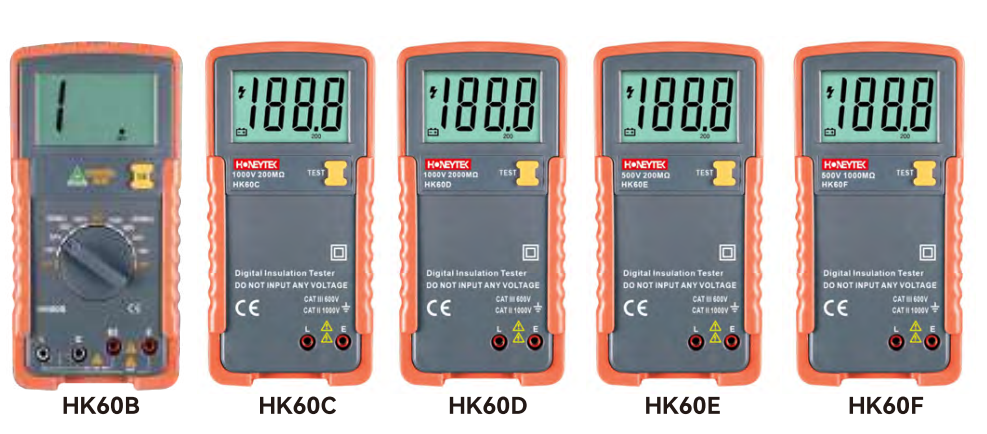
Honeytek offers insulation testers built for both technicians and professionals. Their testers combine reliability, ease of use, and compliance with global standards.
Key Features of HoneytekHK60F 2,000 Counts 1000V Handheld Insulation Tester Insulation Testers
- Test voltages: 100V to 2500V, covering a wide range of applications.
- Measurement range in MΩ to GΩ, ensuring precise results.
- Advanced analysis functions for Polarization Index (PI) and Dielectric Absorption Ratio (DAR).
- Portable and durable design for field or workshop environments.
- Safety ratings that protect users during every test.
Example Applications
- Residential & Commercial Wiring: Confirm circuits are safe before energizing.
- Industrial Equipment: Diagnose motors, generators, and transformers.
- Power Utilities: Monitor switchgear, substations, and distribution lines.
- Renewable Energy Systems: Verify insulation integrity in solar PV and wind turbines.
When Should You Test Insulation Resistance?
- During Installation: Ensure new systems meet required safety standards.
- Scheduled Maintenance: At least once a year for critical assets.
- After Repairs or Downtime: Verify that insulation hasn’t deteriorated during idle periods.
- Before Re-Energizing Equipment: Especially after environmental exposure to moisture or dust.
Frequently Asked Questions (FAQ)
Q1: What is a good insulation resistance value?
Generally, above 100MΩ is excellent, 1MΩ–100MΩ is acceptable, and below 1MΩ indicates potential failure.
Q2: What are PI and DAR, and why are they important?
- Polarization Index (PI): 10-minute/1-minute ratio that shows long-term insulation stability.
- Dielectric Absorption Ratio (DAR): 60s/30s ratio, helpful for detecting moisture or contamination.
Q3: How often should insulation resistance tests be conducted?
At least annually for industrial equipment, but more frequently in harsh environments.
Q4: Can Honeytek testers measure AC voltage too?
Yes, Honeytek insulation testers include AC voltage measurement up to 750V for added versatility.
Q5: What happens if I ignore insulation testing?
You risk sudden breakdowns, safety hazards, and costly damage to equipment and facilities.
Conclusion
Insulation resistance testing isn’t optional—it’s a critical step in maintaining safe, efficient, and compliant electrical systems. Skipping tests invites risks ranging from equipment damage to life-threatening hazards.
With decades of expertise, Honeytek provides insulation testers designed to meet professional needs, whether for residential circuits, industrial equipment, or renewable energy installations.
Don’t leave electrical safety to chance.
Explore Honeytek’s range of insulation testers today and ensure every system you manage is reliable, safe, and efficient. Contact Honeytek for product details, distributor info, or a quote.
