
A voltage tester can indicate whether an electrical circuit is energized—but how can an electrician know that the tester itself is functioning correctly?
A damaged probe, broken connecting cable or internal component failure could prevent a voltage tester from indicating a dangerous electrical condition.
This is where a voltage proving unit becomes an essential addition to a professional electrician’s toolkit.
By combining a compatible two-pole voltage tester with a portable 690V proving unit, electrical professionals can verify instrument functionality without relying on access to an external live electrical supply.
In this guide, we explain how proving units work, why they are valuable for electrical maintenance, and how the Honeytek HK235A and HK690 can support professional safe isolation procedures.
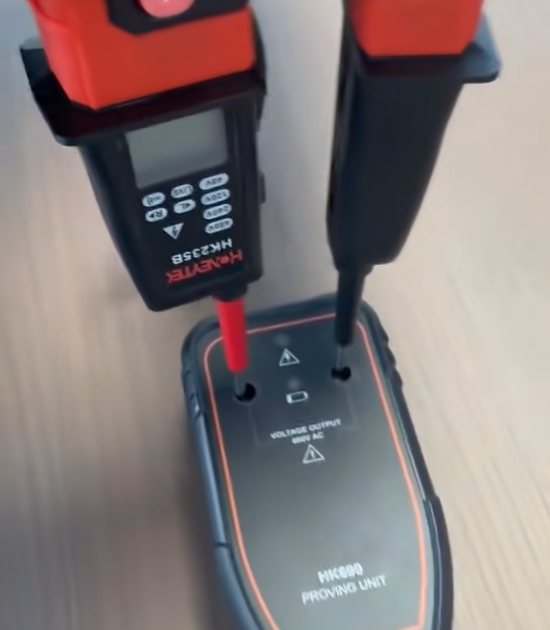
1. What Is a Voltage Proving Unit?
A voltage proving unit is a portable device designed to generate a known electrical output for checking the functionality of voltage detection instruments.
Unlike a voltage tester, which detects voltage from an external electrical system, a proving unit provides a dedicated test voltage.
Its primary purpose is to confirm that the connected voltage detector responds as expected.
Most professional proving units feature a battery-powered design, dedicated probe interfaces and visual operating indicators.
| Instrument | Primary Function |
|---|---|
| Two-Pole Voltage Tester | Detects voltage between electrical points |
| Voltage Proving Unit | Generates a known voltage to verify tester functionality |
| Voltage Tester and Proving Unit Kit | Supports electrical voltage detection and instrument verification |
These two instruments perform complementary functions rather than replacing each other.
2. Why Is a Voltage Tester Self-Test Not Always Enough?
Many modern electrical testing instruments include built-in self-test functions. These functions can help identify certain electronic faults and confirm the operation of internal components.
However, the scope of an internal self-test varies between instruments.
A self-test may not independently verify the complete external voltage detection path, including both probes, connecting leads and the instrument’s response to an applied voltage.
An external proving unit provides an additional functional check by supplying a known voltage directly to the detector.
This helps identify potential problems such as:
- Damaged or disconnected test probes.
- Internal voltage indication failures.
- Broken or intermittent connecting cables.
- Unexpected voltage indicator behavior.
- Instrument damage caused during transportation or previous use.
A proving unit does not replace visual inspections, periodic calibration or electrical safety procedures. Instead, it adds an important layer of functional verification.
3. Why Choose a 690V Proving Unit?
A 690V proving unit is particularly useful when paired with compatible professional voltage detectors designed for conventional low-voltage electrical installations.
Many industrial electrical systems operate at nominal voltages such as 230V, 400V, 480V and 690V AC.
A compatible 690V proving unit can provide a high-level test signal to check the detector’s response across its applicable voltage indication levels.
Advantages of a Portable 690V Proving Unit
- Independent voltage source: Reduces reliance on accessible live electrical circuits.
- Consistent output: Provides a repeatable source for functional verification.
- Portable operation: Supports maintenance activities across multiple locations.
- Flexible application: Can support compatible two-pole testers and other measuring instruments.
- Improved workflow: Allows instrument verification at the point of work.
However, 690V is not a universal proving voltage. The proving unit must be compatible with the detector’s voltage range, input impedance, waveform requirements and manufacturer instructions.
4. How to Prove a Voltage Tester Before and After Use
A proving unit supports the instrument verification stages of an approved safe isolation procedure.
Professional electricians commonly refer to this approach as the Live–Dead–Live method, where the first and final stages confirm the functionality of the voltage detector.
Step 1: Inspect the Test Equipment
Before connecting the voltage tester to a proving unit, inspect its housing, probes, connecting cable and protective insulation.
Check that the tester and proving unit are compatible and that their operating conditions meet the manufacturer’s requirements.
Damaged instruments must not be used.
Step 2: Verify the Voltage Tester Before Use
Using the compatible proving unit according to its operating instructions, confirm that the voltage tester produces the expected voltage indication.
For the Honeytek HK235A, the HK690 provides a nominal 690V AC output for checking its voltage detection response.
If the expected indication is absent or inconsistent, stop and investigate the equipment condition before proceeding.
Step 3: Perform the Approved Absence-of-Voltage Verification
Qualified electrical personnel must verify the absence of voltage following the applicable safe isolation procedure, including identification of energy sources, isolation, securing against reconnection and consideration of stored energy.
The proving unit verifies the tester; it does not verify the electrical installation itself.
Step 4: Recheck the Voltage Tester After Use
After completing the absence-of-voltage test, use the compatible proving unit again to confirm that the detector remains functional.
If the tester fails this final check, the previous absence-of-voltage result cannot be relied upon.
The test equipment must be investigated, and the required verification repeated using suitable functioning equipment.
Important: A proving unit must be used according to its instructions. Its high-voltage output is not intended for general-purpose power supply applications.
5. Proving Unit vs. Live Electrical Source: Which Is More Practical?
Some electricians verify their voltage testers using a known energized socket or another accessible electrical source.
Although this may be acceptable under certain safety procedures, a portable proving unit offers several practical advantages.
| Comparison | Dedicated Proving Unit | Known Live Electrical Source |
|---|---|---|
| Voltage source | Dedicated test output | Existing electrical installation |
| Portability | Да | Dependent on location |
| Output consistency | Specified by the manufacturer | Depends on the supply |
| Availability during power outages | Battery powered | May be unavailable |
| Access to exposed live equipment | Reduced need | May require additional precautions |
| Instrument verification workflow | Convenient at the point of work | May require moving between locations |
| Suitability | Compatible instrument verification | Subject to voltage suitability and safety precautions |
The UK Health and Safety Executive’s GS38 guidance identifies a dedicated proving unit as the preferred option for verifying voltage detection equipment before and after use.
A suitable known live source may also be used when appropriate precautions are taken. 健康与安全执行局+1
For mobile electricians and industrial maintenance teams, carrying a portable proving unit makes instrument verification more convenient and less dependent on site conditions.
6. Honeytek HK235A + HK690: A Professional Voltage Testing Combination
Honeytek offers two complementary instruments for professional electrical testing and safe isolation applications: the HK235A two-pole voltage tester and the HK690 AC voltage proving unit.

Honeytek HK235A Two-Pole Voltage and Continuity Tester
The HK235A is designed for building electrical installations, industrial equipment maintenance and professional AC/DC voltage detection.
Key features:
- 12–690V AC/DC voltage detection
- CAT III 1000 В / CAT IV 600 В
- LED voltage indication
- Continuity and phase rotation testing
- Optical, acoustic and vibration alerts
- IP65 enclosure protection
- Declared EN 61243-3:2014 compliance

Honeytek HK690 AC Voltage Proving Unit
The HK690 provides a dedicated voltage output for checking compatible electrical testing instruments before and after use.
Key features:
- Constant 690V AC output
- 50Hz output frequency
- Supports high- and low-impedance instruments
- High-visibility LED indicators
- Powered by six AA alkaline batteries
- Portable and rugged construction
HK235A and HK690 Technical Comparison
| Технические характеристики | HK235A Voltage Tester | HK690 Proving Unit |
|---|---|---|
| Instrument type | Two-pole voltage detector | Voltage proving source |
| Primary function | Detect electrical voltage | Verify tester functionality |
| Voltage specification | 12–690 В переменного/постоянного тока | 690V AC output |
| Частота | AC detection: 40–400Hz | 50Hz output |
| Indication | Светодиод | Светодиод |
| Power supply | 2 × AAA batteries | 6 × AA batteries |
| Application | Electrical installation and maintenance | Instrument functional verification |
| Recommended workflow | Circuit voltage detection | Pre-test and post-test verification |
The HK235A and HK690 have complementary nominal voltage and frequency specifications, making them a logical combination for professional procurement. Confirm the permitted operating modes and expected indications in the manufacturer’s instructions before use. Honeytek+1
7. Key Applications for a Voltage Tester and Proving Unit Kit
A portable voltage detector and proving unit combination is valuable across several professional electrical environments.
Building Electrical Installation
Electrical contractors frequently move between distribution boards, equipment rooms and installation locations.
A portable proving unit allows them to check their voltage detector without relying on a nearby working socket.
Техническое обслуживание промышленного оборудования
Manufacturing facilities often contain motor control centres, automated machinery and multiple electrical distribution systems.
Dedicated instrument verification supports consistent maintenance procedures across different work areas.
Commercial Facilities Management
Shopping centres, hotels, office buildings and commercial properties require regular electrical inspections.
A standardized voltage testing kit helps maintenance teams maintain consistent equipment verification practices.
Electrical Shutdown Projects
During planned shutdowns or power outages, access to a known live electrical supply may be limited.
A battery-powered proving unit provides an independent voltage source for checking compatible instruments.
Electrical Training and Professional Tool Distribution
Technical schools, electrical training centres and instrument distributors can offer voltage testers and proving units together to emphasize correct instrument verification practices.
8. How to Choose a Compatible Voltage Tester and Proving Unit Kit
Before purchasing a two-pole voltage tester and proving unit combination, professional buyers should evaluate the following characteristics.
| Selection Criteria | What to Check |
|---|---|
| Output voltage | Must be suitable for the detector’s rated input |
| Output waveform | AC or DC according to the detector requirements |
| Output frequency | Within the instrument’s supported frequency range |
| Input impedance compatibility | Suitable for the detector’s normal operating mode |
| Probe compatibility | Secure connection to the proving unit interface |
| Operating limitations | Permitted test duration and load conditions |
| Portability | Battery operation and convenient transportation |
| Technical documentation | Clear instructions for both instruments |
| Supplier support | Replacement products, technical assistance and warranty |
Buyers should pay particular attention to switchable low-impedance functions and load buttons. Compatibility with normal voltage detection does not automatically mean a proving unit supports every available load-testing mode.
For distributors, purchasing compatible instruments together can also simplify product sourcing, customer education and after-sales support.
9. Is a Proving Unit the Same as a Voltage Calibrator?
No. Although both instruments generate an electrical output, they serve different purposes.
| Особенность | Voltage Proving Unit | Voltage Calibrator |
|---|---|---|
| Primary purpose | Functional verification | Measurement accuracy verification or calibration |
| Output | One or more specified test voltages | Precision reference signals |
| Typical user | Electrician or maintenance technician | Calibration technician or laboratory engineer |
| Portability | Generally compact | Model dependent |
| Calibration certification | Does not establish tester calibration | Can support traceable calibration procedures |
A proving unit confirms that a compatible voltage detector responds to a known voltage.
It does not establish the accuracy of every measurement range, verify every internal safety component or replace periodic calibration and manufacturer-recommended inspections.
The Honeytek HK690 is designed for functional instrument verification rather than precision laboratory calibration.
10. Frequently Asked Questions (FAQ)
What is a 690V proving unit used for?
A 690V proving unit generates a specified test voltage to confirm that compatible voltage detectors and measuring instruments respond correctly before and after electrical testing.
Why should electricians use a voltage proving unit?
A dedicated proving unit provides an independent voltage source for checking instrument functionality, reducing reliance on accessible live circuits and supporting consistent electrical safety procedures.
Do I need to prove a voltage tester after every absence-of-voltage test?
Professional safe isolation guidance recommends verifying the voltage detector before and after proving dead. The final verification helps identify instrument failures that may have occurred during testing.
Always follow the applicable workplace safety procedure.
Can a 690V proving unit be used with a digital multimeter?
Yes, provided the multimeter’s voltage input, selected measurement function and electrical characteristics are compatible with the proving unit.
The Honeytek HK690 is designed to support compatible voltage testers and multimeters.
Can the HK690 prove a 1500V DC voltage tester?
The HK690 provides 690V AC, not 1500V DC. It may support an appropriate AC functional check on a compatible AC/DC instrument, but it cannot verify the detector’s full 1500V DC range or its DC-specific indication functions.
Does a voltage proving unit require batteries?
Many portable proving units operate on batteries. The Honeytek HK690 uses six AA alkaline batteries, allowing use without an external mains supply.
Is a proving unit mandatory in the UK?
UK electrical safety guidance recommends proving voltage detectors before and after use, preferably with a dedicated proving unit. A suitable known live source may also be acceptable under appropriate precautions.
Purchasing a dedicated proving unit is therefore a practical choice, but local regulations and workplace procedures determine the specific requirements.
Can I purchase the Honeytek HK235A and HK690 together?
Honeytek can support combined procurement inquiries for the HK235A two-pole voltage tester and HK690 proving unit, as well as OEM/ODM requirements for electrical testing instrument distributors.
Заключение
Reliable electrical safety testing begins with reliable test equipment.
A two-pole voltage tester provides voltage detection, while a proving unit allows electricians to check whether their instrument responds correctly to a known voltage.
Together, these instruments support a more consistent and convenient electrical testing workflow.
Этот Honeytek HK235A and HK690 combination offers professional electricians, industrial maintenance teams and electrical tool distributors a practical solution for voltage detection and instrument functional verification.

 English
 Português
 Español
 Français
 Deutsch
 العربية
 Русский