
A Practical Buyer’s Guide for Solar Professionals
As photovoltaic (PV) systems move toward higher voltages and larger capacities, choosing the right clamp meter has become a critical decision for installers, EPC contractors, and maintenance teams. Unlike conventional electrical testing, PV environments involve high DC voltage, large DC current, outdoor exposure, and inverter-driven waveforms, all of which place higher demands on measurement tools.
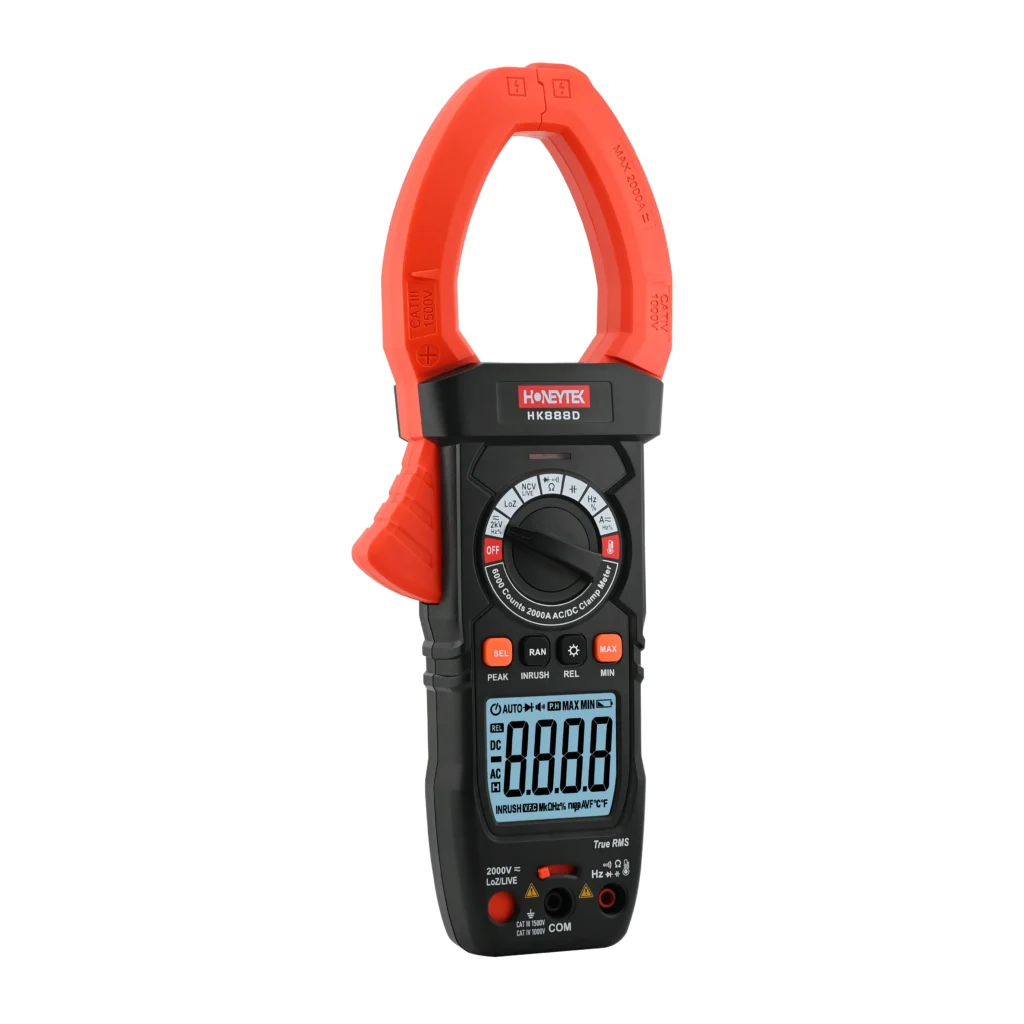
This guide explains how to select a photovoltaic clamp meter based on safety rating, DC capability, current range, and field usability, and uses the HONEYTEK HK888D Digital Clamp Meter as a practical reference.
1. Start with Safety Rating and Voltage Capability
Measurement Category (CAT Rating)
Photovoltaic strings, DC combiner boxes, and inverter inputs typically fall under CAT III environments. For modern PV systems, the clamp meter should meet:
- Minimum: CAT III 1000V
- Recommended: CAT III 1500V / CAT IV 1000V
The HONEYTEK HK888D is rated CAT III 1500V and CAT IV 1000V, making it suitable for both PV array testing and grid-side measurements.
DC Voltage Range
PV system voltage depends on system scale:
- Residential / small commercial systems: up to 1000V DC
- Commercial & utility-scale systems: commonly 1500V DC
To avoid operating at the limit of the instrument, a higher margin is recommended.
The HK888D supports up to 2000V AC/DC, providing sufficient headroom for modern high-voltage PV installations.
2. Consider Current Range and Clamp Design
AC/DC Current Capacity
In PV systems, current levels vary by measurement point:
- String and branch circuits: tens of amps
- Combiner box outputs and inverter inputs: hundreds of amps
A professional PV clamp meter should support at least 600–1000A AC/DC.
The HK888D measures up to 2000A AC/DC, covering most real-world PV applications without additional sensors.
Clamp Opening Size
PV cables and inverter conductors are often thicker than standard building wiring. A clamp meter should offer:
- A large clamp opening
- Easy access in tight combiner boxes and inverter terminals
The HK888D features a Ø57.5 × 74 mm clamp size with a double-opening clamp design, allowing easier access to large-diameter PV cables and busbars.
3. Essential Electrical Functions for PV Work
True RMS Measurement (TRMS)
Inverter-based systems generate non-sinusoidal waveforms with harmonics.
Only True RMS clamp meters can provide accurate readings under these conditions.
The HK888D offers True RMS measurement for both AC and DC, ensuring reliable results in real PV operating environments.
Key Measurement Functions
For photovoltaic installation and maintenance, the following functions are especially important:
- AC/DC voltage and current
- Frequency (up to 10MHz on the HK888D)
- Resistance (up to 60MΩ)
- Capacitance (up to 100mF)
- Temperature measurement
- Peak value capture and inrush current measurement
- LoZ AC/DC mode to suppress ghost voltage
These capabilities allow technicians to diagnose electrical, thermal, and transient issues using a single instrument.
4. Outdoor Adaptability and Field Usability
PV work is rarely performed in clean indoor environments. A suitable clamp meter should support outdoor and low-light operation.
Key features to look for include:
- NCV (Non-Contact Voltage) and live wire detection for quick safety checks
- Built-in spotlight or backlight for dark enclosures and night work
- Rugged construction suitable for dusty and variable weather conditions
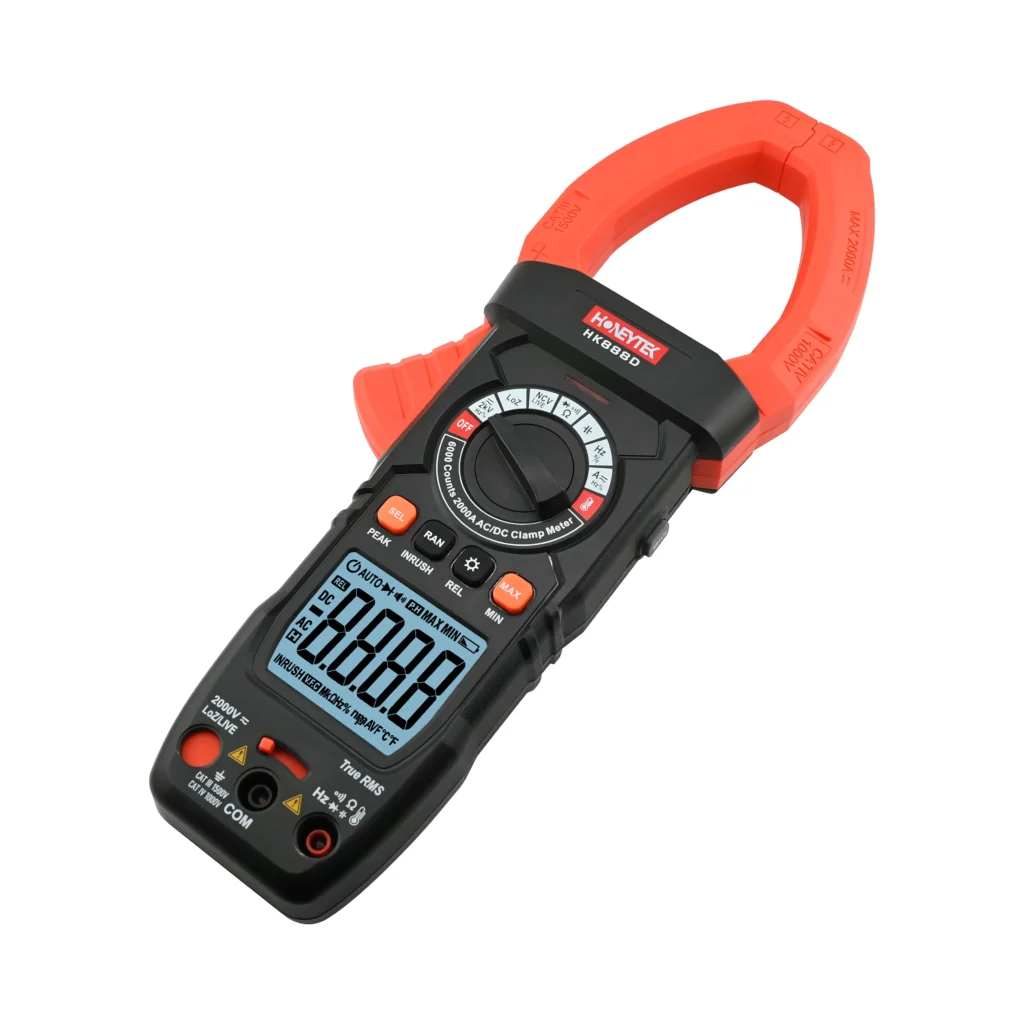
The HK888D includes a built-in spotlight and NCV/live wire detection, improving safety and efficiency in real-world PV job sites.
5. Matching the Clamp Meter to Your Application
Residential or Small Commercial PV
Recommended features:
- 1000V–1500V DC range
- CAT III safety rating
- True RMS AC/DC
- 600–1000A current capability
The HK888D exceeds these requirements, offering long-term usability as systems scale.
Commercial & Utility-Scale PV O&M
Recommended features:
- CAT III 1500V safety rating
- High DC voltage margin
- Large clamp opening
- Advanced diagnostic functions
The HK888D is well suited for ongoing inspection, troubleshooting, and preventive maintenance.
Installation, Commissioning, and Reporting
For professionals involved in system commissioning and verification, additional advantages include:
- Stable high-voltage measurement
- PV-specific test leads
- Consistent, repeatable readings for documentation
The HK888D is supplied with PV test leads with MC4 connectors, simplifying direct connection to solar components.
Conclusion
Choosing a photovoltaic clamp meter starts with safety rating, DC voltage capability, True RMS accuracy, and sufficient current range. From there, clamp size, outdoor usability, and PV-specific features determine real-world efficiency.
The HONEYTEK HK888D Digital Clamp Meter meets these requirements with 2000V / 2000A AC/DC measurement, CAT III 1500V safety, a large clamp opening, and features designed specifically for photovoltaic environments. It is a practical and future-ready tool for professionals working across residential, commercial, and utility-scale PV systems.
Frequently Asked Questions (FAQ)
Q1: What CAT rating is required for photovoltaic systems?
Most PV array and combiner box measurements require CAT III instruments. For modern systems, CAT III 1500V is strongly recommended.
Q2: Why is high DC voltage capability important in PV clamp meters?
Commercial and utility-scale PV systems often operate at up to 1500V DC. A higher voltage rating improves safety margin and measurement reliability.
Q3: Is True RMS necessary for solar applications?
Yes. Inverters produce distorted waveforms. True RMS ensures accurate AC measurements under non-sinusoidal conditions.
Q4: Can the HONEYTEK HK888D measure DC current directly?
Yes. The HK888D supports non-intrusive AC/DC current measurement up to 2000A, ideal for live PV circuits.
Q5: Does the HK888D support solar-specific connectors?
Yes. It includes PV test leads with MC4 PV plugs, enabling safe and direct testing of photovoltaic components.
You May Also Be Interested In:
- True RMS Industrial Digital Multimeters: Why They Matter in Modern Electrical Systems
- Why the Honeytek HK39D Is the Ideal Compact Multimeter for Modern Field Technicians
- How Students, Vocational Schools, Home Users, and Hobbyists Should Choose a Digital Clamp Meter
- How to Choose the Right Clamp Meter for Home Appliance Repair, General Electricians
- How to Choose the Right Clamp Meter for Heavy Industry, Power Stations, Railway Engineering?
- How to Choose the Right Digital Clamp Meter for Electric Vehicle Maintenance
