
In industrial maintenance, not every electrical problem appears when a technician arrives with a multimeter.
A production machine may stop unexpectedly for several seconds before restarting. A motor control circuit may experience occasional voltage drops. A PLC-powered sensor may generate irregular readings only when nearby equipment starts operating.
When maintenance personnel inspect the equipment, everything appears normal.
These are common examples of intermittent electrical faults—problems that occur unpredictably and can be difficult to identify using conventional spot measurements.
Traditional digital multimeters are useful for checking voltage, current, resistance, and continuity at a specific moment. However, brief fluctuations may be missed if the technician is not observing the instrument when the event occurs.
Bluetooth-enabled digital multimeters with data logging capabilities provide another troubleshooting approach.
By transmitting measurement data to a smartphone or computer, technicians can observe electrical behavior remotely and record measurements over time, subject to the instrument’s logging and communication capabilities.
For manufacturing plants, electrical maintenance teams, and equipment service providers, this approach can support more systematic troubleshooting, preventive maintenance, and maintenance documentation.
This article explains how Bluetooth data logging multimeters work, where they are useful, how to identify intermittent faults, and what to consider when selecting an instrument for industrial applications.
1. Why Traditional Spot Measurements May Miss Electrical Problems
A conventional digital multimeter displays an electrical measurement at a particular point in time.
For many maintenance tasks, this is sufficient.
Technicians can check whether a power supply provides the expected voltage, confirm circuit continuity, measure resistance, or investigate a suspected component failure.
However, some faults are temporary.
Common Intermittent Electrical Problems
Loose Electrical Connections
A terminal connection may produce an unstable voltage when the equipment vibrates or the connection temperature changes.
Unstable DC Power Supplies
A 24V DC supply feeding a PLC or industrial sensor may experience occasional voltage dips when additional loads are activated.
Motor Control Problems
Contactors, relays, or associated control circuits may behave irregularly under certain operating conditions.
Temperature-Related Faults
Electrical connections and components may develop abnormal behavior as equipment warms up.
Industrial Sensor Signal Instability
Analog measurement signals may fluctuate because of supply problems, wiring issues, electromagnetic interference, or actual process variations.
The main difficulty is that the problem may disappear before the technician can measure it.
Example: An Intermittent 24V DC Control Supply Problem
Imagine a packaging machine that occasionally reports a sensor communication error.
A technician measures the control power supply and obtains a stable 24.1V DC reading.
The reading appears normal.
However, the machine continues reporting errors during production.
A brief voltage dip might be occurring when another device switches on.
If a suitable recording instrument captures the event, maintenance personnel can compare the electrical behavior with the machine’s operating sequence.
This does not automatically identify the failed component, but it provides evidence that a single spot measurement could miss.
2. What Is a Bluetooth Data Logging Multimeter?
A Bluetooth data logging multimeter combines conventional digital measurement functions with wireless data communication.
Like a standard digital multimeter, it can measure electrical parameters such as voltage, current, and resistance, depending on the model.
The difference is the ability to transmit measurement readings to compatible software.
A typical Bluetooth measurement workflow includes:
- A digital multimeter measures the electrical parameter.
- A Bluetooth module transfers the available readings.
- A smartphone or computer receives the data.
- Compatible software displays live measurements and may record them.
- The technician reviews the measurements to identify changes or abnormal conditions.
The available recording functions depend on the instrument and software.
Some systems provide live values and basic logging, while others support graphs, timestamps, storage, or export functions.
Bluetooth connectivity alone does not guarantee every data analysis feature.
Traditional vs. Bluetooth Data Logging Multimeters
| Funktion | Traditional Digital Multimeter | Bluetooth Data Logging Multimeter |
|---|---|---|
| Instant voltage measurement | Ja | Ja |
| Current and resistance measurement | Model dependent | Model dependent |
| Local display | Ja | Ja |
| Wireless reading display | Generally not available | Available with compatible devices |
| Measurement recording | Manual or model dependent | Supported on logging-enabled systems |
| Trend visualization | Limited or unavailable | Depends on connected software |
| Remote observation | Usually requires viewing the meter | Possible within supported wireless range |
| Maintenance documentation | Often requires manual records | Can support digital recording workflows |
Bluetooth functionality extends the way technicians access measurement data, but the accuracy, safety, and suitability of the measurement still depend on the instrument and test setup.

3. How Data Logging Helps Detect Intermittent Electrical Faults
One of the main advantages of a data logging multimeter is the ability to observe measurements over a defined period rather than relying on a single reading.
This approach is particularly useful when a fault appears only under certain operating conditions.
3.1 Identifying Brief Voltage Drops
Voltage instability can affect PLCs, sensors, contactors, and other control equipment.
Consider a 24V DC control circuit.
A technician measures the circuit during normal operation and records 24.0V.
During a production cycle, however, the voltage briefly falls to 20.5V.
If the recording system captures that event, the technician can investigate whether it corresponds to motor starting, actuator operation, or another load change.
The acceptable voltage range depends on the connected equipment.
Important: A multimeter’s recording interval determines which events it can capture. Very short transients may require a faster instrument, min/max capture function, oscilloscope, or power quality analyzer.
3.2 Monitoring Gradual Electrical Changes
Not all developing problems cause immediate equipment failures.
Some appear as gradual changes in voltage, current, or other measurable parameters.
For example, a maintenance team may periodically record voltage at the same motor control terminal under comparable operating conditions.
Changes across those measurements may suggest the need for further investigation.
However, voltage trends alone do not establish the condition of a motor, cable, or connection.
Maintenance personnel should interpret electrical measurements alongside equipment load, operating temperature, process conditions, and other diagnostic information.
3.3 Investigating Irregular Sensor Signals
Industrial sensors often provide electrical signals to PLC analog input modules.
When a sensor value fluctuates unexpectedly, a technician needs to determine whether the problem originates from the sensor, its power supply, wiring, or the PLC input configuration.
A logging-capable multimeter can help record an accessible signal or power supply measurement over time.
For a 4–20mA transmitter, a meter with a suitable DC milliamp range may be used to investigate loop current.
Alternatively, a voltage measurement across an accessible sensing resistor of known value can provide information about current-loop behavior.
The exact method depends on the installation and must follow safe measurement procedures.
3.4 Comparing Measurements with Machine Events
Data logging becomes more useful when measurement records can be associated with operating events.
For example:
| Equipment Event | Electrical Observation | Possible Investigation |
|---|---|---|
| Motor starts | Control voltage decreases | Supply capacity, wiring, load interaction |
| Conveyor stops unexpectedly | Voltage changes at a relay circuit | Relay operation, control signal, terminals |
| Sensor reports an error | Sensor supply fluctuates | Power supply, connections, interference |
| Equipment reaches operating temperature | Measured value gradually changes | Thermal effects, component condition |
| Production load increases | Current rises | Load conditions, equipment operating parameters |
These observations help technicians develop and test fault hypotheses.
A correlation does not necessarily prove the cause of a problem, so additional measurements may still be required.
4. Wireless Monitoring: Reducing the Need to Remain Beside the Measurement Point
Electrical maintenance sometimes requires measurements inside control cabinets or near operating industrial equipment.
These environments may contain energized conductors, moving machinery, or other hazards.
With a compatible Bluetooth multimeter, technicians can view measurements on a smartphone or computer instead of remaining beside the meter throughout the observation period.
How Remote Viewing Works
After establishing an approved and suitably protected measurement connection, the technician can use the connected software to observe readings from another location within the supported Bluetooth range.
This can be useful when:
- The measurement point is difficult to view.
- The technician needs to observe equipment behavior from a control station.
- A machine must complete several operating cycles before the fault appears.
- Multiple observations must be documented.
- Staying beside the measurement point during repeated observations is unnecessary.
Important Electrical Safety Considerations
Wireless monitoring does not make the initial electrical connection safe, eliminate shock or arc-flash hazards, or replace required electrical safety procedures.
Test leads still need to be installed, secured, inspected, and removed safely.
Before setting up a measurement:
- Follow the facility’s electrical safety procedures.
- De-energize and isolate equipment whenever feasible.
- Use a multimeter and leads with suitable voltage and measurement-category ratings.
- Identify arc-flash and shock hazards.
- Use appropriate PPE and qualified personnel.
- Confirm that test leads and connections are suitable for the entire monitoring period.
- Ensure the measurement arrangement does not compromise protective covers or equipment operation.
Wireless monitoring can reduce the need to remain physically near a measurement point after an approved setup has been established.
It should not be used to justify leaving an improvised test connection unattended inside energized equipment.
5. Step-by-Step: Using a Bluetooth Multimeter for Preventive Maintenance
A structured workflow helps transform wireless measurement from a convenience feature into a useful maintenance process.
Step 1: Identify the Measurement Objective
Begin with a specific maintenance question.
For example:
- Does the 24V DC supply remain stable during machine startup?
- Does the sensor supply change when a motor operates?
- Is a control voltage dropping during intermittent shutdowns?
- Does a measured parameter change as equipment temperature increases?
Avoid collecting data without a defined diagnostic purpose.
Step 2: Select the Correct Measurement Function
Choose the appropriate AC/DC voltage, current, resistance, or other supported measurement function.
Confirm that the selected range and instrument specifications are suitable for the expected electrical conditions.
Resistance and continuity measurements must only be made under the conditions specified by the manufacturer, normally on de-energized circuits.
Step 3: Establish a Safe Test Connection
Follow the site-approved method for connecting the instrument.
Where possible, use appropriate dedicated test points or permanent monitoring provisions designed for maintenance.
Verify lead placement, polarity, instrument input terminals, and circuit condition before starting the measurement.
Step 4: Connect the Multimeter to the Mobile or PC Application
Enable the Bluetooth function and follow the instrument’s pairing procedure.
Confirm that live measurements appear correctly in the compatible application.
Wireless range can vary depending on cabinet construction, surrounding machinery, electrical interference, and device compatibility.
Step 5: Configure the Recording Session
Where supported by the software, select the measurement recording options.
Important parameters may include:
- Recording duration
- Sampling or logging interval
- Measurement units
- Data storage configuration
- Event notes or measurement identifiers
Choose the recording interval according to the expected fault duration.
A slow logging interval may miss short voltage dips even when the instrument provides live wireless measurements.
Step 6: Observe Normal Machine Operation
Operate the equipment according to the approved test procedure.
Record relevant events such as motor startup, equipment loading, valve operation, or control-system alarms.
Where possible, compare the measurement timeline with PLC event records or maintenance logs.
Step 7: Review the Data
Look for:
- Sudden increases or decreases
- Unusual fluctuations
- Repeated changes during specific operating cycles
- Values outside equipment operating limits
- Differences between normal and abnormal operation
Use the results to guide further troubleshooting rather than treating every variation as a component failure.
Step 8: Document Findings and Restore the Equipment
Save available measurement records, document the test conditions, and record any follow-up actions.
After testing, remove temporary connections using the approved procedure and restore the equipment to its normal configuration.
6. Practical Applications in Factory Preventive Maintenance
Bluetooth data logging multimeters can support different maintenance tasks across industrial facilities.
PLC Control Cabinets
Maintenance technicians can monitor accessible control supply voltages and investigate instability affecting PLC modules, sensors, and relays.
For low-voltage control circuits, accurate DC voltage measurement and suitable logging capability can support troubleshooting.
Manufacturing Production Lines
Automated machinery often operates through repeated cycles.
Recording selected electrical measurements can help maintenance teams investigate faults that occur only during particular machine movements or load conditions.
HVAC and Refrigeration Equipment
Technicians may need to observe control voltages, supply behavior, and electrical parameters across equipment operating cycles.
Wireless viewing can reduce repetitive manual observations, while data records may help identify changes associated with compressor or fan operation.
Motor Control and Industrial Drives
Electrical measurements can support investigation of contactor control circuits, supply instability, and auxiliary equipment.
However, measurements at variable-frequency drive outputs require instruments and methods specifically suitable for the waveform and environment.
Renewable Energy and Electrical Infrastructure
Bluetooth multimeters may assist with selected electrical inspections and troubleshooting.
The instrument must have appropriate ratings and measurement capabilities for the installation.
High-voltage PV systems, power distribution equipment, and energy storage systems may require specialized instruments and procedures.
7. Bluetooth Multimeter vs. Dedicated Data Logger: Which Should You Choose?
Although both devices can record measurement information, they are intended for different monitoring requirements.
| Selection Factor | Bluetooth Digital Multimeter | Dedicated Data Logger |
|---|---|---|
| General electrical troubleshooting | Well suited | Depends on model |
| Handheld spot measurements | Ja | Often limited |
| Wireless viewing | Available on Bluetooth models | Depends on system |
| Short-term maintenance recording | Useful when supported | Often supported |
| Multiple simultaneous channels | Model dependent, often limited | Available on selected systems |
| Long-duration autonomous recording | Depends on power, memory, connection, and software | Often designed for this purpose |
| High-speed transient capture | Usually limited | Requires a suitably specified high-speed logger |
| Fixed installation | Generally not the primary purpose | Often available |
A Bluetooth multimeter is often practical when technicians need a portable instrument for routine electrical testing and occasional recorded measurements.
A dedicated data logger, power quality analyzer, or permanent monitoring system may be preferable when the application requires autonomous long-term operation, simultaneous multi-channel measurements, or high-speed event capture.
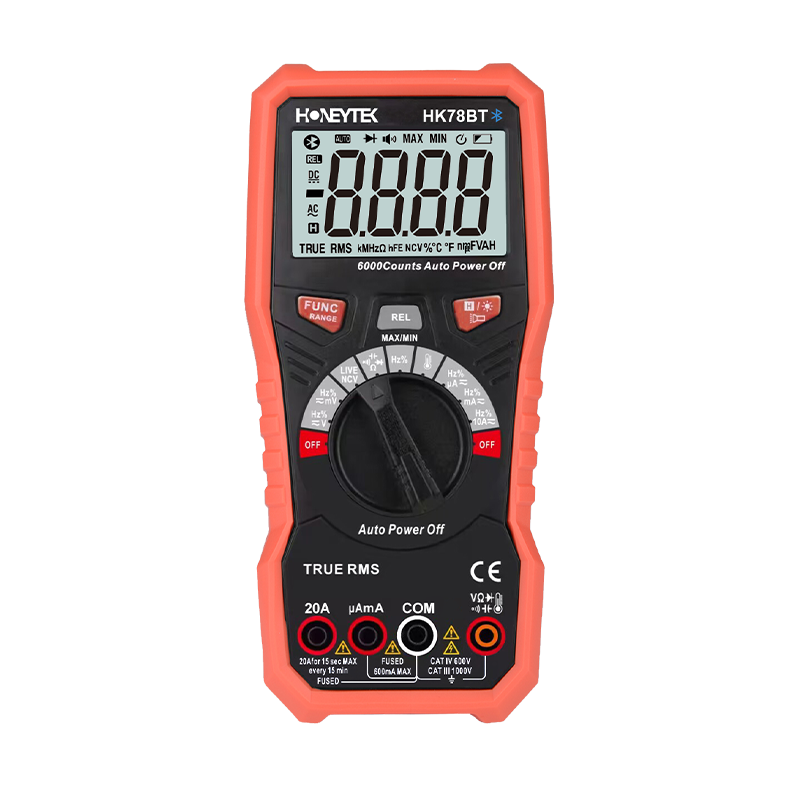
8. Honeytek HK78BT: A Bluetooth Digitalmultimeter for Electrical Maintenance
The Honeytek HK78BT 6000 Counts TRMS Auto Range Digital Multimeter with Bluetooth combines conventional electrical measurement functions with wireless monitoring capabilities.
It is designed for technicians who need a handheld multimeter for electrical diagnostics while also benefiting from data transmission to compatible mobile or PC software.
Main Features of Honeytek HK78BT
6,000-Count True RMS Measurement
Provides a 6,000-count display and True RMS AC measurement capability for supported signal ranges and frequencies.
Bluetooth Connectivity
Supports wireless data transmission and remote reading through compatible mobile or PC software.
Data Logging Support
Enables recording of measurement data through the supported software workflow, helping technicians review electrical behavior over time.
AC/DC Measurement Functions
Supports AC/DC voltage and current measurements, resistance, capacitance, frequency, duty cycle, and temperature measurement.
MAX/MIN and Data Hold
Provides functions for checking measured extremes and retaining displayed readings during inspections.
Auto and Manual Ranging
Allows technicians to select automatic or manual measurement ranges according to the test requirements.
Additional Field Functions
Includes non-contact voltage detection, live-wire recognition, a backlit display, and a built-in flashlight.
Honeytek HK78BT Technical Overview
| Specification | HK78BT |
|---|---|
| Anzeige | 6,000 counts |
| AC measurement | True RMS |
| Wireless connectivity | Bluetooth |
| Wireless monitoring | Compatible mobile/PC software |
| Data logging | Supported through compatible software |
| DC voltage | Up to 1000V |
| AC voltage | Up to 750V |
| DC current | Up to 10A |
| AC current | Up to 10A |
| Widerstand | Up to 60MΩ |
| Häufigkeit | Up to 20MHz |
| Measurement functions | Voltage, current, resistance, capacitance, frequency, duty cycle, temperature |
| Additional functions | MAX/MIN, Data Hold, NCV, live-wire recognition, flashlight |
| Range selection | Automatik / Manuell |
| Published measurement category | CAT III 1000 V / CAT IV 600 V |
Specifications are based on Honeytek’s published product information. Confirm current datasheets, software compatibility, recording intervals, and applicable compliance documentation before purchasing or deploying the instrument.
When Is the HK78BT a Suitable Choice?
The HK78BT may be considered for:
- Industrial electrical troubleshooting
- Control cabinet voltage monitoring
- Equipment maintenance inspections
- Recording selected electrical measurements
- Remote observation during controlled testing
- Electrical maintenance documentation
For intermittent faults, successful detection depends on the event duration, instrument response, software logging interval, and test setup.
The HK78BT should not be assumed to replace high-speed transient recorders, dedicated power quality analyzers, or permanently installed monitoring systems.
Explore the Product:
Honeytek HK78BT Bluetooth Digital Multimeter
9. How Bluetooth Data Logging Supports Preventive Maintenance Programs
Preventive maintenance aims to reduce avoidable equipment failures through scheduled inspection, testing, and maintenance activities.
Digital measurement records can support these programs in several ways.
Establishing Baseline Measurements
Maintenance teams can record electrical readings under known operating conditions.
Future measurements can then be compared with the established baseline, provided the load and environmental conditions are comparable.
Supporting Repeatable Inspections
A documented testing procedure can help ensure technicians check the same measurement points using consistent methods.
This makes maintenance records easier to interpret over time.
Improving Troubleshooting Documentation
When an intermittent fault occurs, recorded measurements may provide useful information for engineers, supervisors, or equipment suppliers.
Instead of relying entirely on verbal descriptions, teams can review documented values and operating conditions.
Supporting Condition-Based Maintenance
Repeated electrical measurements may help identify patterns that justify additional inspection.
However, multimeter logging alone does not constitute a comprehensive predictive maintenance system.
More advanced condition monitoring may require vibration analysis, thermal inspection, current analysis, process data, and other diagnostic technologies.
The value of digital measurement is that it provides additional evidence to support maintenance decisions.
10. Selecting a Bluetooth Digital Multimeter for Industrial Applications
When purchasing a Bluetooth multimeter for maintenance teams, buyers should consider both measurement performance and the software workflow.
Measurement Accuracy and Resolution
Check published accuracy specifications for the relevant functions.
For small signal variations, resolution and accuracy can be more important than the maximum measurement range.
Data Logging Capability
Ask whether the software supports:
- Continuous recording during an active connection
- Measurement graphs
- Timestamps
- Data storage
- Exportable records
- Defined logging intervals
- Reconnection and data recovery
These capabilities differ between instruments and should be confirmed before procurement.
Wireless Communication Reliability
Factory environments contain metal cabinets, motors, drives, and other potential sources of communication interference.
Buyers should test the Bluetooth connection in representative operating conditions.
Electrical Safety
Review the instrument’s rated voltage, measurement category, input protection, and test lead specifications.
A wireless connection does not change the electrical measurement category required at the test point.
Software Compatibility
Check the supported mobile operating systems, PC platforms, application versions, and available software functions.
Manufacturing and After-Sales Support
For distributors and industrial instrument brands, consistent product specifications, documentation, accessories, warranty arrangements, and software support should be part of the supplier evaluation.
11. Honeytek: Digital Multimeter Manufacturer with OEM/ODM Services
Honeytek is a manufacturer of electronic test and measurement instruments, supplying products for electrical maintenance, industrial testing, automotive diagnostics, renewable energy, and related applications.
Its product portfolio includes:
- Digital multimeters
- Bluetooth digital multimeters
- AC/DC clamp meters
- Insulation resistance testers
- Two-pole voltage testers
- Solar PV testing instruments
- Thermal imagers
- Other handheld electrical and environmental measuring instruments
In addition to Honeytek-branded products, the company supports OEM/ODM manufacturing for international distributors, wholesalers, and private-label measurement instrument brands.
OEM/ODM Customization Options
Depending on the model and project feasibility, Honeytek can discuss:
Private-Label Branding
Product logos, model identification, and branded packaging.
Product Appearance
Selected housing colors, product labeling, and exterior configuration.
Documentation and Packaging
Customized instruction manuals, retail packaging, and language requirements.
Hardware and Firmware Requirements
Selected functional or interface modifications subject to engineering evaluation.
Bluetooth-Enabled Instrument Projects
Product configuration and potential software-related requirements can be reviewed according to project scope and technical feasibility.
Who Can Work with Honeytek?
Honeytek welcomes inquiries from:
- Electrical measurement instrument distributors
- Industrial maintenance equipment wholesalers
- Private-label tool brands
- Electrical equipment importers
- Industrial supply companies
- OEM/ODM purchasing teams
Customers can discuss product selection, customization requirements, estimated order quantities, and target market needs directly with the Honeytek team.
12. Frequently Asked Questions
What is a Bluetooth data logging multimeter?
A Bluetooth data logging multimeter is a digital measuring instrument capable of transmitting readings wirelessly to compatible software. Recording functions may allow technicians to store and review measurement values over time.
Can a Bluetooth multimeter detect intermittent electrical faults?
It can help identify intermittent faults when the event occurs during monitoring and the meter’s measurement response and recording interval are fast enough to capture it. Very short events may require specialized equipment.
Can I use a Bluetooth multimeter for long-term monitoring?
That depends on the device’s battery life, software behavior, communication stability, memory, and logging capabilities. For multi-day or continuous autonomous monitoring, a dedicated data logger may be more appropriate.
Is a Bluetooth multimeter safer than a conventional multimeter?
Wireless viewing can reduce the time a technician needs to remain near a measurement location after a safe, approved connection has been established. It does not eliminate electrical hazards or replace isolation, PPE, and other required safety procedures.
What is the difference between data logging and MAX/MIN recording?
MAX/MIN functions generally retain the highest and lowest measured values during a measurement session.
Data logging records a sequence of readings, potentially allowing users to review changes over time.
The availability and capabilities of these functions vary by instrument.
Is a True RMS multimeter useful for industrial maintenance?
Yes. True RMS measurement can be useful for AC signals that are not purely sinusoidal, provided their frequency and waveform characteristics remain within the instrument’s specified measurement capabilities.
Does the Honeytek HK78BT support Bluetooth monitoring?
Yes. The HK78BT supports Bluetooth data transmission and wireless monitoring through compatible mobile or PC software.
Buyers should confirm the current software version, compatible devices, and available recording or export functions for their intended workflow.
Can I order OEM/ODM Bluetooth digital multimeters from Honeytek?
Honeytek offers OEM/ODM services for digital multimeters and related measurement instruments. Customization options, quantities, and technical requirements should be discussed with the manufacturer for each project.
Conclusion: Moving Toward More Data-Driven Electrical Maintenance
Industrial maintenance is gradually moving beyond isolated electrical measurements toward more structured observation, documentation, and condition assessment.
Traditional digital multimeters remain essential for everyday troubleshooting.
Bluetooth-enabled instruments add practical capabilities by allowing technicians to view measurements remotely and record data through compatible software.
For intermittent electrical faults, these records can help reveal changes that might otherwise go unnoticed during a brief inspection.
When combined with appropriate safety procedures, technical knowledge, and maintenance planning, wireless measurement can support more efficient troubleshooting and preventive maintenance practices.
Explore Bluetooth Digital Multimeters from Honeytek
Honeytek is a digital multimeter and electronic test instrument manufacturer providing OEM/ODM solutions for international customers.
Whether you are sourcing Bluetooth multimeters for industrial maintenance, expanding your electrical test instrument product portfolio, or developing private-label measuring tools, Honeytek can discuss suitable products and customization requirements.
Featured Product: HK78BT 6000 Counts True RMS Bluetooth Digital Multimeter
Explore Our Digital Multimeters: Honeytek Digital Multimeter Manufacturer
Website: https://honeytek.com/
E-Mail: [email protected]
WhatsApp: +86 13802253960
Contact Honeytek to discuss product specifications, wholesale purchasing, and OEM/ODM manufacturing opportunities.
Related Reading
- Leitfaden zum MPPT-Tester für Solaranlagen: Prüfung von 2000-W-PV-Modulen
- Fehlerbehebung bei Phantomspannungen und Frequenzumrichter-Störungen: Wie Sie mit den Modi „LoZ“ und „LPF“ Zeit sparen
- Geräte schalten beim Hochfahren ab? So messen Sie den Einschaltstrom genau
- So wählen Sie das richtige Solarmodul-Prüfgerät (MPPT-Messgerät) für Ihre PV-Anlage aus
- Fehlerbehebung bei Solarmodulen mit einem MPPT-Messgerät: 7 häufige Probleme bei Photovoltaikanlagen und deren Lösungen

 English
 Português
 Español
 Français
 Deutsch
 العربية
 Русский