
As electric vehicles (EVs) and hybrid vehicles continue to dominate the global automotive market, high-voltage (HV) electrical safety has become a top priority for manufacturers, workshops, and service technicians.
One of the most critical diagnostic procedures is insulation resistance testing—a method used to verify that high-voltage components and wiring are properly insulated to prevent leakage current, short circuits, and electrical breakdown.
What Is Insulation Testing?
Insulation testing measures the resistance between live conductors and ground (or between conductors) using a high DC test voltage.
A high insulation resistance value indicates good insulation condition, while a low value may signal:
- Moisture ingress
- Aging insulation materials
- Mechanical damage
- Contamination or carbon tracking
For high-voltage automotive systems, early detection of insulation degradation is essential to prevent dangerous faults.

Why Insulation Testing Is Critical in New Energy Vehicles
1. High-Voltage Battery Pack Insulation
EV battery packs operate at hundreds of volts. Insulation testing verifies that:
- Battery modules are electrically isolated from the enclosure
- No leakage path exists between positive/negative terminals and chassis ground
This ensures safe operation and compliance with automotive safety standards.
2. High-Voltage Cable and Harness Testing
High-voltage orange cables connect batteries, inverters, motors, and onboard chargers. Insulation testers help detect:
- Cracked or aged insulation
- Pinched cables
- Contamination from coolant or oil
3. Prevention of Leakage, Short Circuits, and Breakdown
Regular insulation testing helps prevent:
- Electric shock hazards
- Thermal runaway caused by leakage current
- Sudden system shutdowns due to insulation faults
This makes insulation testing a core part of preventive maintenance.
Role of Insulation Testers in Automotive Diagnostics
Unlike standard multimeters, insulation testers apply a controlled high DC voltage (such as 250V, 500V, or 1000V) to stress the insulation system and reveal hidden weaknesses.
Key functions include:
- Measuring insulation resistance in MΩ or GΩ
- Detecting insulation deterioration before failure
- Verifying repairs and new installations
Test Voltage Levels and Application Scenarios
Different systems require different test voltages:
- 250V – Low-voltage control circuits, sensors, auxiliary wiring
- 500V – Standard automotive HV wiring and components
- 1000V – High-voltage battery packs, inverters, traction motors
Selecting the correct test voltage ensures accurate results without damaging components.
Honeytek Insulation Tester Lineup
Honeytek designs and manufactures professional insulation testers for automotive and industrial applications.
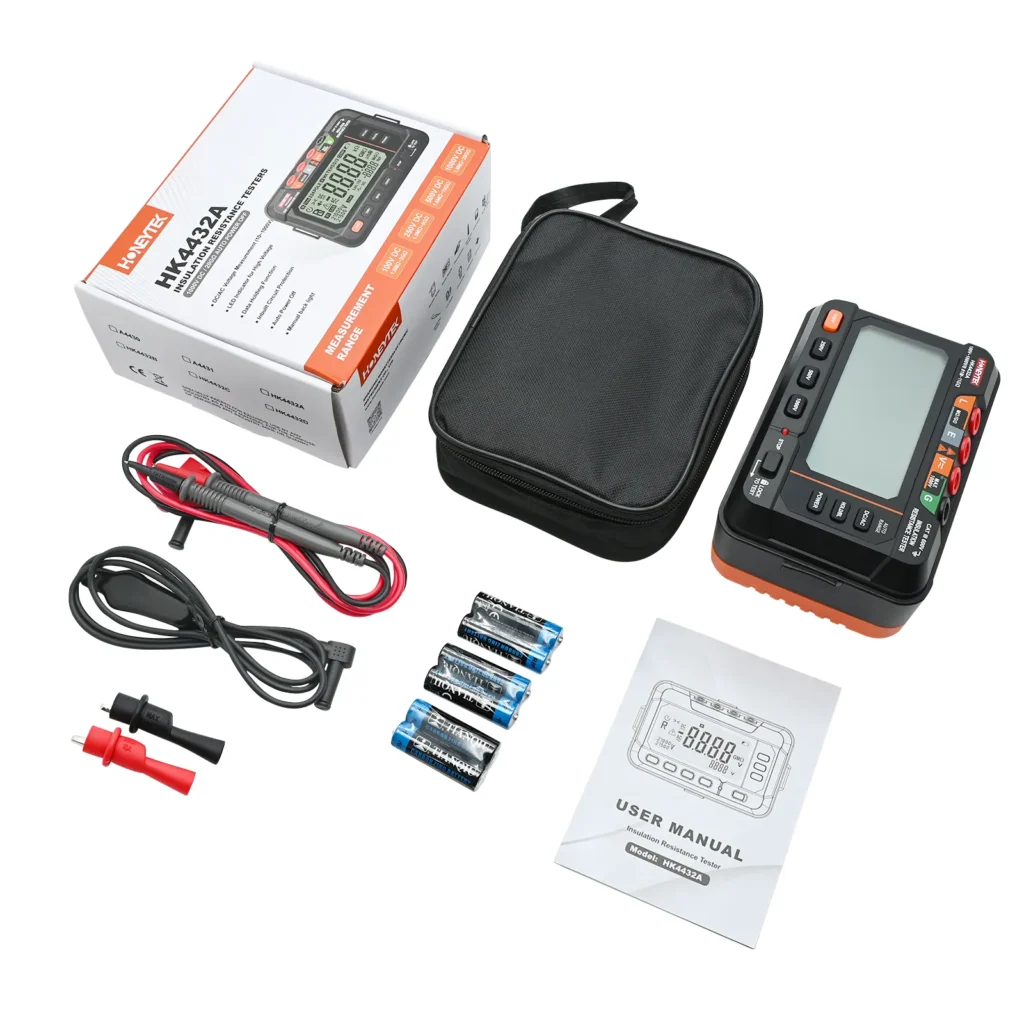
Entry-Level Models
Ideal for:
- Basic insulation checks
- Routine workshop maintenance
- EV service beginners
Advanced Models
- HK505
- HK4432B
Ideal for:
- Wider voltage ranges
- Faster testing
- Professional automotive diagnostics
Professional Model
- HK4432C/D
Ideal for:
- Multi-voltage insulation testing
- High accuracy and stability
- EV and hybrid high-voltage systems
Best Practices for Automotive Insulation Testing
- Power off and isolate the system before testing
- Discharge capacitors completely
- Select appropriate test voltage
- Compare results with manufacturer specifications
- Record results for trend analysis
These steps improve safety and diagnostic reliability.
Why Professionals Trust Honeytek
- Specialized manufacturer of digital multimeters, clamp meters, and insulation testers
- Strict quality control and standardized production
- OEM/ODM customization support
- Stable supply chain and global service capability
Honeytek instruments are trusted by technicians and partners worldwide.
Frequently Asked Questions (FAQ)
Q1: Can I use a regular multimeter instead of an insulation tester?
No. Multimeters cannot generate high DC test voltages required to evaluate insulation quality.
Q2: How often should EV insulation be tested?
During regular maintenance, after repairs, and whenever high-voltage components are replaced.
Q3: Will insulation testing damage EV components?
When the correct voltage level is selected, insulation testing is safe and non-destructive.
Q4: Does Honeytek offer customized insulation testers?
Yes. Honeytek supports OEM/ODM customization for hardware, software, branding, and packaging.
Ensure high-voltage safety with reliable insulation testing solutions.
Contact Honeytek today to learn more about our insulation testers, OEM/ODM services, or global distribution opportunities.
You May Also Be Interested In:
- Smart SMD Tester vs Handheld LCR Meter: Advantages, Limitations, and How to Choose
- How to Measure Capacitance and ESR with Smart Tweezers
- What Is a Smart SMD Tester?
- Infrared Thermometer Measurement Principles and Error Sources Explained
- Consumer vs Industrial Infrared Thermometers: A Practical Buying Guide
- Infrared Thermometers in Medical Screening: Standards & Best Practices
