
What Is an Anemometer?
An anemometer is an instrument designed to measure wind speed—and often wind direction—across various environments, from open-air landscapes to enclosed systems like HVAC ducts or wind tunnels. Derived from the Greek word anemos (meaning wind), these instruments are essential in fields such as weather forecasting, aviation, renewable energy, and environmental monitoring ourmechanicalcenterPengayaanvakxer.com.
Common Types of Anemometers and Their Principles
Cup (Wind-Cup) Anemometer
Uses three or four cups mounted on a vertical shaft. The rotation speed relates to wind velocity. Advantages include simplicity, durability, and acceptable accuracy (typically within ±3%) in moderate winds Wikipediaourmechanicalcenter. However, in gusty or turbulent conditions and at very low speeds, performance drops due to inertia and a minimum start-up threshold.
Vane (Propeller) Anemometer
Combines a propeller and wind vane aligned with the wind. The propeller speed indicates wind velocity. Commonly used in HVAC and low-wind scenarios; offers solid everyday accuracy but remains susceptible to mechanical friction and inertia WikipediaFindThisBest.
Hot-Wire (Thermal) Anemometer
A heated thin wire cools as air passes. The device measures the electrical current needed to maintain the wire’s temperature to infer wind speed. It’s highly precise for low-speed airflow, with fast response, but fragile and sensitive to ambient conditions like temperature and dust Wikipediaour mechanical world.
Pitot‑Tube (Pressure) Anemometer
Used in aviation and wind tunnel testing, it calculates wind speed by measuring the pressure difference between dynamic and static ports (Bernoulli’s principle). Offers accuracy around ±0.5% in stable, high-speed flows, but requires precise alignment and is not effective in turbulent or low-wind environments Wikipediaourmechanicalcenter.
Ultrasonic (Sonic) Anemometer
Sends ultrasonic pulses between transducers; wind alters the travel time, allowing speed and direction detection. With no moving parts, it provides accuracy between ±1% and ±2%, fast response times, low maintenance, and is ideal for turbulent or harsh outdoor conditions Wikipedia+1ourmechanicalcenter.
Laser Doppler Anemometer (LDA)
Uses laser beams and Doppler effect to gauge airflow via scattered light from airborne particles. Among the most precise—with accuracy reaching ±0.1% or better—but expensive, complex, and typically reserved for research or wind tunnel use WikipediaourmechanicalcenterModern Physics Insights.
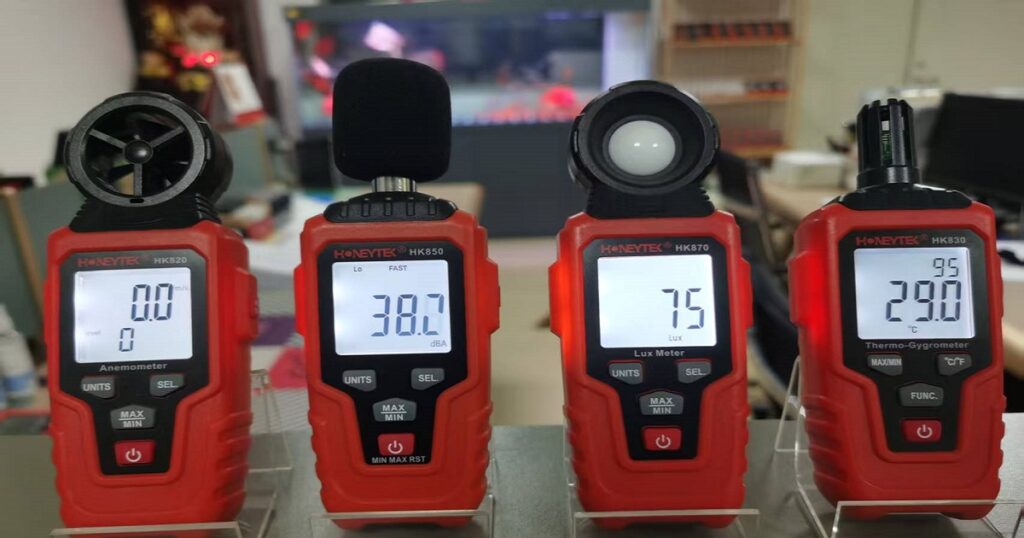
Accuracy Factors & Choosing the Right Anemometer
Environmental Conditions & Installation
Turbulence, obstructions, humidity, temperature, and air pressure all influence accuracy. Proper site placement—such as a clear, elevated location free from nearby obstacles—is vital Modern Physics InsightsWikipedia.
Calibration & Maintenance
Regular calibration ensures long-term reliability. Mechanical anemometers need upkeep (lubrication, cleaning), while advanced models may incorporate sensors to automatically correct for environmental variations newji | QCD管理受発注クラウドRS Components.
Response Speed & Durability
Ultrasonic and laser sensors respond almost instantaneously and have no mechanical wear. In contrast, cup and vane models are slower and prone to mechanical drift due to usage ourmechanicalcenterWikipedia.
Quick Comparison Table
| Anemometer Type | Accuracy | Best Use Cases | Drawbacks |
|---|---|---|---|
| Cup / Vane | ~±2–3% | General meteorology, daily monitoring | Mechanical wear, slow response |
| Hot-Wire | High at low speeds | Labs, indoor airflow, controlled environments | Fragile, sensitive to temperature/humidity |
| Pitot Tube | ~±0.5% | Aviation, wind tunnels, high-speed flows | Alignment-dependent, poor in turbulence |
| Ultrasonic | ±1–2% | Meteorology, aviation, wind energy | Higher cost, rain/snow may interfere |
| Laser Doppler (LDA) | ±0.1% (or better) | Research, highly precise airflow studies | Expensive, complex, setup-intensive |
Which Anemometer Is Most Accurate?
- In scientific and research settings, the Laser Doppler Anemometer (LDA) offers the highest precision—though at a high cost and with operational complexity.
- For field applications demanding a blend of accuracy, robustness, and response, the ultrasonic (sonic) anemometer is typically the best all-rounder.
- In laboratory or low-wind indoor contexts, hot-wire anemometers are unmatched for sensitivity and response.
- For everyday use, such as general weather observations or HVAC checks, cup or vane anemometers are practical and affordable.
