
Selecting the right insulation tester ensures accurate diagnostics, enhances safety, and improves maintenance efficiency. Here are the key factors to consider when choosing an insulation tester:
1. Test Voltage Range
Determine the rated voltage of the equipment under test.
Most insulation testers offer selectable test voltages such as 250V, 500V, 1000V, 2500V, or 5000V.
| Equipment Type | Recommended Test Voltage |
|---|---|
| Control circuits, telecom | 250V |
| Residential wiring, appliances | 500V |
| Motors, cables, transformers | 1000V |
| High-voltage industrial equipment | 2500V–5000V |
Tip: For general electrical maintenance, a tester with 500V and 1000V is often sufficient.
2. Measurement Range (Insulation Resistance)
Insulation testers measure resistance typically in megaohms (MΩ). Choose a tester that can measure a wide range (e.g., up to 2000 MΩ or higher) to detect both minor and severe degradation.
- Higher ranges (e.g. 2000 MΩ+) are better for high-voltage systems.
- Lower ranges (e.g. 20 MΩ–200 MΩ) may suffice for low-voltage or residential systems.
3. Accuracy and Resolution
For critical testing applications (e.g., motor winding diagnostics or compliance testing), look for:
- True RMS measurement capability
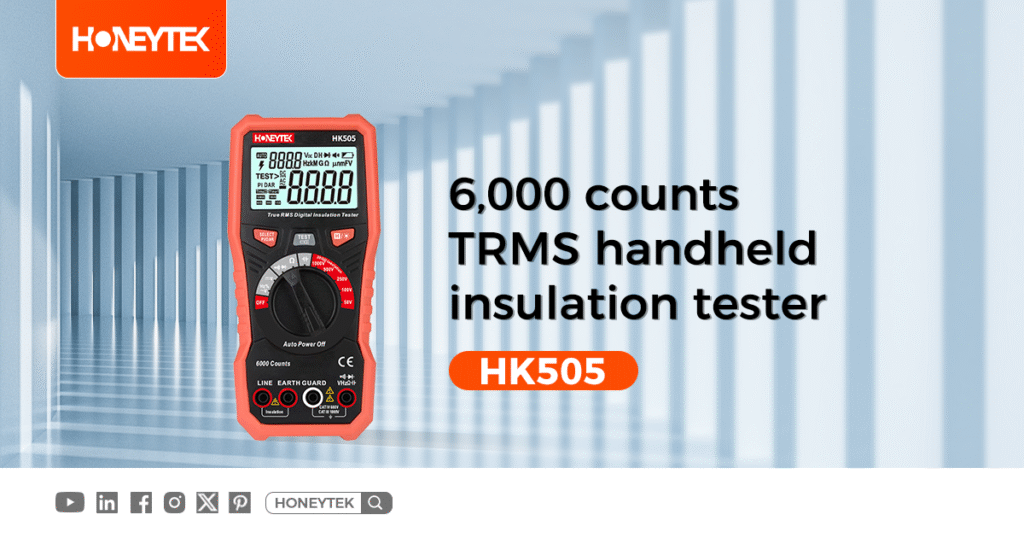
- High resolution (e.g., 6000 counts or more)
- Low resistance accuracy for detecting small leakages
4. Display and Readability
Choose a tester with:
- Large backlit digital display for visibility in dark environments
- Analog bar graph for real-time trend analysis
- Hold function to freeze readings
5. Safety Standards Compliance
Ensure the tester complies with international safety standards such as:
- IEC 61010-1 (Measurement safety)
- CAT III or CAT IV ratings for high-energy environments
- Overvoltage protection to prevent damage or shock
6. Additional Features to Consider
- Battery life and power saving (auto-off)
- Bluetooth or data logging capability for recording test results
- Audible alarms for pass/fail indication
- Multi-function testers that also measure voltage, continuity, or capacitance
7. Application Environment
- For indoor or lab testing, basic handheld models are sufficient.
- For field work or industrial settings, choose rugged models with dust/water resistance (e.g., IP54/IP65 rated casings).
8. Brand and After-Sales Support
Choose a trusted brand like Honeytek, known for:
- High manufacturing standards
- Durable, field-proven insulation testers
- Strong technical support and global warranty service
✅ Recommendation Summary
| Feature | Entry-Level | Professional | Industrial |
|---|---|---|---|
| Voltage | 250V–500V | 500V–1000V | 1000V–5000V |
| Resistance Range | Up to 200 MΩ | Up to 2000 MΩ | 2000 MΩ+ |
| Display | Basic LCD | Large LCD + bar graph | Large LCD + logging |
| Safety | CAT II | CAT III | CAT IV |
| Use Case | Home, light duty | Maintenance, motors | Utilities, transformers |
Need help choosing the right insulation tester for your project?
Contact Honeytek’s technical team for expert guidance and product recommendations tailored to your industry.
