
Meta Description:
Learn what an insulation resistance tester (megohmmeter) is, how it works, why a multimeter cannot replace it, and when each tool should be used. Discover key testing methods (DAR, PI), troubleshooting tips, and best practices for insulation testing.
Introduction
Electrical insulation is the invisible barrier that keeps current flowing where it should—inside conductors, windings, and cables—without leaking into surrounding materials or to ground. Over time, insulation deteriorates due to moisture, heat, contamination, mechanical stress, or aging, increasing the risk of failure.
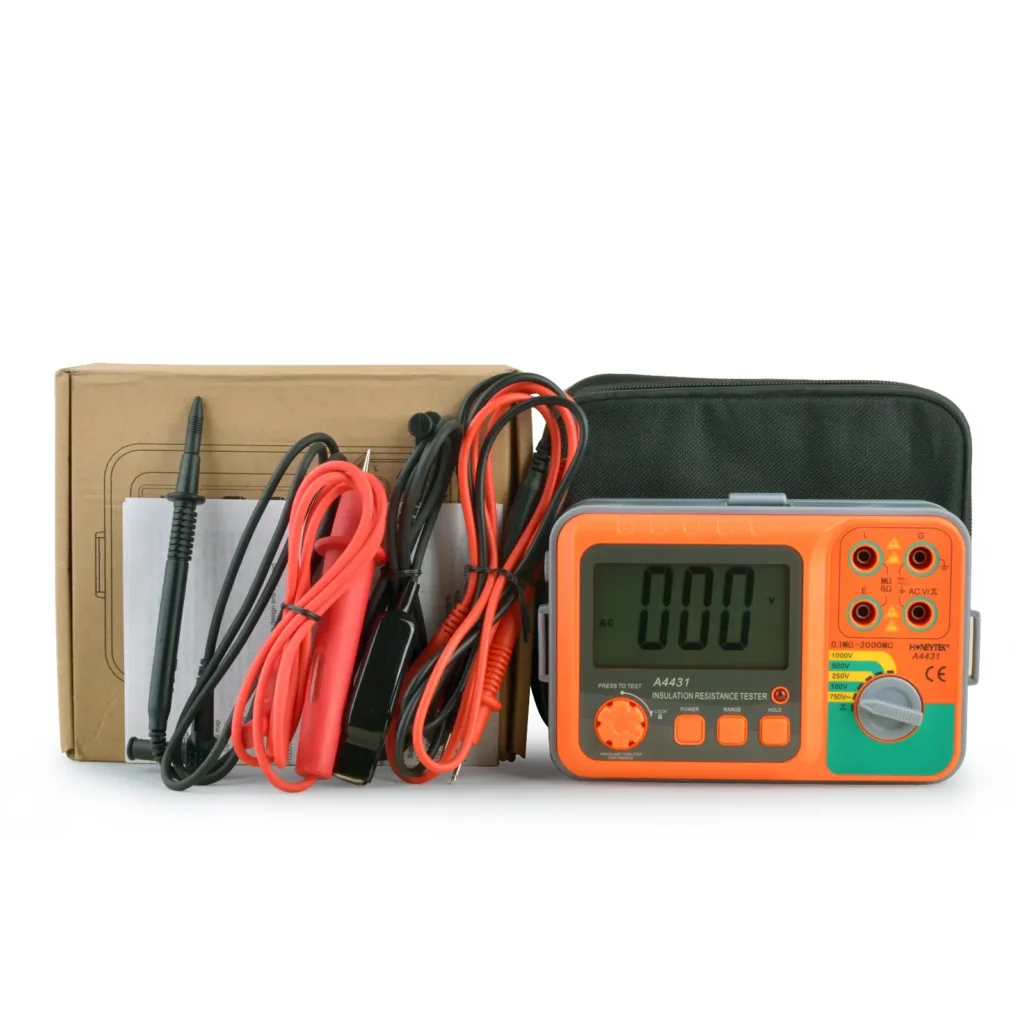
To evaluate insulation health, professionals rely on a specialized instrument called an insulation resistance tester (IR tester), also known as a megohmmeter or “megger.” This tool applies high DC voltage and measures leakage current to calculate resistance in the megohm (MΩ) or gigohm (GΩ) range.
A common question arises: “Can a multimeter replace an insulation resistance tester?” The short answer is no. While a multimeter is useful for basic continuity and low-resistance checks, it lacks the voltage range, sensitivity, and diagnostic features required for reliable insulation testing.
In this article, we’ll explore:
- What an insulation resistance tester is and how it works
- The principle of leakage current under high voltage
- Why a multimeter cannot replace a megohmmeter
- Key diagnostic indicators like DAR and PI
- When you can use a multimeter and when you absolutely must use a megger
- Troubleshooting tips for insulation resistance testing
What Is Insulation Resistance?
Insulation resistance is essentially the opposition to current leakage when a high DC voltage is applied across an insulating material. It is measured in megohms (MΩ) or gigohms (GΩ).
If insulation is healthy, only a tiny leakage current will flow, resulting in a high resistance reading. If insulation is damaged, contaminated, or moisture-saturated, leakage current rises, resistance drops, and equipment reliability suffers.
How Does an Insulation Resistance Tester Work?

An insulation resistance tester operates on a simple principle: R=VIR = \frac{V}{I}R=IV
Where:
- R = insulation resistance
- V = applied DC voltage
- I = leakage current measured
Key Features of IR Testers
- High DC Voltage Output: Typically 100V, 250V, 500V, 1000V, 2500V, or even 5000V.
- Measurement Range: From a few megohms up to gigohms.
- Time-Based Readings: Allows calculation of diagnostic ratios like DAR (Dielectric Absorption Ratio) and PI (Polarization Index).
- Safe Discharge: Built-in discharge function after test to eliminate residual charge.
Why the Nickname “Megger” or “Shaking Meter”?
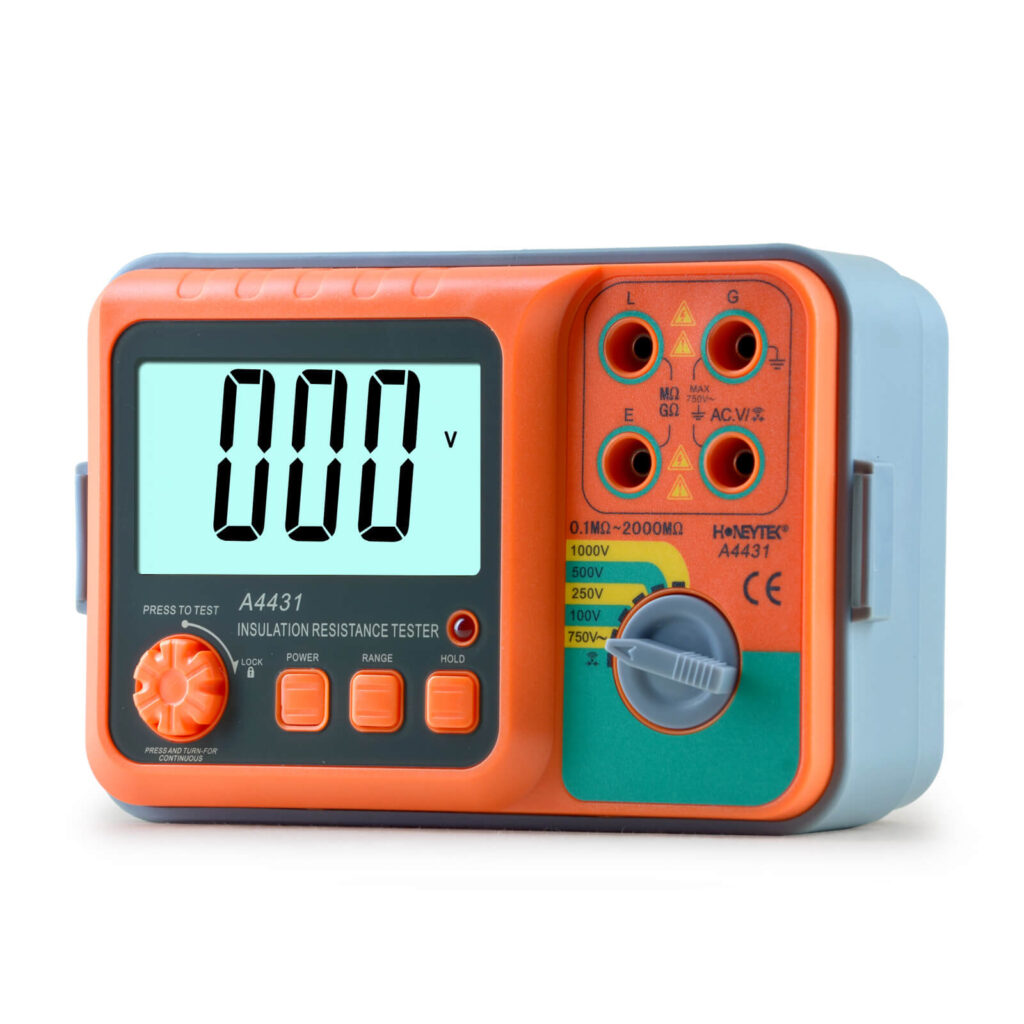
Historically, insulation testers used a hand-cranked generator to produce test voltage, hence the nickname “shaking meter.” Modern electronic insulation resistance testers, such as those from Honeytek, generate test voltage internally without manual cranking but use the same measurement principle.
The Role of High Voltage in Insulation Testing
At low voltages (like the few volts from a multimeter), many insulation defects remain hidden. Surface contamination, moisture ingress, or tiny cracks may not allow significant leakage under small voltages.
However, when hundreds or thousands of volts are applied, weak points reveal themselves as leakage current increases. This makes high-voltage insulation testing far more reliable for detecting early failure risks.
Understanding Leakage Current Components
When high DC voltage is applied, leakage current has three parts:
- Capacitive Charging Current
- Large at the moment voltage is applied, then decays quickly.
- Dielectric Absorption (Polarization) Current
- Slower decay as molecules align with the electric field.
- Conductive Current
- Steady component caused by actual insulation leakage through moisture, dirt, or defects.
As time progresses, the first two currents decline, leaving mainly conductive current. This is why time-dependent readings are so important.
Diagnostic Ratios: DAR and PI
To evaluate insulation health, professionals don’t just look at resistance at one moment—they examine how it changes over time.
- DAR (Dielectric Absorption Ratio): DAR=R60sR30sDAR = \frac{R_{60s}}{R_{30s}}DAR=R30sR60s A ratio above 1.25 usually indicates good insulation.
- PI (Polarization Index): PI=R10minR1minPI = \frac{R_{10min}}{R_{1min}}PI=R1minR10min A PI above 2.0 suggests dry, clean insulation. Lower values may indicate moisture, contamination, or aging.
Why a Multimeter Cannot Replace an Insulation Resistance Tester
Although both instruments measure resistance, their design and purpose are very different.
1. Test Voltage Is Too Low
- Multimeter: Uses about 0.3–3V for resistance measurement.
- Insulation Tester: Applies 500V, 1000V, or higher.
- Without high voltage, many defects cannot be revealed.
2. Measurement Range Is Too Small
- Multimeter: Limited to about 10–20 MΩ.
- Insulation Tester: Reads up to GΩ levels.
- Most insulation tests require ranges far beyond a multimeter’s capability.
3. No Time-Based Diagnostics
- Multimeters give a single static reading.
- IR testers provide time series data for DAR/PI, crucial for detecting subtle problems.
4. Safety Limitations
- IR testers safely discharge residual charge from large capacitive loads (motors, cables).
- Multimeters lack discharge circuits—using them on high-capacitance systems can be dangerous.
When Can You Use a Multimeter?
A multimeter is perfectly fine for:
- Checking continuity of grounding conductors
- Testing connections, terminals, or fuses
- Measuring low-resistance circuits
However, for motors, generators, power cables, busbars, transformers, or switchgear insulation testing, you must use an insulation resistance tester.
Common Issues During Insulation Testing
- Unstable or fluctuating readings
- Often caused by surface moisture or contamination.
- Solution: Clean and dry before retesting.
- Low DAR or PI values
- May indicate deep moisture ingress or insulation aging.
- Consider drying or replacing equipment.
- Environmental impact
- Humidity and temperature strongly influence results.
- Always record environmental conditions during tests.
- Large equipment with capacitance
- Motors and long cables require longer discharge times.
- Test in sections if possible.
FAQs About Insulation Resistance Testing
1. What is a safe insulation resistance value?
- For low-voltage equipment, values above 1 MΩ per kV of rated voltage are usually acceptable. Higher is always better.
2. How often should insulation resistance be tested?
- Regular preventive maintenance schedules recommend annual testing for critical equipment.
3. Can an insulation tester damage equipment?
- No, if used correctly. The applied voltage is within safe limits. However, always check manufacturer specifications before testing sensitive electronics.
4. Why do results vary with temperature and humidity?
- Moisture significantly lowers insulation resistance. For accurate comparison, test under similar conditions or apply temperature correction.
5. Do I need a digital or analog insulation tester?
- Digital models (like Honeytek’s) provide precise readings, auto-ranging, and time-based functions.
- Analog models are simpler but less versatile.
Conclusion
An insulation resistance tester (megohmmeter) is an indispensable tool for ensuring electrical equipment safety and reliability. Unlike multimeters, IR testers apply high DC voltage, measure in the gigohm range, track time-dependent resistance changes, and ensure safe discharge.
For professional testing of motors, cables, transformers, and switchgear, a multimeter is not a substitute. Each tool has its role: use multimeters for basic continuity and low-resistance checks, but always use a dedicated insulation tester for insulation health.
At Honeytek, we specialize in manufacturing advanced electronic measuring instruments, including insulation resistance testers designed for reliable field use. Our testers provide high accuracy, multiple test voltages, safety features, and easy-to-read displays—ideal for electrical engineers, maintenance professionals, and industrial users.
Explore our range of Honeytek Insulation Resistance Testers today and ensure your equipment stays safe, efficient, and long-lasting.
