
When you’re standing in front of a duct, a factory exhaust fan, or a lab ventilation hood, having the right tool can mean the difference between a quick diagnosis and hours of guesswork. That’s why choosing between the Honeytek HK820 and HK820+ Digital Anemometers isn’t just about specs—it’s about matching your workflow, budget, and professional needs.
Both instruments are engineered by Honeytek, a trusted manufacturer of electronic test tools since 2005. They share the same rugged design, core sensor technology, and intuitive interface—but the HK820+ adds several advanced features that justify its higher price tag for certain users.
In this comprehensive head-to-head comparison, we’ll break down every difference—functional, technical, and practical—so you can confidently pick the model that fits your job, not your wallet.

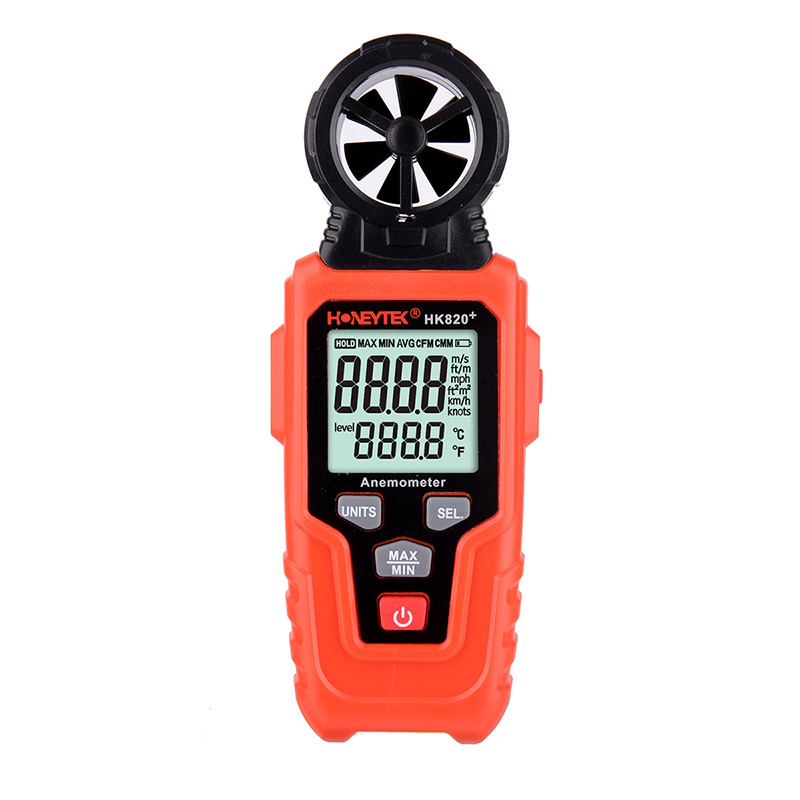
Quick Comparison Summary
| HK820 | HK820+ | |
|---|---|---|
| Air Velocity & Temp | ✅ Yes | ✅ Yes |
| MAX/MIN/Avg Hold | ✅ Yes | ✅ Yes |
| Backlight & Data Hold | ✅ Yes | ✅ Yes |
| Air Volume (CFM/CMM) | ❌ No | ✅ Yes |
| Adjustable Probe Angle | ❌ Fixed | ✅ Rotatable Head |
| Battery Level Display | ❌ Basic Low-Battery Alert | ✅ Full Battery Gauge |
| Duct Area Input | ❌ Not Available | ✅ Customizable |
| Price Point | 💰 Budget-Friendly | 💰💰 Premium Features |
TL;DR: Choose the HK820 if you need accurate wind speed and temperature for basic diagnostics. Choose the HK820+ if you require airflow volume calculations (CFM), flexible probe positioning, or battery monitoring for extended fieldwork.

Core Similarities: What Both Models Share
Before diving into differences, let’s acknowledge what makes both models reliable:
🔹 Identical Sensor Technology
Both use a magnetic induction wind speed sensor and a negative temperature coefficient (NTC) sensor. This means:
- High accuracy: ±(2.0% + 0.5 m/s) for velocity, ±1.5°C for temperature.
- Long-term stability with minimal drift.
- Fast sampling rate: 2 readings per second.
🔹 Same Build Quality & Ergonomics
- Compact, lightweight body (108g) with rubberized grip.
- Large backlit LCD with bargraph for easy reading.
- Auto power-off after 15 minutes of inactivity.
- Low-battery indicator to prevent surprises.
🔹 Identical Operating Ranges
- Air Velocity: 0.40–30.00 m/s (also supports km/h, ft/s, knots, mph, ft/m)
- Temperature: -20°C to 60°C (-4°F to 140°F)
These shared traits make both models excellent choices for general-purpose airflow measurement.
Key Differences: Where the HK820+ Adds Value
Now, let’s explore the upgrades that set the HK820+ apart—and whether they matter for your work.
📊 1. Air Volume Measurement (CFM / CMM)
This is the biggest differentiator.
- HK820: Measures only air velocity and temperature.
- HK820+: Calculates air volume flow in CFM (cubic feet per minute) or CMM (cubic meters per minute).
Why It Matters:
If you’re balancing HVAC systems, verifying ventilation compliance, or calculating air changes per hour (ACH), you need volume—not just speed. The HK820+ lets you input duct dimensions or area, then automatically computes total airflow.
✅ Ideal for: HVAC technicians, energy auditors, industrial hygienists.
🔄 2. Adjustable Test Angle (Rotatable Probe Head)
- HK820: Fixed probe orientation.
- HK820+: Probe head rotates 360° for flexible positioning.
Real-World Impact:
In tight spaces like ceiling plenums, behind equipment, or inside angled ducts, being able to pivot the sensor without contorting your body saves time and reduces strain. It also ensures the sensor faces directly into the airflow for optimal accuracy.
✅ Ideal for: Field technicians working in confined or awkward locations.
🔋 3. Battery Capacity Display
- HK820: Simple low-battery icon (blinks when power is critical).
- HK820+: Shows remaining battery percentage or bar graph.
Why It’s Useful:
On long jobs or multi-site inspections, knowing exactly how much battery life remains helps you plan recharges or carry spares. No more guessing if you’ll make it through the day.
✅ Ideal for: Mobile professionals, contractors, or anyone working remotely.
🧮 4. Duct/Area Setting Function
- HK820: No area input.
- HK820+: Allows manual entry of duct cross-sectional area (in m² or ft²) for precise volume calculation.
This feature turns the HK820+ into a true HVAC diagnostic tool, not just a meter. For example:
- Measure velocity at 5 points in a 2ft x 2ft duct → enter area = 4 ft² → device calculates total CFM.
✅ Ideal for: System commissioning, duct leakage testing, LEED certification projects.
Who Should Choose the HK820?
The HK820 is perfect for:
✅ Budget-conscious buyers who need core functionality without extras.
✅ Students or educators learning basic airflow principles.
✅ Facility managers performing routine checks on vents or fans.
✅ Outdoor enthusiasts measuring wind speed for sports or weather logging.
✅ General maintenance crews who don’t require CFM calculations.
It’s a no-frills, highly reliable instrument that gets the job done—without complexity or cost.
Who Should Upgrade to the HK820+?
The HK820+ is worth the investment if you:
✅ Perform HVAC system balancing or commissioning (requires CFM).
✅ Work in tight, hard-to-reach spaces (rotatable probe = game-changer).
✅ Need precise documentation for compliance reports (volume data + area settings).
✅ Spend long days in the field (battery gauge prevents mid-job shutdowns).
✅ Want future-proof versatility for evolving job requirements.
Think of the HK820+ as your all-in-one airflow diagnostic assistant—not just a meter.
Price & Value Consideration
While Honeytek doesn’t publicly list retail prices (varies by region and distributor), the HK820+ typically costs 20–30% more than the HK820.
Is it worth it?
- If you never calculate airflow volume, stick with the HK820.
- If you regularly need CFM, flexible probing, or battery monitoring, the HK820+ pays for itself in saved time, fewer errors, and enhanced professionalism.
Frequently Asked Questions (FAQ)
Q1: Can I upgrade the HK820 to have CFM calculation?
No. The air volume function requires hardware-level integration (area input, processing chip). It’s not a software update.
Q2: Is the HK820+ heavier than the HK820?
No. Both weigh exactly 108 grams. The added features don’t compromise portability.
Q3: Do both models come with calibration certificates?
Yes. All Honeytek anemometers are factory-calibrated and include a basic calibration report. For traceable NIST-certified calibration, contact support for optional services.
Q4: Can I use the HK820+ for outdoor wind measurements?
Absolutely. Its rugged housing and wide operating range (-20°C to 60°C) make it suitable for field use. Just avoid direct rain exposure.
Q5: What’s included in the box?
Both models include:
- Anemometer unit
- 3 × AAA batteries
- User manual
- Soft carrying pouch
Make the Smart Choice for Your Workflow
There’s no “best” model—only the right model for your specific needs.
Choose the HK820 if you need a simple, accurate, affordable tool for basic air velocity and temperature measurement.
Choose the HK820+ if you demand advanced features like CFM calculation, adjustable probe angle, and battery level monitoring for professional-grade diagnostics.
At Honeytek, we believe tools should empower—not complicate. Whether you’re starting out or scaling up, we’ve got the instrument that matches your ambition.
