
In electrical maintenance, efficiency is no longer a luxury—it is a requirement. Field engineers, maintenance technicians, and commissioning teams are under constant pressure to diagnose problems faster, reduce downtime, and work safely in increasingly complex electrical environments. At the same time, toolkits are getting heavier, and job sites are becoming more constrained.
This has led to a clear market shift: professionals are looking for multi-functional test instruments that can handle most daily tasks without compromising accuracy or safety. Insulation resistance testers, once considered highly specialized tools, are now expected to perform far beyond a single measurement function.
Today, the most practical solution is a tester that combines insulation testing with everyday electrical measurements, allowing one device to cover the majority of on-site diagnostic work.

The Changing Role of Insulation Testers in the Field
Traditionally, insulation resistance testers were used only at specific stages—such as commissioning, periodic maintenance, or fault investigation. For daily electrical work, technicians relied on digital multimeters or clamp meters, switching instruments frequently throughout a job.
This separation no longer fits modern workflows. On a typical site visit, an engineer may need to:
- Verify supply voltage before testing
- Check frequency or duty cycle on control circuits
- Confirm continuity before insulation testing
- Measure resistance or diode behavior during troubleshooting
- Perform insulation resistance testing as the final validation step
Using multiple instruments increases setup time, raises the risk of connection errors, and complicates safety management. As a result, insulation testers that integrate AC/DC voltage, frequency, resistance, diode, and continuity measurements have become increasingly valuable.
Why Multi-Function Electrical Testers Are a Growing Trend
The demand for multi-purpose test instruments is driven by real-world conditions rather than marketing preferences.
First, job sites are time-sensitive. Maintenance windows are shorter, and downtime costs are higher. Engineers want tools that minimize switching, reconfiguration, and repeated lead connections.
Second, tool portability matters. Field technicians often work in confined spaces, elevated locations, or outdoor environments. Carrying fewer instruments improves mobility and reduces fatigue.
Third, safety requirements are becoming stricter. Using one properly rated tester reduces the chances of misusing a tool outside its intended category.
As a result, many professionals aim for a practical benchmark: one tester that can handle around 80 percent of daily electrical measurements.
Daily Electrical Measurements That Matter Most
For a tester to truly replace multiple tools, it must cover the measurements most frequently required in the field.
AC and DC voltage measurement is essential for verifying power sources, checking control circuits, and confirming system status before and after testing. Accurate voltage measurement is also a critical safety step before performing insulation resistance tests.
Frequency and duty cycle measurement are increasingly important in modern electrical systems, particularly where variable frequency drives, inverters, and control electronics are involved. These measurements help engineers identify signal abnormalities that may not be visible through voltage checks alone.
Resistance, diode, and continuity testing remain fundamental for troubleshooting wiring, connections, and electronic components. These functions are often used before insulation testing to ensure that circuits are correctly configured and safe to test.
When these capabilities are integrated into a single instrument, workflow becomes significantly more efficient.
The Importance of Safety Ratings in Multi-Function Testers
Combining multiple measurement functions into one device only makes sense if safety is not compromised. Electrical testing environments can involve high-energy circuits, transient overvoltage events, and unpredictable fault conditions.
A tester designed for professional use must comply with internationally recognized safety standards. Instruments rated CAT IV 600V and CAT III 1000V are suitable for a wide range of industrial, commercial, and utility applications, including distribution panels and fixed installations.
Using a single tester with appropriate safety ratings reduces the need to reassess tool suitability for each measurement. This simplifies compliance with safety procedures and helps protect both the user and the equipment.
A Complete Workflow: Before, During, and After Insulation Testing
In practical terms, insulation testing is rarely an isolated task. It is part of a broader diagnostic process.
Before insulation testing, engineers typically:
- Measure AC or DC voltage to confirm that the circuit is de-energized
- Check continuity to verify correct wiring paths
- Measure resistance to identify obvious faults or short circuits
During insulation testing, accurate test voltage selection and stable measurement are essential for meaningful results.
After insulation testing, technicians may:
- Reconfirm voltage levels after re-energizing the system
- Verify frequency and control signals
- Perform final continuity checks
A tester that supports all these steps eliminates unnecessary instrument changes and reduces the likelihood of missed checks.
Why Field Engineers Prefer Insulation Testers with Multimeter Functions
From the perspective of experienced field engineers, practicality outweighs theoretical perfection. Carrying a specialized insulation tester and a separate multimeter may offer marginal performance benefits, but it also increases complexity.
An insulation tester that includes core multimeter functions offers several advantages:
- Faster job completion due to reduced setup time
- Lower risk of incorrect lead placement
- Improved focus on diagnostic results rather than tool management
- Simplified training for technicians
This is especially valuable in maintenance teams where multiple users rely on the same equipment.
How HK505 Supports Multi-Task Electrical Work
Honeytek, as a manufacturer of electronic measurement tools including digital multimeters and digital clamp meters, designs products with real-world electrical work in mind.
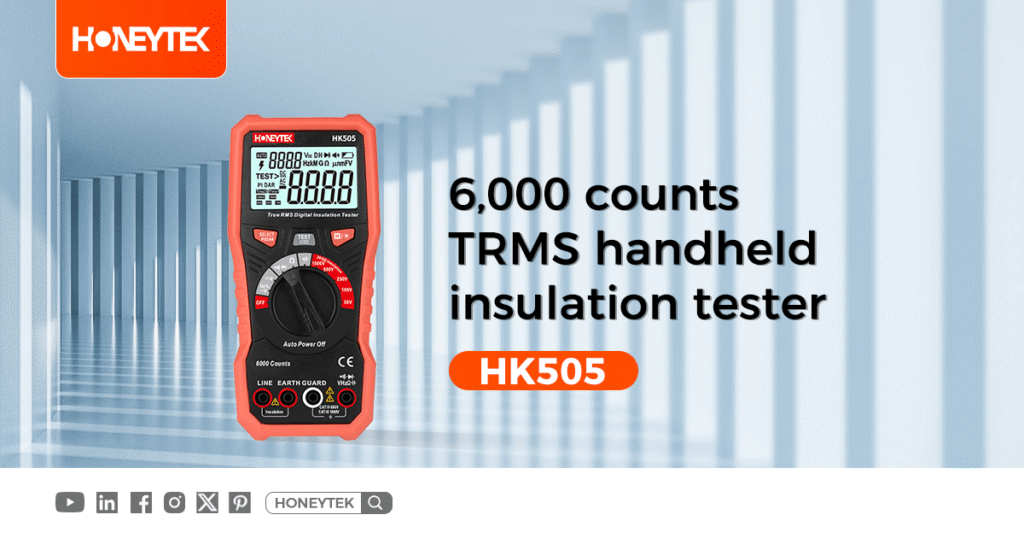
The HK505 handheld insulation resistance tester reflects this approach by integrating insulation testing with essential electrical measurement functions such as AC/DC voltage, frequency, duty cycle, resistance, diode, and continuity testing.
With safety ratings suitable for demanding environments and a design optimized for field use, the HK505 allows engineers to handle insulation diagnostics and routine electrical measurements using a single instrument. This reduces tool load, streamlines workflows, and supports consistent measurement practices across different tasks.
Traditional Insulation Testers vs Multi-Function Insulation Testers
Traditional insulation testers are often limited to insulation resistance measurement alone. While accurate, they require additional instruments for voltage verification, continuity checks, and troubleshooting.
Multi-function insulation testers, by contrast, align better with modern maintenance practices. They support a broader range of measurements without sacrificing safety or usability.
For many users, the decision is no longer about whether multi-function capability is useful, but whether a single-purpose tester still makes sense in daily work.
Frequently Asked Questions
Can a multi-function insulation tester replace a digital multimeter?
For many routine tasks, yes. A tester that includes voltage, resistance, continuity, and frequency measurements can cover most daily requirements. Specialized applications may still require dedicated instruments.
Is measurement accuracy affected when multiple functions are combined?
Not when the instrument is properly designed and calibrated. Professional-grade testers maintain accuracy across all supported functions.
Why is safety category important for multi-function testers?
Because the same instrument may be used in different parts of an electrical system. Appropriate CAT ratings ensure safe operation across these environments.
Do multi-function insulation testers complicate operation?
Modern designs focus on intuitive interfaces, making it easier—not harder—to perform multiple tests with one device.
Who benefits most from a combined insulation and electrical tester?
Field technicians, maintenance engineers, commissioning teams, and service providers who value efficiency, portability, and safety.
Conclusion
Electrical testing is no longer about isolated measurements. It is about efficiency, safety, and informed decision-making across an entire workflow. As systems become more complex and maintenance expectations rise, tools must adapt accordingly.
You may like these:
