
Insulation resistance testing is one of the most effective ways to evaluate the health and safety of electrical equipment. From motors and cables to household appliances and industrial systems, insulation condition directly affects reliability, energy efficiency, and operational safety.
Yet despite its importance, one aspect of insulation testing is frequently misunderstood and often misapplied: test voltage selection.
Selecting the wrong insulation test voltage can lead to meaningless results, false confidence, or even permanent damage to equipment. As electrical systems span a wide range of voltage levels and insulation designs, there is no universal test voltage that works for every application. Understanding how and why to choose between 50V, 100V, 250V, 500V, and 1000V is essential for accurate diagnostics.
Why Insulation Test Voltage Matters
Insulation resistance testing works by applying a DC voltage across insulation material and measuring leakage current. The resulting resistance value reflects how well the insulation prevents current flow.
However, insulation behaves differently at different test voltages. A voltage that is too low may not stress the insulation enough to reveal defects. A voltage that is too high may overstress or damage sensitive components.
This is why test voltage selection is not just a technical detail—it is a critical diagnostic decision.
Common Problems Caused by Incorrect Test Voltage Selection
In real-world maintenance work, test voltage errors are common and often unintentional.
When the test voltage is too low, insulation defects such as moisture ingress, surface contamination, or micro-cracks may not appear. The test result looks acceptable, but the insulation may fail under normal operating conditions.
When the test voltage is too high, especially on low-voltage or electronic equipment, insulation layers and internal components can be damaged. In some cases, the test itself becomes the cause of failure.
Both situations lead to incorrect maintenance decisions, increased downtime, and unnecessary risk.

Understanding the 50V to 1000V Test Voltage Range
Modern insulation testers offer multiple selectable test voltages to match different applications. A five-step range—50V, 100V, 250V, 500V, and 1000V—covers the majority of real-world testing needs.
Lower voltages are designed for sensitive electronics and low-voltage circuits. Higher voltages are intended for industrial power equipment with thicker insulation systems.
Having access to multiple test voltages allows technicians to apply the correct electrical stress without compromising safety or accuracy.
When to Use 50V Insulation Testing
A 50V insulation test voltage is typically used for:
- Electronic circuits
- Control systems
- Signal wiring
- Low-voltage PCB assemblies
These systems often contain semiconductors, sensors, or solid-state components that can be damaged by higher test voltages. Testing at 50V provides a safe way to identify gross insulation issues without overstressing the circuit.
Although the measurable resistance range may be lower at this voltage, the results are still meaningful within the context of sensitive equipment.
When to Use 100V Insulation Testing
A 100V test voltage is commonly applied to:
- Low-voltage control panels
- Building automation wiring
- Low-voltage appliances
- Communication and data cables
This voltage level provides slightly more stress than 50V while remaining safe for most low-voltage systems. It is often used in commercial buildings and light industrial environments where electronic control systems are integrated with power wiring.
When to Use 250V Insulation Testing
A 250V test voltage is widely used for:
- Small motors
- Distribution wiring below 250V
- Household appliances
- Lighting circuits
This voltage represents a transition point between low-voltage electronics and higher-energy electrical systems. It is high enough to detect insulation degradation caused by aging or contamination, while still suitable for many consumer and commercial devices.
For many maintenance teams, 250V is the most frequently used insulation test voltage for general-purpose testing.
When to Use 500V Insulation Testing
A 500V insulation test voltage is standard for:
- Industrial motors
- Power cables
- Electrical panels
- Industrial machinery
This voltage is widely recognized in electrical standards and maintenance procedures for equipment operating in the 230V to 480V range. It provides sufficient electrical stress to reveal insulation weaknesses that may not appear at lower voltages.
For industrial maintenance and commissioning work, 500V testing is often considered the baseline requirement.
When to Use 1000V Insulation Testing
A 1000V test voltage is intended for:
- High-voltage motors
- Large transformers
- Heavy-duty power cables
- Industrial and utility installations
This voltage level is not suitable for low-voltage or electronic equipment. It is designed to evaluate insulation systems built to withstand significant electrical stress.
Using 1000V testing requires careful adherence to safety procedures, proper equipment ratings, and complete de-energization of the system under test.
Why Low-Voltage Equipment Should Not Be Tested at 1000V
One of the most common field mistakes is applying a 1000V insulation test to low-voltage devices “to be safe.”
In reality, this approach introduces unnecessary risk. Low-voltage insulation systems are not designed to withstand such high DC stress. Applying 1000V can degrade insulation materials, damage internal components, or permanently alter measurement characteristics.
Correct testing is about matching the test voltage to the equipment design, not maximizing voltage.
Matching Test Voltage to Equipment Type
A practical way to select insulation test voltage is to consider the equipment category:
Industrial equipment typically uses higher operating voltages and thicker insulation, making 500V or 1000V testing appropriate.
Commercial installations often combine power and control circuits, requiring a mix of 100V, 250V, and 500V testing depending on the subsystem.
Residential and consumer equipment usually operates at lower voltages and includes sensitive electronics, making 50V to 250V testing more suitable.
This tiered approach ensures meaningful results without unnecessary stress.
How Multi-Voltage Testers Improve Accuracy and Flexibility
An insulation tester with multiple selectable test voltages allows technicians to adapt to different applications without changing instruments. This flexibility is especially valuable for service teams working across varied environments.
Testers capable of measuring insulation resistance up to 20GΩ further extend diagnostic capability, allowing accurate evaluation of both new and aged insulation systems.
Rather than forcing all tests into a single voltage category, multi-voltage testers support correct methodology across a wide range of equipment.
Practical Test Voltage Selection with Honeytek Instruments
Honeytek, as a manufacturer of electronic measurement tools such as digital multimeters and digital clamp meters, designs insulation testers with practical field requirements in mind.
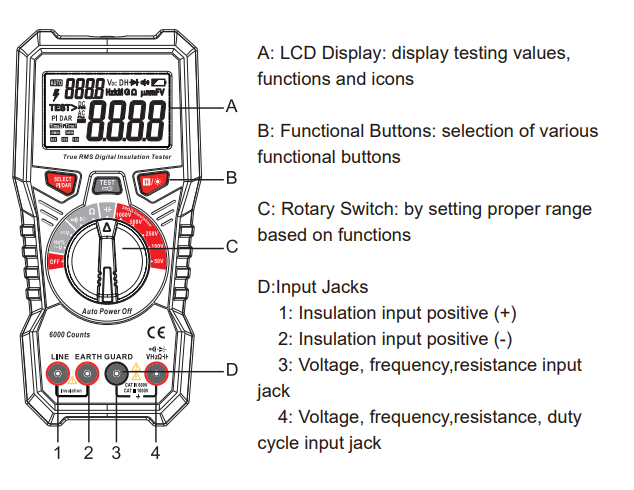
Instruments like the HK505 handheld insulation resistance tester offer five selectable test voltages—50V, 100V, 250V, 500V, and 1000V—combined with high insulation resistance measurement capability. This allows technicians to perform accurate insulation diagnostics across industrial, commercial, and residential applications using a single device.
By supporting proper voltage selection rather than a one-size-fits-all approach, Honeytek tools help reduce testing errors and improve maintenance decision quality.
Frequently Asked Questions
What happens if the insulation test voltage is too low?
The test may not reveal insulation defects, resulting in false confidence and missed early-stage failures.
Is higher insulation test voltage always better?
No. Higher voltage increases electrical stress and may damage low-voltage or sensitive equipment.
How do I know which test voltage to use?
Consider the operating voltage, insulation design, and equipment type. When in doubt, start with a lower voltage and increase only if appropriate.
Can one tester cover all applications?
Yes, provided it offers multiple selectable test voltages and sufficient measurement range.
Is insulation testing safe for electronic equipment?
Only when the correct low test voltage is used and the equipment is properly isolated.
Conclusion
Choosing the right insulation test voltage is as important as performing the test itself. Incorrect voltage selection can lead to unreliable results, damaged equipment, and unsafe decisions.
By understanding how 50V, 100V, 250V, 500V, and 1000V test voltages apply to different equipment types, electrical professionals can perform insulation testing with confidence and accuracy. Multi-voltage insulation testers make this process simpler, safer, and more effective.
If you want to improve the accuracy and safety of your insulation testing, explore Honeytek’s range of electronic measurement tools. From digital multimeters and clamp meters to advanced multi-voltage insulation resistance testers, Honeytek supports professionals with reliable, field-ready solutions.
Contact Honeytek today to learn more about our products or discuss OEM and customization options for your application.
You may like these:
