
CAT III 300V and CAT III 600V describe where a voltage detector can be used and the maximum rated voltage level within that measurement category. CAT III 600V offers a higher voltage rating than CAT III 300V in the same category, making it the better choice for users who need broader coverage in distribution-level electrical environments.
For HONEYTEK voltage detectors, the HK11E is rated CAT III 300V and supports AC/DC ranges up to 250V. The HK11F is rated CAT III 600V and supports AC/DC ranges up to 600V, making it more suitable for users who need wider voltage detection.
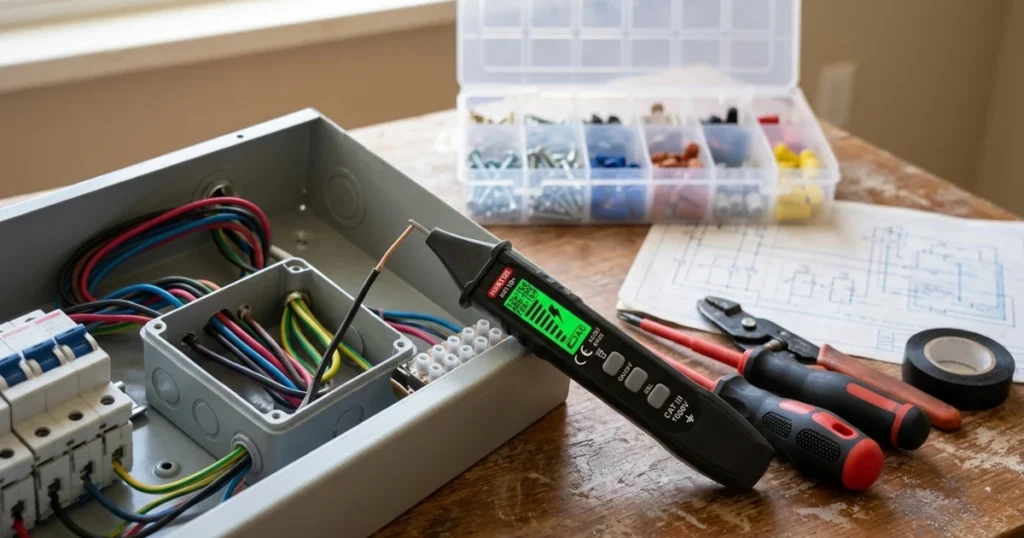
What Does CAT III Mean?
CAT stands for measurement category. It helps describe the electrical environment where a test instrument is designed to be used. A higher category or higher voltage rating does not simply mean “more powerful.” It means the tester is designed for specific electrical conditions, including possible transient overvoltage.
CAT III is commonly associated with fixed electrical installations, such as distribution boards, feeders, branch circuits, and permanently installed equipment. For a voltage detector, the CAT rating is an important part of safe selection.
If you are choosing tools for electricians, maintenance teams, facility service, or OEM tool programs, the CAT rating should not be treated as a decorative label. It should match the intended use.
For buyers, the key question is not only “What voltage can this tester detect?” The better question is “Where will the customer use this tester?” A product used around fixed building wiring needs a different safety expectation from a simple low-voltage hobby tool.
CAT III 300V vs CAT III 600V
The simplest difference is voltage rating.
CAT III 300V means the tester is rated for CAT III environments up to 300V. CAT III 600V means the tester is rated for CAT III environments up to 600V.
In practice, CAT III 600V gives more headroom for users who may work across a wider range of circuits. It is often the preferred choice when the product needs to cover more professional or industrial applications.
This does not mean every user must buy a CAT III 600V detector. If the intended work is basic residential checking within the lower voltage range, a CAT III 300V model can be the right fit. If the product will be sold to electricians, facility maintenance teams, or industrial users, CAT III 600V is usually easier to position because it covers more demanding use cases.

Simple Selection Guide
| User or market | Recommended direction | Reason |
|---|---|---|
| Home DIY user | CAT III 300V or suitable local rating | Basic fixture, outlet, and switch checks within rating |
| Retail tool kit | HK11E or HK11F depending on price point | Entry-level and premium options can coexist |
| Facility maintenance | CAT III 600V preferred | Wider range coverage for building systems |
| Electrical contractor | CAT III 600V preferred | Better fit for professional electrical environments |
| OEM distributor | Offer both levels | Covers basic and higher-spec customer segments |
The goal is to match the detector to the environment, not simply to choose the highest number on the package.
HONEYTEK HK11E and HK11F Comparison
| Feature | HONEYTEK HK11E | HONEYTEK HK11F |
|---|---|---|
| DC voltage range | 12/20/200/250V | 12/24/50/110/240/400/600V |
| AC voltage range | 12/20/200/250V | 12/24/50/110/240/400/600V |
| DC accuracy | +/- (1.0% + 5d) | +/- (0.5% + 1d) |
| AC accuracy | +/- (1.0% + 5d) | +/- (1.0% + 5d) |
| Response time | <0.1s | <0.1s |
| CAT rating | CAT III 300V | CAT III 600V |
| Battery | 2 x 1.5V AAA | 2 x 1.5V AAA |
| Product size | 190 x 33 x 31mm | 190 x 33 x 31mm |
| Product weight | 65g | 65g |
Both models include practical field features:
- Continuity buzzer
- Flashlight
- NCV function
- Live wire recognition
- LCD backlight
- Low battery display
- Auto power off
- Automatic range selection
The two models share the same compact form factor, but the HK11F provides a wider voltage range and higher CAT III voltage rating.
How to Read the Voltage Range
The HK11E supports 12/20/200/250V ranges for both AC and DC voltage. This makes it suitable for many basic electrical detection tasks, especially where the target market mainly works with lower-voltage circuits.
The HK11F supports 12/24/50/110/240/400/600V ranges for both AC and DC voltage. This wider range allows the same tool to cover more situations, from low-voltage checks to higher-voltage building and maintenance applications within its rating.
For OEM buyers, this difference is useful for product line planning. HK11E can be placed as a compact standard model, while HK11F can be positioned as an upgraded detector for professional users.
When to Choose CAT III 300V
A CAT III 300V voltage detector can be a good choice when the target users mainly work with lower-voltage building circuits, basic maintenance, home inspection, or general electrical checks within the product rating.
Choose HONEYTEK HK11E when:
- The required voltage range is up to 250V
- The application is basic electrical detection
- A compact, cost-effective detector is preferred
- The buyer needs a practical tool for home, retail, or entry-level maintenance kits
HK11E is suitable for distributors and OEM customers who need a straightforward voltage detector with essential functions and CAT III 300V rating.
In a retail catalog, HK11E can be described as a practical AC/DC voltage detector for everyday electrical checking. Its compact body, LED indication, flashlight, NCV function, live wire recognition, LCD backlight, and auto power off make it easy for non-specialist users to understand.
When to Choose CAT III 600V
CAT III 600V is the better option when users need wider voltage coverage or when the tool may be used in more demanding electrical environments.
Choose HONEYTEK HK11F when:
- The required voltage range extends up to 600V
- The product is aimed at professional users or facility maintenance
- Wider AC/DC range selection is important
- A stronger specification is needed for OEM positioning
- CAT III 600V is required by the target market
With detection ranges of 12/24/50/110/240/400/600V, HK11F gives users more flexibility than a basic low-range detector.
In product marketing, HK11F can be positioned for electricians, facility maintenance teams, distributors, and professional tool channels. The CAT III 600V rating and wider range coverage make the model easier to present as the higher-spec choice in the same product family.
Why Voltage Range Matters
Voltage range affects how useful a detector is across different markets. A tool designed only for basic household voltage may not be suitable for customers who work with broader electrical systems.
For example, a distributor selling to professional users may prefer the HK11F because it covers more ranges and has CAT III 600V marking. A retailer focused on simple home electrical checks may choose HK11E because it covers common lower-voltage needs with a more basic specification.
Voltage range also affects user confidence. When a detector clearly lists the ranges it supports, users can more easily decide whether the product matches their work. This is especially important for online product pages, where buyers compare specifications before contacting a supplier.
Do Accuracy Specifications Matter for a Voltage Detector?
Yes, but they should be understood correctly. A voltage detector pen is typically used for detection and indication, not as a replacement for a full diagnostic meter.
The HK11E DC voltage accuracy is listed as +/- (1.0% + 5d), while the HK11F DC voltage accuracy is listed as +/- (0.5% + 1d). Both models list AC voltage accuracy as +/- (1.0% + 5d). For users who need exact troubleshooting readings, a multimeter may still be required.
Other Selection Factors
When choosing a voltage detector, consider more than the CAT label:
- Voltage range
- AC/DC detection capability
- Response time
- LED visibility
- NCV sensitivity
- Live wire recognition
- Low battery warning
- Operating temperature
- Product size and weight
- OEM packaging and branding needs
The HONEYTEK HK11E/HK11F operate from 5°F to 113°F (-15°C to 45°C), with storage temperature from 5°F to 122°F (-15°C to 50°C), relative humidity up to 80% RH, and altitude measurement up to 2000m.
Product Page Copy Angle for HK11E
HK11E is suitable for buyers who need a compact AC/DC voltage detector for common electrical inspection. It supports 12/20/200/250V ranges, offers fast response under 0.1 seconds, and includes practical functions such as NCV, live wire recognition, flashlight, LCD backlight, low battery display, and auto power off.
This model is a good fit for entry-level tool kits, retail channels, household electrical checking, and distributors who want a cost-effective detector with a clear CAT III 300V specification.
Product Page Copy Angle for HK11F
HK11F is the stronger option when wider range coverage is required. It supports 12/24/50/110/240/400/600V ranges for both AC and DC voltage, with CAT III 600V rating. It keeps the same compact 190 x 33 x 31mm size and 65g weight, while extending the voltage detection range.
For OEM customers, HK11F is easier to position as a professional or upgraded model. It can serve electricians, maintenance technicians, industrial buyers, and distribution partners who need a higher specification than a basic voltage detector.
OEM Considerations for Tool Brands and Distributors
For OEM buyers, the best model depends on the target customer.
If the product line needs an accessible voltage detector for general use, HK11E is a practical choice. If the product line needs a higher-spec model for electricians, maintenance users, or industrial channels, HK11F is easier to position because of its CAT III 600V rating and wider range coverage.
HONEYTEK is a measuring instrument manufacturer and supports OEM cooperation for voltage detectors and related electrical test instruments.
An effective OEM product strategy may include both models. The HK11E can cover price-sensitive channels and basic electrical users. The HK11F can cover customers who compare specifications and need broader voltage coverage. This creates a simple good-better product structure for distributors and private-label brands.
How to Avoid Choosing the Wrong Detector
Before selecting a model, confirm these points:
- Maximum voltage the end user may encounter
- Whether AC and DC detection are both required
- Required safety category for the market
- Whether the buyer wants a basic or upgraded product position
- Packaging, branding, and documentation requirements
- Local regulatory or certification expectations
If the target market includes professional electrical maintenance, choosing only a lower-rated detector may limit the product’s appeal. If the target market is basic household use, a higher-spec detector may be useful but not always necessary.
Bottom Line
Choose CAT III 300V when your users need a basic voltage detector for lower-voltage applications within that rating. Choose CAT III 600V when your users need broader voltage coverage and a stronger specification for professional or industrial use.
For the HONEYTEK lineup, HK11E is the basic CAT III 300V option, while HK11F is the wider-range CAT III 600V option.
FAQ
Is CAT III 600V better than CAT III 300V?
CAT III 600V has a higher voltage rating within the same measurement category. It is better when the application requires that wider rating. The right choice depends on where the detector will be used.
Can I use a CAT III 300V detector on 600V circuits?
No. Do not use a tester beyond its rated category and voltage. Choose a detector rated for the application.
What is the main difference between HONEYTEK HK11E and HK11F?
HK11E is rated CAT III 300V and supports ranges up to 250V. HK11F is rated CAT III 600V and supports ranges up to 600V.
Does HONEYTEK support OEM voltage detector projects?
Yes. HONEYTEK is a measuring instrument manufacturer and supports OEM cooperation for brands, distributors, and industrial customers.
Which model is better for professional tool channels?
HK11F is generally the stronger option for professional channels because it supports a wider AC/DC range up to 600V and carries a CAT III 600V rating.
Which model is better for entry-level retail?
HK11E is a practical choice for entry-level retail because it covers common voltage detection ranges up to 250V and has a CAT III 300V rating.
Should a distributor sell both HK11E and HK11F?
Yes, if the distributor serves more than one customer type. HK11E can cover basic users, while HK11F can cover customers who need wider voltage coverage and a higher specification.
