
Choosing the wrong anemometer can lead to inaccurate airflow data, inefficient HVAC balancing, or even damage to the instrument. This is especially important when measuring air velocity in HVAC systems, industrial ventilation, cleanrooms, laboratories, and other controlled environments.
Vane and thermal anemometers both measure air velocity, but they use different sensing technologies and are designed for different conditions.
The general rule is simple:
- Choose a vane anemometer for HVAC outlets, grilles, industrial ventilation, outdoor measurements, and medium-to-high air velocities.
- Choose a thermal or hot-wire anemometer for low-velocity airflow, duct traverses, cleanrooms, laboratories, and confined spaces.
However, sensor type is only one part of the decision. Measurement range, accuracy, probe size, air quality, environmental conditions, and the required test procedure should also be considered.
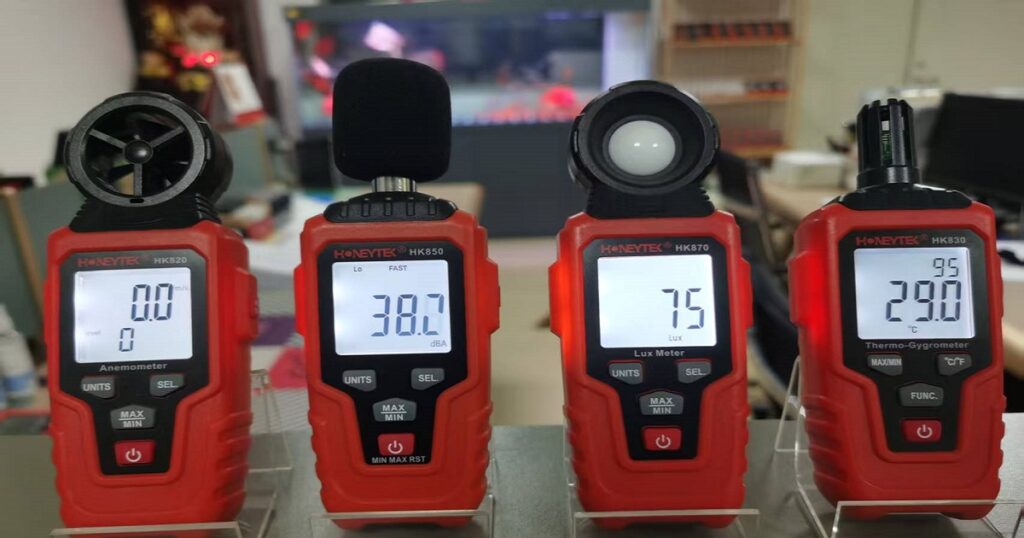
Vane vs. Thermal Anemometers: Quick Comparison
| Selection Factor | Vane Anemometer | Thermal/Hot-Wire Anemometer |
|---|---|---|
| Measurement principle | Air rotates a mechanical impeller | Moving air cools an electrically heated sensor |
| Best velocity range | Medium to high air velocity | Low and very low air velocity |
| Low-velocity sensitivity | Generally limited by impeller inertia | Excellent; some models measure down to approximately 0.01 m/s |
| Response characteristics | Stable and naturally averaged | Fast and sensitive to small changes |
| Probe size | Usually larger | Small and often telescopic |
| Uneven airflow | A large vane samples a wider area | Requires multiple point measurements |
| Dust tolerance | Generally more durable | Sensor may be affected by contamination |
| Moisture tolerance | Usually better, subject to the instrument rating | Condensation and droplets may damage the sensor |
| Typical applications | Grilles, registers, ventilation outlets, outdoor airflow | Ducts, cleanrooms, laboratories, biosafety cabinets |
| Air volume measurement | Available on models with area input | Calculated from average velocity and duct area |
| Maintenance | Relatively simple | Sensor requires careful cleaning and handling |
| Typical cost | Low to moderate | Moderate to high |
These are general characteristics. Always check the manufacturer’s specified measurement range, accuracy, operating conditions, and probe limitations before selecting an instrument.
What Is a Vane Anemometer?
A vane anemometer uses a lightweight impeller that rotates when air passes through it. The instrument detects the rotational speed and converts it into an air-velocity reading.
Modern digital vane anemometers often use magnetic or electronic sensors to detect impeller rotation. Many models can also measure temperature and calculate airflow volume in CFM or CMM.
Advantages of Vane Anemometers
Suitable for HVAC Grilles and Outlets
Airflow at a grille, register, or diffuser is rarely uniform. A large vane samples a wider area than a small point sensor, helping the instrument produce a more stable and representative reading.
For improved accuracy, take measurements at several positions across the outlet or use a compatible airflow hood.
Effective at Medium and High Air Velocities
Vane anemometers are commonly used for the air velocities found at HVAC supply outlets, industrial exhausts, fans, and outdoor locations.
The maximum allowable velocity varies by model. Never use an instrument above its rated measurement range.
Durable for Field Use
Vane sensors are generally more robust than exposed hot-wire sensors. This makes them practical for mechanical rooms, workshops, industrial ventilation systems, and other field environments.
A vane anemometer is not automatically waterproof or dustproof, however. Heavy dust can affect the impeller bearings, while condensation and corrosive substances may damage the sensor or electronics.
Limitations of Vane Anemometers
The impeller has mechanical mass and inertia. When airflow is extremely weak, it may not generate enough force to rotate the vane consistently.
For this reason, many general-purpose vane anemometers are less suitable for measurements below approximately 0.4 to 0.5 m/s. The actual minimum usable velocity depends on the instrument.
Other potential sources of error include:
- Incorrect probe alignment
- Holding the probe too close to the grille
- Airflow obstruction caused by the operator
- Dirty or worn impeller bearings
- Using a single reading to represent a large outlet
- Measuring highly directional airflow at the wrong angle
Best Applications for a Vane Anemometer
A vane anemometer is usually a good choice for:
- HVAC supply and return grilles
- Registers and ventilation outlets
- Industrial exhaust openings
- General ventilation inspections
- Fan outlet measurements
- Building maintenance
- Outdoor wind-speed measurements
- Medium-to-high velocity airflow
What Is a Thermal or Hot-Wire Anemometer?
A thermal anemometer uses an electrically heated sensing element. When air passes over the sensor, it removes heat. The instrument measures this heat loss and converts it into an air-velocity value.
A hot-wire anemometer is one type of thermal anemometer. Other thermal instruments may use hot-film or heated-bead sensors.
Advantages of Thermal Anemometers
Excellent Low-Velocity Sensitivity
Thermal sensors can detect airflow that is too weak to rotate a conventional vane. Depending on the instrument, the lower measurement limit may reach approximately 0.01 m/s.
This sensitivity makes thermal anemometers useful for:
- Low-speed duct airflow
- Cleanroom airflow
- Laminar-flow workstations
- Biosafety cabinets
- Laboratory enclosures
- Air leakage investigations
- Electronics cooling analysis
Small Probe Design
Many thermal anemometers have a narrow telescopic probe. The probe can be inserted through a small duct access hole and moved to different positions across the duct.
Its small diameter also reduces airflow disturbance and makes it easier to measure inside confined spaces.
Fast Response
A low-mass thermal sensor can respond quickly to small changes in air velocity. This is useful for identifying fluctuations, drafts, and unstable flow conditions.
However, fast response can also make the displayed reading appear less stable in turbulent air. Operators may need to use time averaging or record several measurements.
Limitations of Thermal Anemometers
The sensing element is relatively delicate. Dust, oil mist, fibers, water droplets, and condensation can change the heat-transfer characteristics of the sensor, causing drift or measurement errors.
Operators should never touch the thermal sensor. It should not be exposed to wet or heavily contaminated air unless the manufacturer specifically approves the instrument for those conditions.
Thermal measurements may also be influenced by:
- Air temperature
- Gas composition
- Probe contamination
- Sensor aging
- Incorrect probe orientation
- Operation outside the specified environmental range
Best Applications for a Thermal Anemometer
A thermal or hot-wire anemometer is usually preferred for:
- Low-velocity duct traverses
- Cleanroom airflow verification
- Biosafety cabinet testing
- Laboratory airflow analysis
- Small ducts
- Restricted access points
- Draft and leakage detection
- Research requiring rapid response
Thermal anemometers are widely used in cleanrooms because of their low-velocity sensitivity and small probe size. However, this does not mean that every cleanroom test must use a hot-wire instrument.
Instrument selection should follow the applicable test procedure, expected velocity range, internal standard operating procedure, customer requirements, and relevant standards such as ISO 14644-3.
Vane vs. Hot-Wire Anemometer Accuracy
A lower percentage in an accuracy specification does not always mean that an instrument is more accurate in actual use.
Many manufacturers express accuracy as a percentage of the reading plus a fixed value. For example:
Accuracy = ±(2% of reading + 0.5 m/s)
At a measured velocity of 10 m/s:
±[(10 × 2%) + 0.5] = ±0.7 m/s
At a measured velocity of 0.5 m/s:
±[(0.5 × 2%) + 0.5] = ±0.51 m/s
At low velocities, the fixed component may represent a large percentage of the measured value. Therefore, an instrument with a displayed minimum range of 0.4 m/s is not necessarily suitable for precise measurements close to 0.4 m/s.
Always compare accuracy at the actual velocity you expect to measure.
Response Speed and Reading Stability
A thermal anemometer normally reacts more quickly to small airflow changes. This makes it useful for detecting fluctuations, but the display may change rapidly in turbulent conditions.
A vane anemometer has mechanical inertia, which naturally smooths short-term fluctuations. This can provide a steadier reading, although very rapid changes may not be fully captured.
Response speed and accuracy are not the same. A fast instrument can still produce an inaccurate result if it is positioned incorrectly or used outside its intended range.
For repeatable measurements:
- Keep the probe properly aligned with the airflow.
- Use an appropriate averaging period.
- Avoid taking measurements immediately after an elbow, damper, or fan.
- Use several measurement points across a duct or large outlet.
- Record the air temperature and duct dimensions.
- Check the instrument’s calibration status.
- Use the same test procedure when comparing results over time.
Why a Duct Traverse Is Important
Air velocity is rarely uniform across a duct.
Friction reduces air velocity near the duct walls, while elbows, dampers, transitions, filters, and fans can produce swirl or uneven velocity profiles. A measurement taken only at the center of a duct may therefore overestimate or underestimate the total airflow.
During a duct traverse, the cross-section is divided into multiple measurement points. The operator records the velocity at each point and calculates the average.
The average velocity is then multiplied by the duct area to determine airflow volume.
A thermal probe is especially convenient for low-velocity duct traverses because it can be inserted through a small access hole. A vane probe may also be used when its dimensions and velocity range are appropriate.
How to Calculate CFM and CMM
Air volume is calculated from average air velocity and cross-sectional area:
Air volume = Average air velocity × Airflow area
CFM Calculation
When velocity is measured in feet per minute:
CFM = Average velocity in ft/min × Area in ft²
For example:
- Average velocity: 800 ft/min
- Duct area: 2 ft²
800 × 2 = 1,600 CFM
CMM Calculation
When velocity is measured in meters per second:
CMM = Average velocity in m/s × Area in m² × 60
For example:
- Average velocity: 4 m/s
- Duct area: 0.25 m²
4 × 0.25 × 60 = 60 CMM
The area entered into the instrument must be accurate. A 10% error in the entered area will generally create a 10% error in the calculated airflow volume.
When measuring a grille, use the effective free area or the manufacturer’s correction factor when available. The outside dimensions of a grille do not necessarily represent its actual airflow area.
How to Choose the Right Anemometer
Measuring Inside Ductwork
Recommended: Thermal anemometer for low-velocity or restricted-access ducts
A narrow telescopic thermal probe is easy to insert into a duct and move through multiple traverse points. It also creates relatively little blockage.
For higher velocities, a vane anemometer or Pitot-static measurement system may also be suitable.
Measuring Diffusers, Registers, and Grilles
Recommended: Large-vane anemometer or airflow hood
The wider sensing area of a large vane is useful for uneven airflow at an outlet. Take measurements at several positions instead of relying on one center reading.
For professional testing, adjusting, and balancing work, an airflow hood or properly performed duct traverse may produce a more representative result.
Measuring in Dusty or Humid Industrial Environments
Recommended: Robust vane anemometer
A vane instrument is generally more suitable than an exposed hot-wire probe when dust, fibers, oil mist, or moderate humidity is present.
Always check the temperature, humidity, dust, and ingress-protection ratings of the selected model. A standard vane instrument should not be treated as waterproof.
Measuring Airflow in Pharmaceutical or Electronics Cleanrooms
Recommended: Calibrated low-velocity thermal anemometer when appropriate for the test method
A thermal probe is often preferred because it can measure low velocities with minimal airflow disturbance.
However, instrument selection must follow the facility’s approved procedure, validation protocol, required uncertainty, calibration policy, and applicable cleanroom standards. A thermal anemometer should not be described as universally mandatory for every cleanroom application.
Recommended Honeytek Digital Anemometer
For HVAC maintenance, ventilation testing, workshop inspections, and general wind-speed measurements, the Honeytek HK820 Series Digital Anemometer is a practical vane-based solution.
The product family includes the Honeytek HK820, HK820+, and HK880A.
Honeytek HK820
The Honeytek HK820 is designed for users who primarily need wind-speed and temperature measurements.
Key specifications include:
- Air-velocity range: 0.40 to 30.00 m/s
- Equivalent range: 1.40 to 108.0 km/h
- Air-velocity accuracy: ±(2.0% of reading + 0.5 m/s)
- Temperature range: −20°C to 60°C
- Temperature accuracy: ±1.5°C
- Sampling rate: Two readings per second
- Magnetic induction wind-speed sensor
- Backlit display with bar graph
- Data Hold
- MAX/MIN/AVG Hold
- Automatic power-off
The HK820 is suitable for general HVAC outlet testing, ventilation inspection, fan checks, industrial maintenance, and outdoor wind-speed measurements.
Honeytek HK820+
The Honeytek HK820+ adds airflow-volume functions for HVAC users who need to calculate CFM or CMM.
In addition to wind speed and temperature, it supports:
- CFM measurement from 0 to 9,999
- CMM measurement from 0 to 9,999
- Airflow-area input
- Data Hold
- MAX/MIN/AVG Hold
- Backlit display
- Battery-capacity display
The area-setting function allows the instrument to calculate airflow volume from the measured velocity and entered cross-sectional area.
This makes the HK820+ the recommended model for HVAC technicians who regularly work with ducts, ventilation openings, and airflow-volume calculations.
Honeytek HK880A
The Honeytek HK880A provides wind-speed, temperature, and airflow-volume measurement. It also includes an adjustable measurement angle, making it useful when the display or sensor must be repositioned for easier access and viewing.
Honeytek Model Comparison
| Model | Wind Speed | Temperature | CFM/CMM | Area Setting | Adjustable Test Angle |
|---|---|---|---|---|---|
| Honeytek HK820 | Yes | Yes | No | No | No |
| Honeytek HK820+ | Yes | Yes | Yes | Yes | No |
| Honeytek HK880A | Yes | Yes | Yes | Yes | Yes |
Which Honeytek Model Should You Choose?
Choose the Honeytek HK820 if you need:
- Wind-speed measurement
- Temperature measurement
- A straightforward, cost-effective field instrument
- General HVAC and ventilation testing
Choose the Honeytek HK820+ if you also need:
- CFM and CMM calculations
- Adjustable airflow-area input
- HVAC airflow-volume testing
- A battery-capacity display
Choose the Honeytek HK880A if you need:
- Wind speed, temperature, and airflow volume
- Adjustable measurement positioning
- Greater flexibility in difficult measurement locations
The Honeytek HK820 Series is intended for measurements from 0.40 to 30.00 m/s. For extremely low airflow below the specified minimum, a specialized thermal anemometer would be more appropriate.
Frequently Asked Questions
How Often Should a Hot-Wire Anemometer Be Calibrated?
A 12-month calibration interval is a common starting point, but there is no universal interval for every application.
The appropriate calibration frequency depends on:
- Manufacturer recommendations
- Frequency of use
- Previous calibration results
- Environmental exposure
- Required measurement uncertainty
- Internal quality procedures
- Customer or regulatory requirements
An instrument used frequently in a critical cleanroom may require more frequent calibration or verification than a meter used occasionally for general maintenance.
The instrument should also be inspected or recalibrated after sensor damage, heavy contamination, abnormal readings, or exposure to conditions outside its rated limits.
Can a Hot-Wire Anemometer Measure CFM?
Yes. A hot-wire anemometer measures air velocity, which can be used to calculate CFM.
The formula is:
CFM = Average air velocity in ft/min × Airflow area in ft²
Because duct airflow is not uniform, the average velocity should normally be obtained from a multi-point traverse. Using only one center-point reading may produce a significant error.
Is a Vane Anemometer Better Than a Hot-Wire Anemometer?
Neither instrument is universally better.
A vane anemometer is generally better for:
- HVAC grilles and outlets
- Medium-to-high air velocities
- Outdoor measurements
- Industrial field conditions
- General ventilation inspection
A hot-wire anemometer is generally better for:
- Very low air velocities
- Small ducts
- Confined spaces
- Cleanrooms
- Laboratory airflow studies
- Sensitive leakage measurements
Can a Vane Anemometer Measure Below 0.5 m/s?
Some specialized vane instruments can measure below 0.5 m/s, but many general-purpose models have limited sensitivity at very low velocities.
Check both the minimum measurement range and the accuracy specification. A meter may display a low velocity without providing the precision required for the application.
Can a Vane Anemometer Measure CFM?
Yes, if the instrument includes an airflow-volume function or if the user calculates the volume manually.
The meter must use the average air velocity and the correct airflow area. Honeytek models such as the HK820+ and HK880A include CFM/CMM measurement and an airflow-area setting.
Does Probe Size Affect Airflow Measurement?
Yes. Probe size affects how much of the airflow is sampled and how much the probe disturbs the flow.
A large vane averages velocity over a broader area, making it useful at grilles and outlets. A small thermal probe measures velocity at a specific point and is better suited to duct traverses and confined spaces.
Regardless of probe size, representative sampling is essential for an accurate airflow calculation.
Final Recommendation
The correct wind-speed meter should be selected according to the expected airflow, measurement location, environmental conditions, and required accuracy.
Choose a thermal or hot-wire anemometer for low-velocity duct measurements, cleanrooms, laboratories, and other applications requiring a small, sensitive probe.
Choose a vane anemometer for HVAC outlets, grilles, industrial ventilation, outdoor wind measurements, and general field use.
For straightforward wind-speed and temperature testing, the Honeytek HK820 offers a practical and cost-effective solution.
For HVAC technicians who also need CFM/CMM calculations and airflow-area input, the Honeytek HK820+ Digital Anemometer is the recommended option.
Reliable airflow measurement depends on more than sensor type. Correct probe positioning, representative sampling, accurate area input, proper maintenance, and traceable calibration are equally important.
