
Choosing a solar panel tester starts with three electrical limits: power, voltage and current. All three must suit the module or circuit you intend to test. A higher wattage figure alone does not guarantee compatibility.
Beyond electrical ratings, consider how you work. Occasional module checks call for straightforward operation and a readable display. Repeated inspections may also require stored measurements, exportable records and more advanced diagnostic functions.
This solar MPPT meter buying guide explains the specifications that matter and when the HONEYTEK HK88PV 2000W Solar Panel Tester MPPT Meter is worth considering.
HK88PV details in this guide are based on the supplied product specifications. This is a selection guide, not an independent hands-on product review.
Why Choosing the Right PV Solar Panel Tester Matters
A photovoltaic testing instrument should match both your electrical system and your testing objective.
If you want to check available module power, an MPPT tester can help identify the operating point where voltage multiplied by current is highest:
Pmax = Vmp × Imp
However, a maximum-power measurement does not replace every other PV test. Insulation resistance testing, protective conductor checks and detailed I-V curve analysis require suitable functions or separate equipment.
Voc and Isc measurements are useful, but some performance problems appear primarily under load. Fluke explains that open-circuit voltage and short-circuit current tests can miss deviations that reduce maximum power.
Before comparing products, define your task: checking individual modules, troubleshooting low output, inspecting strings or documenting system performance.
Check the Maximum Testing Power
The tester’s permitted power input must cover the source you plan to connect, under the expected conditions.
A solar panel tester 1000W may provide sufficient power capacity for many individual modules. A solar panel tester 2000W may offer additional capacity, but its voltage and current limits still determine which configurations it can test.
Check these details in the manual:
- Maximum permitted input power.
- Power measurement range.
- Allowed measurement duration and cooling intervals.
- Operating temperature limits.
- Any restrictions on testing connected modules.
Do not calculate usable power capacity simply by multiplying the maximum voltage and maximum current ratings. Those limits may not be available simultaneously.
For example, a hypothetical tester labeled 80 V, 35 A and 1000 W is not automatically a 2800 W instrument. The 1000 W limit still applies.
Compare Voltage and Current Measurement Ranges
Voltage: check Voc, including cold conditions
Use the module’s open-circuit voltage, Voc, when assessing maximum voltage compatibility. Vmp is lower and does not represent the highest voltage the tester may encounter.
PV voltage generally rises as cells become colder. Determine the expected maximum Voc using the module manufacturer’s temperature coefficient and the applicable design conditions.
Series-connected modules add voltage. A tester suitable for one module may therefore be unsuitable for a string of the same modules.
Also check minimum operating voltage. A wide upper range does not guarantee support for every small panel.
Current: check the requirements of each test mode
Confirm the tester’s permitted operating current and short-circuit current capability.
An MPPT measurement involves Imp, while an Isc test involves the higher short-circuit current. If the instrument performs both, checking Imp alone is insufficient. Account for expected conditions and any manufacturer-required allowances.
Parallel-connected modules add current, which can exceed a handheld tester’s limit even when voltage remains acceptable.
When comparing a solar tester 80V 35A with a higher-voltage, lower-current model, choose according to the source being tested. Neither specification is inherently better.
Accuracy matters as well as range
Check accuracy at the values you expect to measure, not just at the top of the range.
A display resolution of 0.1 W does not mean an accuracy of ±0.1 W. Where accuracy includes a percentage and a digit term, both contribute to the stated error limit.
Automatic MPPT Mode vs. Manual MPPT Mode
An automatic MPPT tester adjusts the load to search for maximum power with limited operator input. This is useful for repeatable module checks and routine field work.
Manual functions vary by manufacturer. They may allow adjustment of an operating point, a test setting or a measurement sequence.
| Mode | Potential benefit | What to verify |
|---|---|---|
| Automatic MPPT | Convenient routine testing | Tracking behavior, test duration and supported conditions |
| Manual or adjustable mode | More control during investigation | Exactly which settings the operator can change |
| Repeated testing | Comparing successive measurements | Duty cycle, cooling requirements and recording capability |
Manual operation is not automatically more accurate. Measurement quality also depends on the instrument, connections and stability of the sunlight.
The supplied HK88PV specification lists SMART/AUTO selection. It does not describe a separate manual MPPT mode, so buyers needing manual control should request clarification.
MC4 Compatibility and Field Connection
A solar tester with MC4 connector can simplify connection to appropriately equipped modules. However, connector shape alone does not establish compatibility.
Check the exact connector manufacturer, product family, mating approval and lead ratings. Confirm which leads or adapters are included with the tester.
For installed panels, follow the system’s shutdown and isolation procedure. Illuminated modules can remain energized after other equipment is switched off.
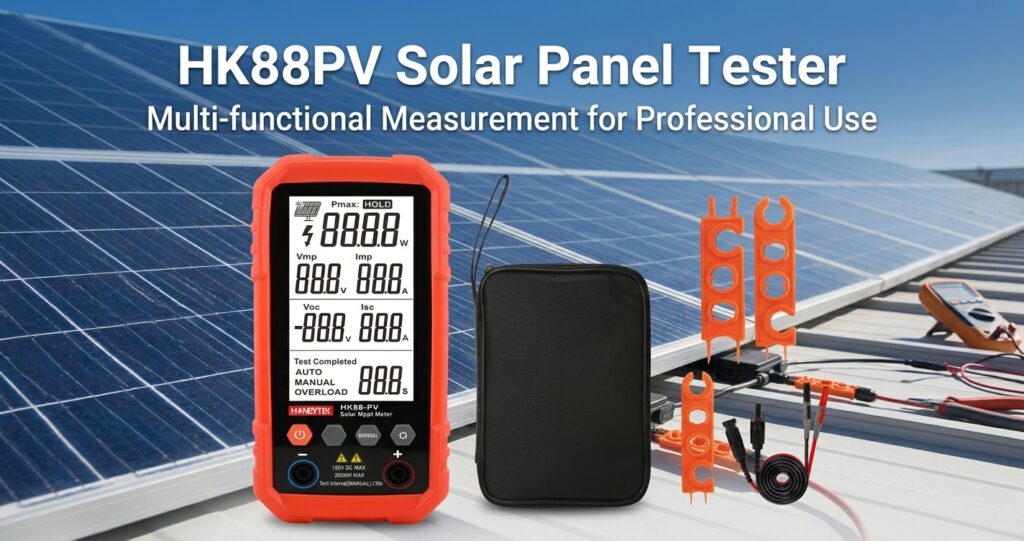
The supplied HK88PV table does not identify the included connector models or adapter package. Confirm these before ordering.
Safety Protection Features to Look For
Ask for documented protection behavior rather than relying on a general “multiple protections” claim.
| Feature | What buyers should verify |
|---|---|
| Overvoltage handling | Permitted input limit and response to an excessive voltage |
| Overcurrent handling | Current limits for each measurement mode |
| Overtemperature protection | Temperature cutoff and cooling procedure |
| Reverse-polarity protection | Whether protection is provided and under what conditions |
| Overrange indication | Meaning of the warning and required operator action |
| Safety rating | Applicable category, voltage and supporting documentation |
An error message is not proof that an instrument can safely withstand any excessive input.
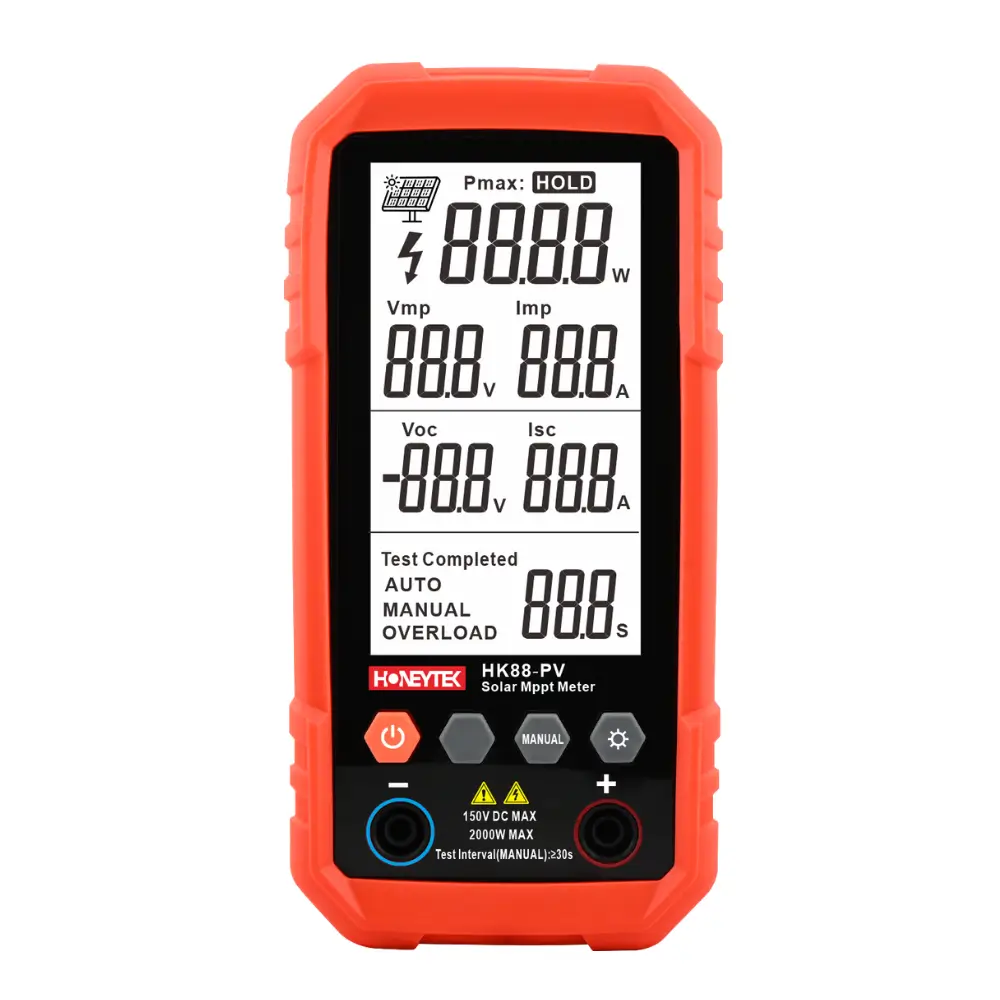
For the HK88PV, the supplied specification states that an input exceeding the rated value restricts entry into measurement mode and produces an OL indication. It also lists CAT III 150 V.
The supplied table does not separately establish reverse-polarity protection or thermal shutdown. Request the current manual if these functions are important to your application.
Display, Data Hold and Outdoor Readability
Field usability affects how easily measurements can be read and recorded.
Look for clear units, readable digits, useful viewing angles and a display layout that makes the active measurement mode obvious. A backlight helps in dim conditions, but does not by itself guarantee readability in direct sunlight.
Useful features include:
- Data Hold: Keeps a reading visible while it is recorded.
- MAX: Captures a maximum according to the instrument’s defined behavior.
- Automatic power-off: Helps conserve battery power.
- Clear range warnings: Makes unsuitable input conditions easier to identify.
The HK88PV specifications list a backlit LCD, MAX, Data Hold and automatic power-off, with power supplied by two 1.5 V batteries.
Data Hold should not be confused with permanent storage or automatic logging.
When Bluetooth and Data Export Are Useful
Bluetooth and data export become valuable when inspection records need to be organized, compared or shared.
For repeated site work, check whether the system can save:
- Module identification and timestamps.
- Voltage, current and power readings.
- Test conditions and inspection notes.
- Files in a usable format, such as CSV.
- Records locally when internet access is unavailable.
Also verify app compatibility, export restrictions and whether stored data remains accessible without an ongoing subscription.
Bluetooth alone does not guarantee a useful reporting workflow. For occasional checks, manually recording readings may be sufficient.
Bluetooth, internal logging and data export are not listed in the supplied HK88PV specifications. Buyers who require them should confirm availability before selecting the instrument.
Choosing a Tester for Residential, RV and Commercial Solar Systems
| Application | Main selection priorities | Important boundary |
|---|---|---|
| Residential module checks | Suitable ranges, simple operation and clear readings | Individual-module capability does not imply string capability |
| RV and portable solar | Minimum voltage, connector compatibility and portability | A nominal “12 V” panel has a higher actual Voc |
| Commercial module inspections | Repeatability, documentation and efficient handling | Batch inspections may benefit from logging |
| Commercial string or array testing | Adequate voltage/current ratings and required diagnostic functions | A handheld MPPT meter may cover only part of the work |
The size of the installation does not determine the required tester by itself. A technician inspecting individual modules at a large site may need a different instrument from one testing complete strings at the same site.
When to Consider the HONEYTEK HK88PV 2000W MPPT Meter
HONEYTEK is a manufacturer of measurement instruments and meters. Its HK88PV 2000W Solar Panel Tester MPPT Meter is an option for buyers seeking power, open-circuit voltage and short-circuit current measurements for compatible PV sources.
The supplied specifications provide the following starting point:
| Item | Supplied HK88PV specification |
|---|---|
| Product designation | 2000W Solar Panel Tester MPPT Meter |
| Power measurement range | 5–2200 W, across specified ranges |
| Open-circuit voltage measurement | 12–150 V, across two ranges |
| Short-circuit current measurement | 0–20 A |
| Selection | SMART/AUTO |
| Display features | Backlit LCD, MAX and Data Hold |
| Power management | Automatic power-off |
| Battery supply | Two 1.5 V batteries |
| Listed safety category | CAT III 150 V |
Confirm the distinction between the 2000W product designation and the listed 2200 W measurement range. The measurement range alone does not establish a continuous load rating or authorize operation above the confirmed input limit.
The supplied table also does not provide separate Vmp and Imp accuracy specifications. Request those details if they are essential to your purchasing decision.
The HK88PV is worth shortlisting when its confirmed limits cover your modules and its documented functions meet your workflow. Applications requiring higher current, complete-string testing or automated reports need additional evaluation.
Request the Right Tester for Your Application
The best Solar Panel Tester MPPT Meter for your work is the one that matches your electrical limits, measurement requirements and reporting needs.
Contact HONEYTEK, a manufacturer of measurement instruments and meters, to discuss the HK88PV 2000W Solar Panel Tester MPPT Meter.
Share your panel’s Pmax, Voc and Isc, the number of modules you intend to connect, and whether you need individual-module checks or string testing. Request the latest datasheet, operating manual, included accessory list and quotation so you can confirm suitability before purchasing.
