
Clamp meters are essential tools for electricians, technicians, and engineers who need to measure current safely and efficiently without interrupting the circuit. They combine the convenience of non-contact measurement with multiple functions, making them indispensable in power systems, industrial maintenance, and household electrical testing.
In this article, we’ll cover everything you need to know about clamp meters: their concept, measurement methods, safety precautions, advanced applications, and proper maintenance. By the end, you’ll be ready to use your clamp meter more effectively and extend its service life.
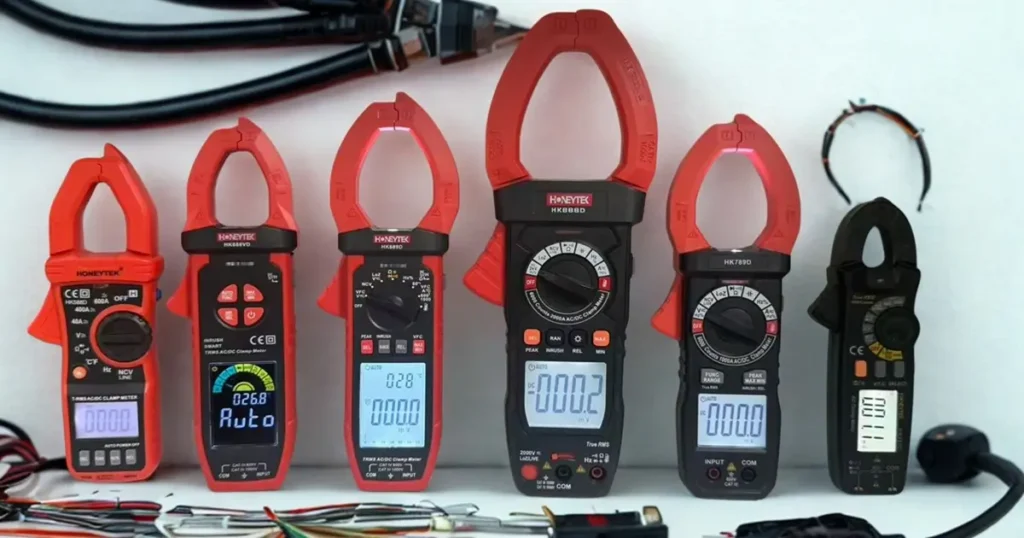
What Is a Clamp Meter?
A clamp meter—short for clamp-type ammeter—is built around a current transformer. Its core component is a hinged magnetic clamp that allows the user to encircle a conductor without cutting or disconnecting it.
When the clamp is placed around a current-carrying conductor, it acts as the primary winding of a transformer. The secondary winding inside the meter induces a current proportional to the conductor’s current, which is then displayed on the meter’s screen.
This design enables safe and quick current measurement in live circuits.
Types and Measurement Ranges of Clamp Meters
Clamp meters have evolved significantly over the years:
- Traditional clamp meters: Limited to AC current and voltage measurement.
- Modern digital clamp meters: Measure AC/DC voltage, AC/DC current, resistance, capacitance, frequency, continuity, diode function, temperature, and even phase sequence in three-phase systems.
- Specialized models: Include True RMS measurement for accurate readings of non-sinusoidal waveforms, or leak current clamp meters for insulation testing.
Different clamp meters serve different purposes. For instance, fork-type clamp meters allow quick measurement without fully closing the magnetic core, though they typically offer lower accuracy.

How to Measure Single-Phase Current
1. Safety First
- Always wear insulated gloves during measurement.
- Never clamp onto bare conductors without insulation.
- Avoid accidental short circuits by keeping the clamp clear of adjacent live parts.
2. Correct Conductor Position
For accurate readings, ensure the conductor is centered within the clamp jaw. Off-center placement may result in measurement errors.
3. Measuring Small Currents
When the current is very small, accuracy may be compromised. A practical solution is to loop the conductor multiple times around the clamp. For example:
- If the conductor is looped 5 times and the clamp shows 2.5 A, the actual current is 2.5 ÷ 5 = 0.5 A.
This technique improves sensitivity and accuracy in low-current applications.
4. Limitations in VFD Circuits
Ordinary clamp meters are not suitable for measuring the PWM output of variable-frequency drives (VFDs). The high-frequency modulated square waves cannot be read accurately by standard meters. For such applications, use a True RMS clamp meter specifically designed for distorted waveforms.

Measuring in Special Conditions
1. Measuring One Phase in a Three-Phase, Three-Wire System
If one phase cannot be measured directly, you can clamp the other two conductors together. The reading will indicate the current of the missing phase, since the vector sum of three-phase currents is zero.
2. Measuring Neutral Line Current in a Three-Phase, Four-Wire System
By clamping all three phase conductors simultaneously, the meter will display the neutral current, as it equals the vector sum of the phase currents.
Measuring Leakage Current
Clamp meters can also detect ground leakage currents. By clamping all conductors of a cable together, the displayed reading corresponds to the leakage current flowing to ground. This is a common diagnostic method for insulation faults.
Best Practices for Using a Clamp Meter
- Check the instrument before use – Inspect insulation, clamps, and display for damage. Ensure the jaws close tightly.
- Confirm measurement category (CAT rating) – Match the meter’s voltage rating with the test environment.
- Read the user manual carefully – Identify if the clamp meter is AC-only or AC/DC capable.
- Use the winding technique for small currents – Loop conductors to amplify readings.
- Ensure clamp closure is tight and clean – Remove dust or rust from the jaw surfaces for reliable readings.
- Measure one conductor at a time – Clamping multiple phases together may yield misleading results.
- Avoid exceeding rated voltage/current – Prevents instrument damage and personal injury.
- Check motor load conditions – Clamp meters can help determine if motors are overloaded or experiencing unbalanced currents.
- Start with the highest range – If unsure of current size, begin with the largest range to avoid overloading the meter.
Example: Correct vs. Incorrect Measurement
- Correct method: Clamp around a single insulated conductor at the jaw’s center.
- Incorrect method: Clamping two or more phase wires together, which cancels the current reading.
Visual diagrams in product manuals often illustrate these differences clearly.
Advanced Measurements with Clamp Meters
- Inrush current: Some advanced models measure surge current when motors or transformers start.
- True RMS measurement: Essential for circuits with harmonics or distorted waveforms.
- AC/DC flexibility: High-end clamp meters measure both alternating and direct currents, useful in renewable energy, automotive, and industrial testing.
Maintenance Tips for Clamp Meters
- Store the instrument in a dry, dust-free environment.
- Clean clamp jaws regularly with a soft cloth to maintain magnetic integrity.
- Replace batteries promptly to avoid leakage.
- Calibrate the instrument periodically to ensure accuracy.
- Avoid dropping or exposing the clamp meter to high humidity or temperature extremes.
By following these maintenance steps, you extend the lifespan of your clamp meter and ensure precise performance.
Frequently Asked Questions (FAQ)
Q1: Can I use a clamp meter to measure household current?
Yes. Clamp meters are commonly used to measure household appliance currents, breaker loads, and power consumption safely without disconnecting wires.
Q2: What is the difference between a clamp meter and a multimeter?
A clamp meter specializes in current measurement without circuit interruption, while a multimeter is versatile for voltage, resistance, and continuity. Many modern clamp meters combine both functions.
Q3: Can a clamp meter measure DC current?
Not all models. Standard clamp meters measure AC only, but advanced AC/DC clamp meters—like those from Honeytek—can handle both.
Q4: How do I choose the right clamp meter range?
Estimate the expected current first. If unsure, start at the maximum range and adjust downward for precise readings.
Q5: Why does my clamp meter show zero when clamping two wires?
If two conductors carry equal and opposite currents, their magnetic fields cancel, leading to a zero reading. Always measure a single conductor for accuracy.
Conclusion
Clamp meters are powerful tools for safe and efficient electrical measurements. From basic AC current measurement to advanced leakage detection and inrush current analysis, they support a wide range of applications in modern electrical work.
Proper usage, safety precautions, and regular maintenance are essential for accuracy and durability. With the right clamp meter, professionals can diagnose electrical systems confidently and prevent costly downtime.
Looking for reliable, accurate, and versatile clamp meters? Honeytek is a trusted manufacturer of professional electronic measurement tools, offering high-performance clamp meters designed for electricians, engineers, and technicians worldwide.
Explore Honeytek’s Clamp Meters Today and take your electrical testing to the next level.
