
High Voltage Multimeters Designed for Modern Solar PV Systems
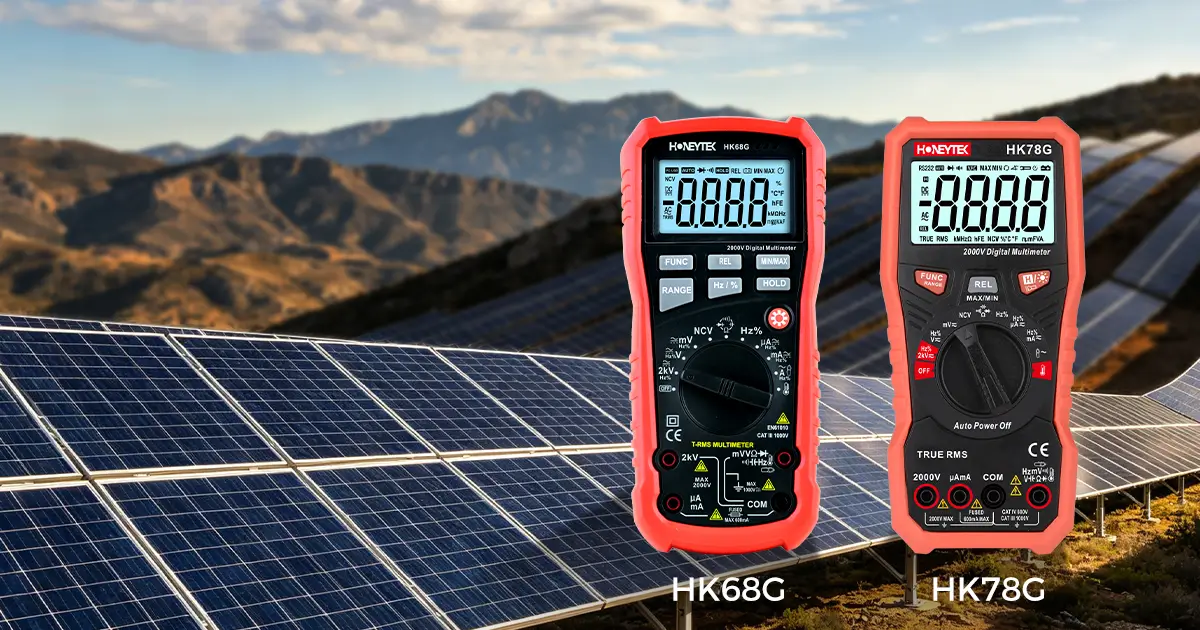
The HK68G and HK78G are professional-grade 2000V digital multimeters designed for photovoltaic (PV) system installation, maintenance, and troubleshooting. Built for demanding solar environments, both models deliver high-voltage measurement capability, True RMS accuracy, and full safety compliance for industrial field applications.
These two models share the same core electrical performance, making them equally suitable for 1500V and 2000V solar PV systems, grid-connected installations, and industrial electrical diagnostics.
While the measurement functions remain identical, the main differences lie in form factor, battery configuration, and portability design.
Core Shared Features (HK68G & HK78G)
Both HK68G and HK78G are engineered for professional solar technicians and electrical engineers who require safe and accurate high-voltage measurement.
High Voltage Measurement up to 2000V AC/DC
Both models support:
- DC Voltage: up to 2000V with high accuracy
- AC Voltage: up to 2000V for industrial power systems
- Ideal for 1500V photovoltaic string testing and commissioning
True RMS Measurement Technology
Accurate readings for both sinusoidal and non-sinusoidal waveforms, ensuring reliable performance in real-world PV and inverter environments.
Full Electrical Measurement Functions
- AC/DC voltage measurement
- AC/DC current measurement (up to 600A AC clamp capability)
- Resistance measurement up to 60MΩ
- Capacitance measurement up to 60mF
- Frequency measurement up to 10MHz
- Duty cycle measurement from 1% to 99%
- Temperature measurement from -50°C to 1300°C
Advanced Testing Functions
Both models include:
- Non-contact voltage detection (NCV)
- Diode test
- Continuity buzzer
- MAX/MIN recording
- Data hold function
- Relative measurement mode
- Auto and manual ranging
- Auto power-off function
- Built-in flashlight and LCD backlight
Safety Compliance
Designed for high-risk electrical environments:
- CAT III 1000V
- CAT IV 600V
Ensuring safe operation in solar farms, industrial power distribution, and high-voltage maintenance systems.
HK68G vs HK78G Key Differences
Although HK68G and HK78G share identical measurement performance, their design philosophy differs in usability and field application preference.
1. Design and Form Factor
HK68G – Traditional Full-Size Design
- Larger and more robust housing
- Designed for users who prefer a solid grip and traditional multimeter structure
- Suitable for workshop and fixed maintenance environments
HK78G – Compact Lightweight Design
- More compact and streamlined body
- Optimized for field technicians and mobile maintenance work
- Easier to carry in tool bags and tight installation environments
2. Battery System
HK68G
- Powered by 1 × 9V battery
- Traditional industrial power supply format
HK78G
- Powered by 2 × AA batteries
- More universal and easier to replace in field conditions
3. Portability and Field Usage
- HK68G is preferred for stationary testing, lab environments, and long-term installation work
- HK78G is optimized for on-site PV installation, rooftop maintenance, and field inspections
Application Scenarios
Both models are widely used in:
- Solar PV system installation and commissioning
- PV string voltage testing (up to 1500V/2000V systems)
- Inverter diagnostics and troubleshooting
- Industrial electrical maintenance
- Power distribution system inspection
- Renewable energy plant operation and maintenance (O&M)
Which Model Should You Choose?
Choose HK68G if:
- You prefer a larger, traditional multimeter design
- You work in controlled environments such as workshops or testing labs
- You prefer a 9V battery-powered instrument
Choose HK78G if:
- You need a compact and lightweight field tool
- You prefer widely available AA batteries
- You work frequently on rooftops, solar farms, or outdoor PV systems
Conclusion
The HK68G and HK78G are built on the same high-performance electrical platform, delivering identical measurement capability and safety protection for modern solar PV applications.
The decision between the two models depends entirely on mobility preference and battery system choice, not measurement performance.
For photovoltaic professionals requiring reliable 2000V measurement tools, both models provide a stable, accurate, and safe solution for daily field operation.
