
Choosing a digital multimeter (DMM) is not just about finding a tool that “can measure voltage.”
In real-world electrical and electronic environments, a multimeter is both a measurement instrument and a personal safety device.
Based on Honeytek’s long-standing engineering experience, a reliable multimeter selection follows a progressive logic:
Basic understanding → Measurement accuracy → Safety boundaries → Application matching
This guide walks you through that logic step by step—so you can make decisions based on physics, standards, and real use cases, not marketing labels.
Why Multimeter Selection Matters More Than Price
At first glance, many digital multimeters appear similar:
- They all measure voltage, current, and resistance
- They may even share the same voltage rating (e.g. 600V or 1000V)
However, in professional environments, two hidden factors determine whether a measurement is trustworthy and safe:
- How accurately the meter handles real-world waveforms
- How well it protects the user against high-energy transient events
Ignoring either can lead to:
- Incorrect diagnosis
- Component damage
- Or, in the worst case, serious personal injury
Core Measurement Accuracy: True-RMS vs. Average Responding
Understanding the Difference
Average Responding Multimeters
- Designed for pure sine wave signals
- Measure the average value of the waveform
- Multiply it by 1.11 to estimate RMS
- Accurate only when the waveform is an ideal sine wave
True-RMS Multimeters
- Measure the actual heating effect of the signal
- Calculate the real Root-Mean-Square value
- Accurate for both sinusoidal and non-sinusoidal waveforms
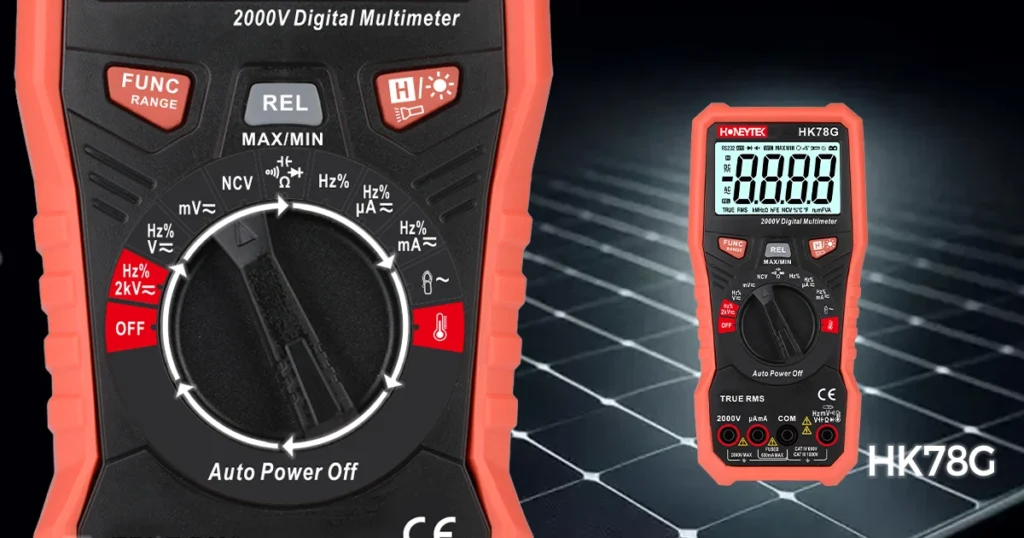
Why This Difference Matters in Modern Systems
In today’s electrical environment, pure sine waves are the exception, not the rule.
Common non-linear loads include:
- Variable Frequency Drives (VFDs)
- LED drivers and electronic ballasts
- Switching power supplies
- Inverters and solid-state control circuits
These devices produce distorted, pulsed, or chopped waveforms.
The Risk of Using Average Responding Meters
When measuring non-linear loads:
- Average responding meters can show 10%–40% lower readings
- This can lead to:
- Undervoltage misdiagnosis
- Incorrect load calculations
- Faulty system adjustments
Honeytek Engineering Conclusion:
- For basic resistive loads or standard AC mains, average responding meters may be acceptable
- For any modern electronic or industrial application, True-RMS is essential for data credibility
The Safety Bottom Line: CAT Safety Ratings (IEC 61010)
Accuracy alone is not enough.
A multimeter must also survive high-energy transient events—and protect the user when they occur.
The IEC 61010 Safety Framework
The IEC 61010 standard defines Measurement Categories (CAT) based on where the measurement is performed—not just voltage level.
Measurement Category Breakdown
- CAT I
Low-energy electronic circuits (e.g. internal electronics, signal-level testing) - CAT II
Single-phase loads connected to outlets (household appliances, portable tools) - CAT III
Distribution-level installations (distribution boards, circuit breakers, motors) - CAT IV
Source of installation (utility connections, outdoor lines, service entrances)
Why CAT Rating Is More Important Than Voltage Rating
A common misconception:
“A CAT II 1000V meter is safer than a CAT III 600V meter.”
This is incorrect.
CAT ratings define the meter’s ability to withstand:
- High-energy transient spikes
- Sudden fault currents
- Electrical arc events
A CAT III 600V meter is far safer in industrial environments than a CAT II 1000V meter.
Rule of thumb:
👉 Always choose CAT based on environment, not voltage alone
Supporting Parameters: Resolution, Digits, and Counts
While not decision drivers, these parameters refine the final choice.
Resolution Explained Simply
Resolution is like the smallest marking on a ruler.
- 3½ digits (2000 counts)
Suitable for general maintenance - 4½ digits (6000 counts)
Better for fine adjustments and diagnostics
Higher counts mean:
- More stable readings
- Better differentiation between close values
But resolution cannot compensate for poor accuracy or insufficient safety rating.
The Honeytek Selection Funnel
To simplify real-world selection, Honeytek applies a three-layer decision funnel:
Step 1: Determine Your CAT Environment
- Industrial / distribution → CAT III or CAT IV
- Appliance / facility maintenance → CAT II
Step 2: Identify Load Type
- Non-linear or electronic loads → True-RMS required
- Pure resistive loads → Average responding acceptable
Step 3: Refine with Resolution
- Maintenance & troubleshooting → 2000–6000 counts
- Precision diagnostics → Higher resolution as needed
A digital multimeter should never be treated as a simple reading tool.
It is a measurement system and a safety barrier between you and high-energy electrical environments.
Best practice:
- Prioritize True-RMS accuracy
- Match CAT rating to real working conditions
- Choose resolution based on actual diagnostic needs—not marketing numbers
This philosophy reflects why Honeytek’s selection methodology is widely regarded as a professional reference, not a sales checklist.
Frequently Asked Questions (FAQ)
Q1: Do I really need a True-RMS multimeter?
If you work with modern electronics, inverters, LED systems, or industrial drives—yes. Without True-RMS, readings may be misleading.
Q2: Can I use a CAT II meter in industrial environments?
No. Industrial panels and distribution systems require CAT III or CAT IV protection due to high transient energy.
Q3: Is higher digit count always better?
Not necessarily. Accuracy and safety matter more than resolution. Extra digits are only useful when the application requires them.
Q4: What causes transient overvoltage spikes?
Motor switching, lightning, inductive loads, and fault clearing events can all create high-energy transients.
Honeytek is a professional manufacturer of digital multimeters, clamp meters, and electrical test instruments, serving engineers, technicians, and industrial users worldwide.
- OEM / ODM customization available
- Stable quality aligned with IEC safety standards
- Actively expanding global distributor and agent partnerships
Contact Honeytek to discuss product selection, private labeling, or regional agency cooperation.
You can choose these products:
