
In the lifecycle of a Photovoltaic (PV) plant, “Low Insulation Resistance” (ISO Fault) is one of the most common inverter error codes. It usually signifies damaged cable sheathing, moisture ingress in junction boxes, or a compromised module backsheet. Ignoring this leads to inverter shutdowns, fire hazards, and severe efficiency losses.
This guide provides a standard operating procedure (SOP) based on IEC 62446-1 standards, detailing how to safely use a Honeytek Insulation Tester to diagnose these faults.
1. Safety First: The “Zero Energy” Prerequisite
Trustworthiness (T): Before connecting any insulation tester (Megger), safety is non-negotiable.
- Disconnect: Ensure the PV system is completely isolated. Disconnect the AC breaker and the DC switch (inverter side).
- Verify Dead: Use a Honeytek HK235A/B Voltage Detector to confirm there is no voltage on the conductive parts of the racking system.
- Discharge: PV components act like capacitors. Before testing, ensure the circuit is discharged. Honeytek insulation testers automatically discharge the circuit after the test, but initial caution is required.
2. Step-by-Step Measurement Methods (IEC 62446)
There are two primary methods for testing the insulation of a PV array.
Method A: The Short-Circuit Test (Standard Commissioning)
Best for: Routine maintenance and verifying the entire string at once.
- Short the String: Use a specialized short-circuit box to connect the PV Positive (+) and PV Negative (-) cables together.
- Connect the Tester:
- Connect the High Voltage Line (L) of the Honeytek Tester (e.g., HK4432C) to the shorted PV cables.
- Connect the Earth Lead (E) to the grounding bar or the metal racking structure.
- Execute: Select the appropriate voltage (see Section 3), press the “Test” button, and hold for several seconds until the reading stabilizes.
Method B: The Separate Leg Test (Troubleshooting)
Best for: Locating faults without a shorting box.
- Do NOT Short the String.
- Test 1: Connect Line (L) to PV Positive (+) and Earth (E) to Ground. Measure.
- Test 2: Connect Line (L) to PV Negative (-) and Earth (E) to Ground. Measure.
- Analysis: If one reading is significantly lower than the other, the fault is likely on that specific polarity wire.
3. Inverter Insulation Testing
Ensure the inverter is disconnected from both DC (PV) and AC (Grid) sources.
- Input to Ground: Connect the tester between the DC Input terminal and the Chassis Ground.
- Output to Ground: Connect the tester between the AC Output terminal and the Chassis Ground.
- Input to Output: Connect Positive DC to AC Output to check isolation between the two internal circuits.
4. Selecting the Correct Test Voltage
Expertise (E): Using too much voltage can damage surge protection devices (SPDs); too little won’t detect faults. Follow this IEC 62446 reference table:
| System Voltage (Voc) | Recommended Test Voltage | Minimum Pass Threshold |
| < 120 V | 250 V | ≥ 0.5 MΩ |
| 120 V – 500 V | 500 V | ≥ 1.0 MΩ |
| > 500 V | 1000 V | ≥ 1.0 MΩ |
Pro Tip: For most modern residential and commercial systems (600V or 1000V arrays), always set your Honeytek HK4432D to 1000V test mode.
5. Interpreting the Results: The “1 MΩ Rule”
How do you know if the system is safe to turn back on?
The Official Standard
According to industry regulations, any system over 120V must have an insulation resistance of at least 1 MΩ.
The Field Technician’s Guide (Real-World Experience)
While 1 MΩ is the limit, experienced engineers use a tiered judgment system:
- 🟢 > 50 MΩ (Excellent): The system is healthy. New installations often read in the GΩ range (using HK505 or HK4432C).
- 🟡 1 MΩ – 2 MΩ (Caution): This is technically passing but dangerously close to the failure limit. Check if it rained recently. Moisture can temporarily lower resistance. Monitor this string closely.
- 🔴 < 1 MΩ (FAIL): Do not energize. There is a severe insulation breach. Energizing could cause an arc fault or fire. Inspect connectors, cable bends, and module glass immediately.
6. Recommended Gear: Honeytek Insulation Series
To perform these tests accurately, Honeytek offers a range of Insulation Resistance Testers tailored for global distributors and OEM partners.
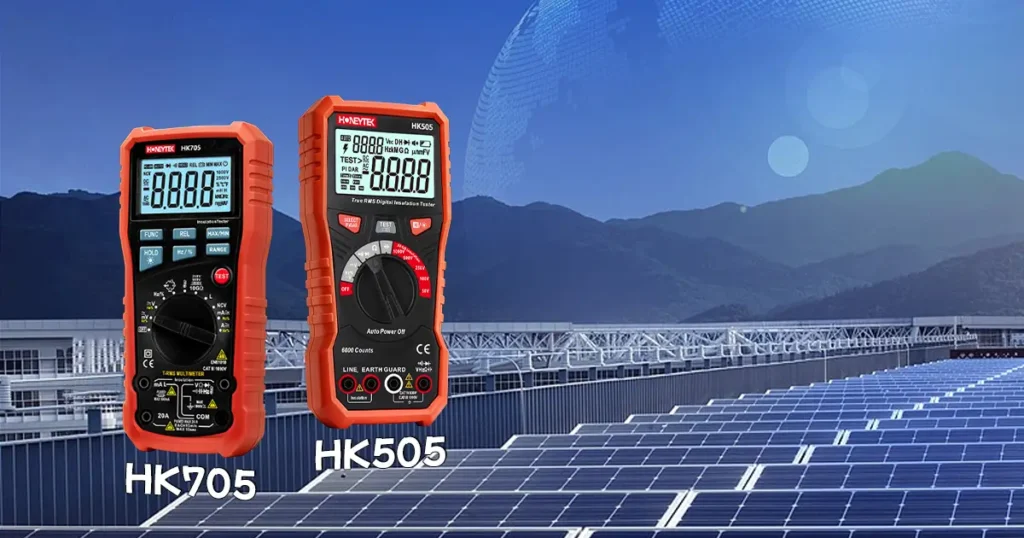
- HK505 (Analog/Digital Hybrid): Rugged design for quick “Go/No-Go” field testing. Simple interface for rapid deployment.
- HK4432C / HK4432D (Digital Precision): The professional choice. Features:
- Auto-Discharge: Safety feature to drain residual voltage.
- High Range: Measures up to gigohms (GΩ) for precise cable health tracking.
- Backlit Display: Essential for working in dark electrical cabinets.
- HK235A / HK235B (Voltage Detectors): Essential PPE to verify the system is dead before connecting leads.
7. FAQ: Frequently Asked Questions
Q1: Can I test insulation while the sun is shining?
A: Yes, but be careful. The PV modules are generating voltage. If using Method B (Separate Leg), you are connecting to a live voltage source. Ensure your insulation tester has “Live Circuit Protection” to prevent blowing the meter fuse. Honeytek testers warn users if external voltage is detected.
Q2: Why does the insulation resistance drop when it rains?
A: Water is conductive. If there is a tiny pinhole in a cable connector, water creates a path from the copper conductor to the grounded metal rack, lowering the resistance reading. If the reading recovers after the site dries, you have a moisture ingress issue.
Q3: Do I need to disconnect the SPD (Surge Protection Device) before testing?
A: Yes. If you apply 1000V to a circuit with a 600V SPD connected to ground, the SPD may clamp the voltage, giving you a false “short circuit” reading or potentially damaging the SPD.
Q4: How long should I hold the test button?
A: IEC standards recommend holding until the reading stabilizes. Usually, 5 to 10 seconds is sufficient for the capacitive charge to settle and provide an accurate resistance value.
Partner with Honeytek
Looking for Reliable Test Instruments?
Honeytek is a premier manufacturer of Digital Multimeters, Clamp Meters, and Insulation Testers. We combine precision engineering with rugged durability to serve electricians worldwide.
- Global Agents Wanted: Join our distribution network.
- OEM/ODM Services: We customize designs, colors, and branding to fit your market needs (e.g., Custom colors for HK4432 series).
[👉 Contact Our Sales Team for an OEM Quote]
[📥 Download the Full Solar Inspection Catalog]
You May Also Be Interested In:
- HK888D 6000 Count TRMS 2000A AC/DC Solar PV Clamp Meter
- HK78G 2000V TRMS Auto Range Digital Multimeter for PV solar
- HK4432A 6000 Counts Portable Insulation Tester
- HK4432B 6000 Counts 1250V Portable Insulation Tester
- HK4432C 6000 Counts 2500V Portable Insulation Tester
