
In the rapidly evolving solar industry, the shift from 1000V to 1500V DC systems has become the new standard for utility-scale projects. While this increases efficiency, it creates a dangerous gap in the toolkits of many technicians. Standard multimeters max out at 1000V. Using them on a 1500V string isn’t just inaccurate—it’s a catastrophic safety risk.
This guide outlines a professional “SOP” (Standard Operating Procedure) for inspecting PV modules and inverters, introducing Honeytek’s specialized high-voltage instrument suite designed to close that safety gap.
1. The Scenario: The “High-Noon” Fault
The Scene:
You are at a 50MW photovoltaic power station. It is 1:00 PM, ambient temperature is 40°C. The SCADA system reports that “Combiner Box #12” is underperforming by 40%, and there is a potential ground fault.
The Challenge:
- Voltage Limit: The array is a 1500V system. Your standard CAT III 600V meter cannot measure the open-circuit voltage (Voc) of the full string.
- Arc Flash Risk: You need to measure current in a crowded combiner box where breaking the circuit could cause a massive DC arc.
- Invisible Leaks: The cables look fine, but somewhere, insulation has degraded, causing leakage current to ground.
The Solution:
You need a “Solar-Grade” toolkit: A 2000V-rated Multimeter, a High-Current DC Clamp, and a Gigohmmeter.
2. The Solution: Honeytek Solar Inspection Series
To handle modern solar arrays, Honeytek has engineered a specific lineup of rugged, high-safety instruments.
Step 1: Initial Safety Check (Non-Contact)
Before touching any terminal, verify if the cabinet chassis is live.
- Tool: Honeytek HK235A / HK235B Voltage Detectors
- Action: Use these NCV (Non-Contact Voltage) pens to scan the inverter casing and combiner box door. High sensitivity ensures you detect stray voltage leaks before you even open the panel.
Step 2: String Voltage & Polarity (The 2000V Standard)
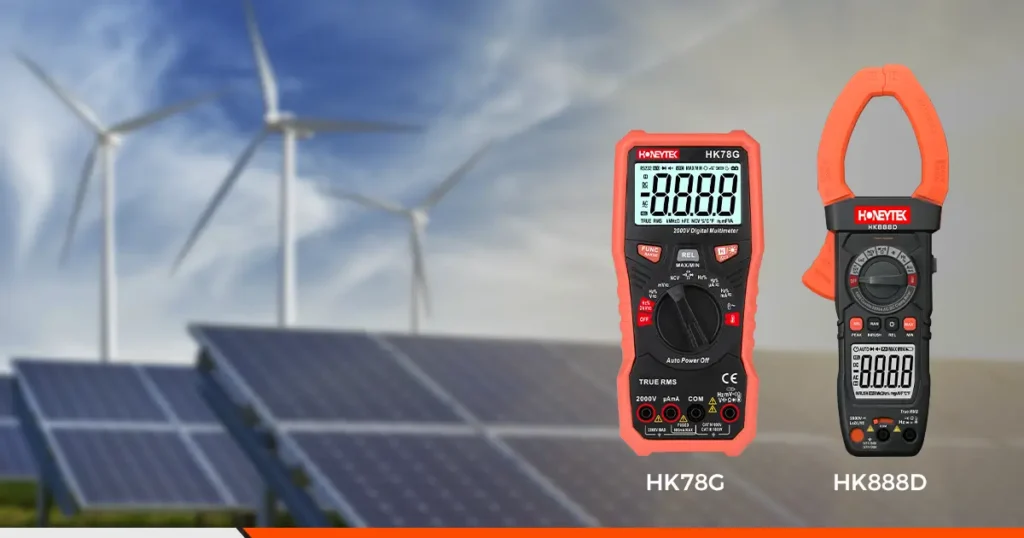
- Tool: Honeytek HK78G Digital Multimeter
- Why it wins: Unlike standard 1000V meters, the HK78G is engineered for 2000V DC measurement.
- The Check:
- Switch to DC Voltage.
- Measure Voc (Open Circuit Voltage) of the string.
- Observation: If the reading is negative, check for reverse polarity. If the reading is 0V, check for blown fuses. The HK78G handles the full 1500V+ load safely without blowing internal protection.
Step 3: Current Analysis (Non-Intrusive)
- Tool: Honeytek HK888D Solar PV Clamp Meter
- Why it wins: This is the flagship model. It features a massive Φ60.5mm jaw to fit around thick main feeder cables and is rated for 2000A AC/DC and 2000V AC/DC.
- The Check:
- Clamp around the positive DC cable.
- Compare the current (Amps) of String A vs. String B.
- Diagnosis: If String A is 8A and String B is 2A, the HK888D instantly highlights the underperforming string without you ever loosening a screw.
Step 4: Insulation Resistance (The Megger Test)
- Tool: Honeytek HK505 / HK4432C / HK4432D Insulation Testers
- The Check:
- Disconnect the PV string from the inverter (System must be dead).
- Connect one lead to the PV Positive/Negative and the other to Ground (Earth).
- Inject high voltage (e.g., 1000V/2500V test).
- Result: A reading below 1MΩ usually indicates damaged cable insulation or water ingress in the junction box.
3. Core Specification Comparison
(Designed for Quick Scanning)
| Feature | HK78G (PV Multimeter) | HK888D (PV Clamp Meter) | HK4432 Series (Insulation) |
| Primary Use | Voc Measurement & Continuity | High Current & Inverter Output | Cable Health & Leakage |
| Max DC Voltage | 2000V DC (Solar Ready) | 2000V DC | 1000V Measurement |
| Max Current | 600mA (Direct) | 2000A AC/DC (Clamp) | N/A |
| Safety Rating | CAT III 1000V / CAT IV 600V | CAT III 1500V / CAT IV 1000V | CAT III / CAT IV |
| Key Feature | True RMS, Auto Range | Inrush Current, LoZ Mode | High GΩ Range, PI/DAR |
4. Visual Guide: Operation Tips
5. Safety Tips: The “CAT Rating” Reality
For professional SEO visibility, safety compliance is key.
- Respect the CAT: Never use a CAT II meter on a PV combiner box. You are directly connected to the source of energy. Always use CAT III 1000V or CAT IV 600V rated tools like the HK78G.
- Lead Inspection: Before measuring 1500V, inspect your HK78G test leads. If the silicone is nicked or the finger guards are damaged, replace them immediately.
- The “Live-Dead-Live” Rule: Test your HK235A pen on a known live source, test the panel, then test the known source again to ensure the battery didn’t die during the test.
6. Conclusion & Call to Action
Solar maintenance is not about guessing; it’s about precision. Whether you are detecting a 0.5A drift in a string or verifying a 1500V open circuit, Honeytek provides the professional accuracy required to maximize energy yield.
From the pocket-sized HK235 voltage detector to the heavy-duty HK888D clamp meter, our tools are built for the harsh reality of the job site.
Partner with Honeytek
We are a leading manufacturer of Digital Multimeters and Clamp Meters.
Honeytek offers comprehensive OEM/ODM customization services. We are actively recruiting global agents and distributors to bring professional-grade test instruments to your local market.
- Custom Branding: Your Logo, Your Colors.
- Factory Direct: Competitive pricing for bulk orders.
- Global Standards: CE, RoHS, and CAT safety compliance.
👉 [Contact Us Today to Become a Distributor]
FAQ: Frequently Asked Questions
Q1: Why do I need the HK78G instead of a standard multimeter for solar?
A: Most standard multimeters are limited to 600V or 1000V. Modern commercial solar farms operate at 1500V. The HK78G is specifically designed to measure up to 2000V DC, preventing damage to the meter and ensuring user safety.
Q2: Can the HK888D clamp meter measure night-time leakage?
A: While the HK888D measures current, detecting minute insulation leakage is best done with an Insulation Tester like the HK4432C or HK4432D. These inject a voltage to measure the resistance of the cable sheathing to the ground.
Q3: What is the difference between HK235A and HK235B voltage pens?
A: Both are reliable NCV testers. Differences usually lie in sensitivity ranges (dual range vs single range) or alert types (vibration vs light). Both are essential for the initial “Safe-to-Touch” verification.
Q4: Does Honeytek offer ODM services for my tool brand?
A: Yes. We specialize in OEM/ODM. We can modify the housing, firmware, and packaging of instruments like the HK888D or HK78G to match your brand identity and market requirements.
You May Also Be Interested In:
- HK888D 6000 Count TRMS 2000A AC/DC Solar PV Clamp Meter
- HK78G 2000V TRMS Auto Range Digital Multimeter for PV solar
- HK4432A 6000 Counts Portable Insulation Tester
- HK4432B 6000 Counts 1250V Portable Insulation Tester
- HK4432C 6000 Counts 2500V Portable Insulation Tester
