
In modern industrial automation, the Variable Frequency Drive (VFD) is the heart of motion control. However, when a motor begins to vibrate or overheat, shutting down the production line for diagnostics is often not an option. Downtime costs money.
This guide details the technical challenges of measuring Pulse Width Modulation (PWM) signals and provides a tiered selection of Honeytek instruments designed to handle the complex harmonics of industrial environments safely.
1. The Scenario: A High-Pressure Environment
The Scene:
Imagine you are a maintenance engineer at a continuously running HVAC cooling plant or a plastic extrusion factory. It is 2:00 PM, the ambient temperature is hovering around 35°C (95°F), and the noise level is deafening.
The main cooling pump motor controlled by a VFD starts making an irregular “whining” noise. The control panel shows no error codes, yet the motor surface temperature is rising. The plant manager is standing next to you; shutting down the main breaker means halting the entire cooling process, potentially causing a system-wide thermal trip or ruining the material inside the extruder.
You need to measure the output voltage and frequency between the VFD and the motor while it is running to determine if a phase is unbalanced or if the carrier frequency is drifting. You open the cabinet. The VFD is outputting a complex PWM waveform at 480V. You have your multimeter in hand. This is the critical moment where the quality of your instrument determines whether you solve the problem or create a safety hazard.
2. The Challenge: Why “Standard” Meters Fail
Measuring the output of a VFD is not the same as measuring standard 50/60Hz mains electricity. Here is why generic multimeters often provide false readings or fail completely in this scenario:
- The PWM Problem: VFDs do not output a pure sine wave. They output high-voltage pulses (Pulse Width Modulation). A standard averaging multimeter will read these high-frequency pulses as erratic voltage spikes, giving you ghost readings (e.g., showing 600V when the effective voltage is 380V).
- High-Frequency Noise: The switching frequency of the inverter creates harmonic noise that interferes with the measurement circuit of non-shielded meters.
- Safety Risks (Arc Flash): Measuring live VFD terminals puts you in a high-energy environment. If a meter does not have the correct fuse protection or spacing (Creepage and Clearance), a transient spike could trigger a catastrophic arc flash.
To solve this, you need a multimeter with True RMS (Root Mean Square) capabilities and, ideally, a Low-Pass Filter (LPF/V.F.C) to block high-frequency noise and measure the fundamental frequency driving the motor.
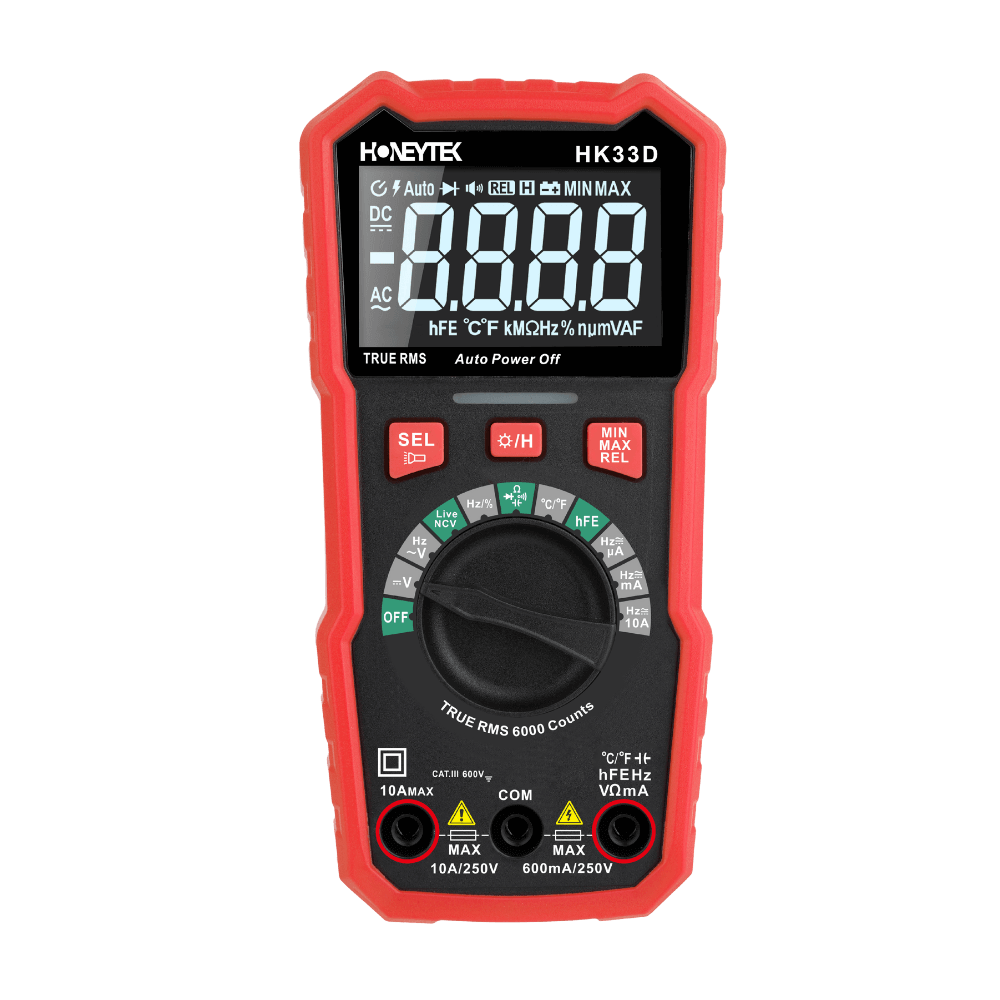
3. The Solution: Honeytek Measurement Series
To troubleshoot live VFDs accurately, Honeytek offers a range of multimeters tailored to different skill levels and precision requirements.
Selection Guide: From Apprentice to Expert
For Beginners / General Maintenance (HK33D, HK78B+)
Best for: Input power checks and basic continuity testing.
If you are checking the mains input (pure sine wave) going into the VFD or checking fuses, these models are robust and cost-effective.
- HK33D: Compact, pocket-sized. Ideal for quick continuity checks and battery testing.
- HK78B+: Adds manual ranging reliability. Good for verifying that 220V/110V control signals are present.
For Upgraded Maintenance (HK78N, HK88B)
Best for: Routine inspection and intermediate diagnostics.
These models introduce True RMS, which is essential for accurate AC measurements in non-linear loads typical of industrial cabinets.
- HK78N: Auto-ranging with a durable protective holster. Features a backlit screen for dark electrical cabinets.
- HK88B: Enhanced precision with a wider capacitance range, allowing you to check start capacitors alongside voltage checks.
For Professionals / VFD Specialists (HK88C, HK78BT)
Best for: VFD Output measurement, data logging, and complex harmonics.
These are the flagship models designed for the scenario described above.
- HK88C: High-precision True RMS with frequency measurement. It handles the noisy electrical environment of a running VFD without fluctuating readings.
- HK78BT (Bluetooth): The safest choice for live testing. You can clamp or probe the terminals, close the cabinet door, and view the data remotely on your smartphone via the Honeytek App. This removes the technician from the “Arc Blast Zone.”

Core Specification Comparison
| Feature | HK33D / HK78B+ | HK78N / HK88B | HK88C / HK78BT |
| User Level | Apprentice / Basic | Technician | Professional Engineer |
| True RMS | No | Yes | Yes (High Bandwidth) |
| VFD Suitability | Input Side Only | Input & Control | Input & Output |
| Safety Rating | CAT II 600V | CAT III 600V | CAT III 1000V / CAT IV 600V |
| Key Advantage | Compact & Low Cost | Auto-Ranging & Backlight | Bluetooth & Frequency |
Visual Guide: Live Testing Operation
(Placeholder for Visuals – Recommended for SEO)
[GIF INSERTION: Selecting the ‘Hz/%’ button on HK88C to switch from Voltage to Frequency]Caption: Switch to Frequency mode to verify the VFD is outputting the commanded speed (e.g., 45Hz).
[VIDEO INSERTION: Connecting HK78BT via Bluetooth]Caption: Using the HK78BT allows you to monitor voltage fluctuations on your phone while standing 5 meters away from the live cabinet.
Safety Tips: The “Life-Saving” Standard
In professional search results, safety compliance is a major ranking factor.
- Check the Category: Never use a CAT II meter on a VFD main bus. Industrial VFDs are typically connected to the mains with high short-circuit current availability. Always use Honeytek models rated CAT III 600V or CAT IV 600V (like the HK88C).
- Inspect Probes: Before touching live terminals, inspect your test leads. If the insulation is damaged or the metal tip is exposed more than 4mm (GS38 standard), replace them immediately.
- Three-Point Test: Test a known live source, test your target, then test the known source again to ensure the meter didn’t fail during measurement.
Conclusion
Troubleshooting a live VFD requires more than just bravery; it requires the right instrumentation. While the HK33D is perfect for your tool bag’s “everyday carry,” diagnosing complex PWM output faults requires the True RMS precision of the HK88C or the wireless safety of the HK78BT.
FAQ: Frequently Asked Questions
Q1: Why does my multimeter show a different voltage than the VFD display?
A: The VFD display shows the commanded voltage. A standard multimeter reads the raw PWM pulses and average voltage, which is often inaccurate. Using a True RMS Honeytek meter (like the HK88C) will provide a reading much closer to the effective voltage powering the motor.
Q2: Can I use the HK33D to measure the output of a VFD?
A: It is not recommended. The HK33D is excellent for DC control signals and checking input mains power. However, the high-frequency switching at the VFD output requires a higher bandwidth meter like the HK88 series to avoid damage to the meter or incorrect readings.
Q3: What is the advantage of the HK78BT Bluetooth function?
A: Safety. In Arc Flash boundary zones, distance is your best protection. You can connect the leads, step back, and monitor the startup current or voltage sag on your phone without standing directly in front of the cabinet.
Q4: What is the difference between measuring DC and AC on a VFD?
A: You measure AC at the input (L1/L2/L3) and output (U/V/W) terminals. You measure DC at the “DC Bus” terminals (often labeled PA/+ and -). The DC Bus voltage is critical for diagnosing capacitor health (usually 1.414 x Input AC Voltage).
You can may like these products:
