
Introduction: Why Overvoltage Categories Matter
When working with electrical measurement instruments—such as multimeters, clamp meters, oscilloscopes, and test leads—it’s not enough to know just the measurement range. Another critical safety specification is the overvoltage category (CAT rating), defined by the IEC (International Electrotechnical Commission).
The CAT rating tells you how much transient overvoltage (surge energy) a device can safely withstand in a given electrical environment. Choosing a tool with the wrong category rating may not just cause equipment failure—it can lead to arcing, fire, or personal injury.
In this guide, we’ll explain what CAT I, CAT II, CAT III, and CAT IV ratings mean, how they apply in real-world scenarios, and how to select the right measurement tool for your application.

What is CAT (Overvoltage Category)?
CAT stands for Overvoltage Category, an IEC-defined classification that indicates the expected transient overvoltages in different parts of an electrical installation.
Key points about CAT ratings:
- It is not the same as voltage range—a 1000 V CAT II meter is not automatically safe for 1000 V CAT III.
- It defines the level of surge energy the device can handle safely.
- It ensures measurement tools are matched to the environment where they are used.
Why is this important?
Electrical installations are exposed to switching surges, lightning strikes, and faults. The closer a device is to the power source (utility lines, transformers, service entrances), the higher the surge energy it may encounter. A mismatched CAT rating increases the risk of catastrophic failure and operator injury.

Overview of CAT I, CAT II, CAT III, and CAT IV
CAT I – Internal Circuits (Lowest Surge Energy)
- Definition: For circuits not directly connected to the mains, such as protected electronic devices or signal-level circuits.
- Examples:
- Electronic sensors
- Circuit board measurements
- Low-voltage DC rails
- Component leads
- Transient energy: Lowest among all categories.
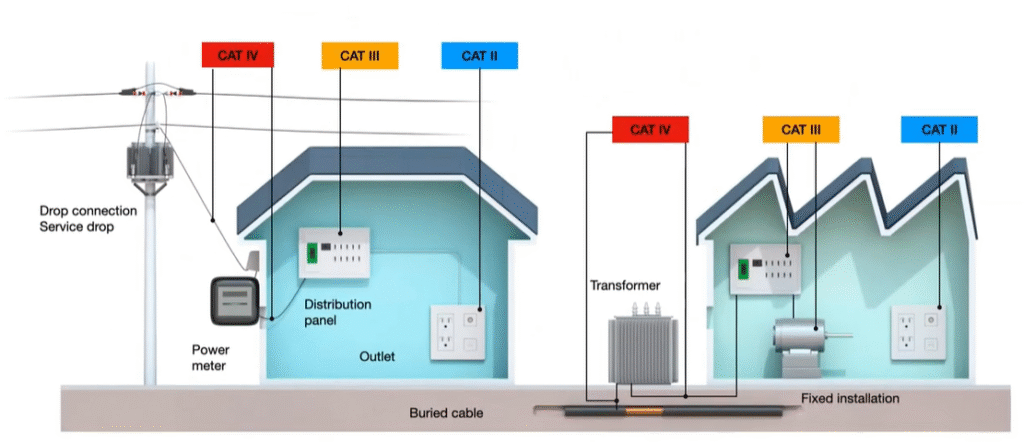
CAT II – Local Power Outlets & Appliances
- Definition: For loads connected directly to low-voltage sockets and plug-in devices.
- Examples:
- Household appliances (TVs, computers, refrigerators)
- Portable tools plugged into wall outlets
- Testing at receptacles (AC mains outlets)
- Transient energy: Medium surges from switching loads or small lightning-induced disturbances.
CAT III – Fixed Building Installation
- Definition: For fixed distribution systems inside buildings, where fault currents and surge energy are higher.
- Examples:
- Distribution panels and feeders
- Circuit breakers and wiring
- Three-phase motors
- Permanently installed equipment
- Transient energy: Higher surges due to switching of inductive loads and nearby lightning strikes.
CAT IV – Utility Connections (Highest Surge Energy)
- Definition: For the origin of installation, closest to the utility supply.
- Examples:
- Service entrances (main breakers, utility meters)
- Outdoor conductors (overhead or underground lines)
- Pole-to-building connections
- Transient energy: Highest, as these points can experience direct lightning surges and major fault currents.
Voltage Ratings in Overvoltage Categories
Each CAT category also has a voltage-withstand rating (impulse test voltage, Uimp) defined by IEC 61010. These represent the surge the equipment must handle safely for its environment.
| Nominal System Voltage | CAT I | CAT II | CAT III | CAT IV |
|---|---|---|---|---|
| ≤ 150 V | 0.8 kV | 1.5 kV | 2.5 kV | 4.0 kV |
| ≤ 300 V | 1.5 kV | 2.5 kV | 4.0 kV | 6.0 kV |
| ≤ 600 V | 2.5 kV | 4.0 kV | 6.0 kV | 8.0 kV |
| ≤ 1000 V | 4.0 kV | 6.0 kV | 8.0 kV | 12.0 kV |
Example: If a multimeter is labeled “600 V CAT III, 1000 V CAT II”:
- It is safe to use on circuits up to 600 V in a CAT III environment (distribution panels).
- It is safe to use on circuits up to 1000 V in a CAT II environment (wall outlets).
How to Select the Right CAT Rating
When selecting a measurement tool, consider:
- Application Environment
- CAT II: Sockets, plug-in appliances
- CAT III: Distribution panels, motors, wiring inside buildings
- CAT IV: Service entrances, outdoor lines
- Nominal Voltage of the Circuit
- Match the tool’s rated voltage to the system voltage.
- Example: 600 V CAT III is safer than 1000 V CAT II for panel measurements.
- Altitude & Pollution Degree
- Higher altitude reduces air insulation strength → derating may be needed.
- Harsh environments (dust, moisture) require greater creepage/clearance distances.
- Accessories Compatibility
- Test leads, probes, and clips must match or exceed the CAT rating of the instrument.
- Best practice: Choose accessories one level higher than the instrument.
Practical Examples
- Measuring outlet voltage at home: 300 V CAT II multimeter is sufficient.
- Checking motor wiring in an industrial facility: 600 V CAT III instrument recommended.
- Testing utility incoming line or energy meter: Requires CAT IV 600–1000 V tools.
- Circuit board debugging: CAT I probes are acceptable.
Common Misconceptions About CAT Ratings
- CAT ≠ Measurement Range: The voltage range determines how high a circuit you can measure, but the CAT rating defines how much transient surge it can survive.
- Higher CAT = Always Better? Not necessarily—while higher CAT provides better surge protection, it may also increase size, cost, or reduce sensitivity in certain instruments.
- One Tool for All Applications? It’s best to have multiple instruments, each optimized for specific categories.
FAQ: Overvoltage Categories (CAT Ratings)
Q1: Why can’t I just use a CAT I meter for everything?
Because CAT I instruments cannot withstand the surge energy present in real-world electrical systems like outlets or panels. This could cause catastrophic failure.
Q2: What’s the safest choice for general electricians?
A 600 V CAT III / 1000 V CAT II multimeter is a practical choice for most residential and commercial applications.
Q3: How do I know the CAT rating of my instrument?
It is usually printed near the input terminals or in the technical specifications of the instrument.
Q4: Does CAT IV mean it’s “better” than CAT III?
Not exactly—it means it’s rated for higher surge environments. You should match the category to the location where you are measuring.
Q5: Do test leads need the same CAT rating?
Yes. Using low-rated probes with a high-CAT meter can create a dangerous mismatch. Always ensure leads and accessories meet or exceed the instrument’s CAT rating.
Conclusion
Understanding CAT I, CAT II, CAT III, and CAT IV ratings is essential for electrical safety. These categories are not about how much voltage your instrument can measure but how much surge energy it can safely handle in a specific environment.
- CAT I: Internal electronics, low energy.
- CAT II: Plug-in devices and outlets.
- CAT III: Distribution systems, motors, building wiring.
- CAT IV: Service entrances and utility connections.
Choosing the right category rating helps prevent accidents, equipment failure, and ensures compliance with IEC standards.
At Honeytek, we design and manufacture high-quality electronic measurement tools with certified CAT ratings to ensure maximum safety and reliability for engineers, electricians, and technicians worldwide.
👉 Explore our latest multimeters, clamp meters, and test accessories built for CAT II, CAT III, and CAT IV applications at Honeytek Official Website
