
From commissioning to troubleshooting, accurate electrical measurement directly affects:
- system safety
- installation efficiency
- fault detection speed
- long-term system reliability
However, many field issues are not caused by complex equipment failures — but by incorrect measurement methods.
Based on real PV installation scenarios, the following five multimeter measurement techniques cover nearly all high-frequency operations at solar project sites and can significantly improve safety and diagnostic accuracy.
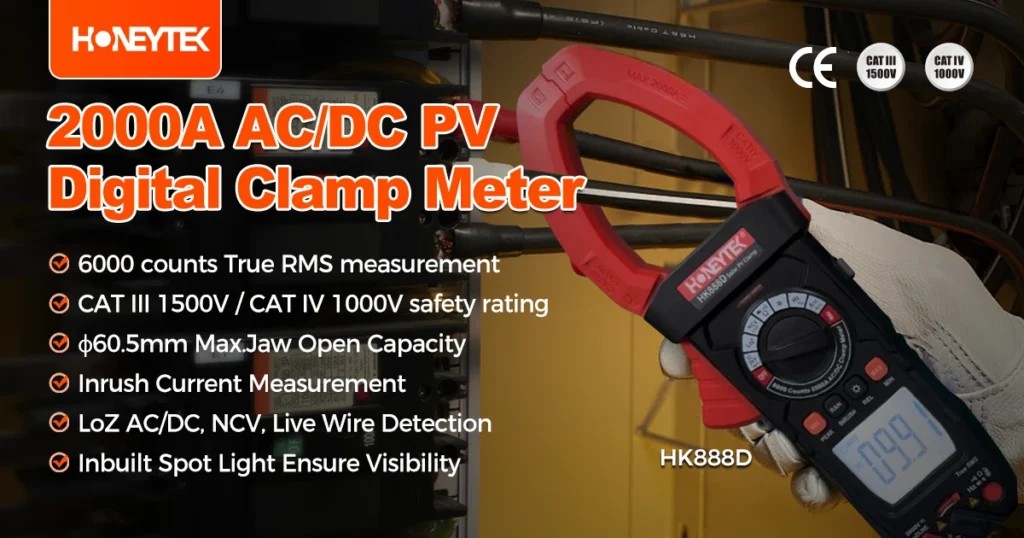
🔧 Tip 1: Always Select the Correct High-Voltage DC Range
PV string open-circuit voltage can easily reach:
- 600 V
- 1000 V
- up to 1500 V DC in modern utility systems
Before measuring, confirm that:
- the multimeter supports DC 1000 V or 1500 V
- safety rating meets CAT III or CAT IV
- test leads are rated equal to or higher than system voltage
Best practice:
Always start from the maximum DC voltage range, then gradually step down to a suitable measurement range.
This prevents:
- over-voltage damage
- insulation breakdown
- probe arcing
Example:
12 modules × 40 V Voc ≈ 480 V
→ Use a meter rated at 600 V DC or higher, ideally with high-voltage probes.
Tip 2: Measure Open-Circuit Voltage (Voc) to Detect String Loss
Under good sunlight conditions (≈1000 W/m²):
- Set multimeter to DC voltage
- Red probe → positive terminal
- Black probe → negative terminal
The measured value equals open-circuit voltage (Voc).
Diagnostic reference:
- Single module Voc deviation should stay within ±5% of nameplate value.
Fault indication:
If a string designed for 800 V measures only 600 V, possible causes include:
- missing module
- reversed polarity
- faulty bypass diode
- loose connectors
Segment-by-segment voltage testing quickly identifies the fault location.
Tip 3: Measure Short-Circuit Current (Isc) to Evaluate Output Capability
Short-circuit current reflects real photovoltaic performance.
Measurement method:
- Switch multimeter to DC current mode
- Insert probes into correct current terminals
- Connect meter in series with the module terminals
- Select a current range higher than rated Isc
⚠️ Important safety note
For large PV strings or high-current systems:
- do NOT measure directly using a standard multimeter
- use a DC clamp meter or professional PV tester
Incorrect current measurement may permanently damage the meter.
Interpretation:
If measured Isc is significantly lower than the datasheet value (under similar irradiance):
Possible issues include:
- shading
- dust accumulation
- micro-cracks
- hot spots
- cell degradation
This makes Isc testing an effective first-level screening method.
Tip 4: Estimate Power Output and Module Degradation
Under near-STC conditions:
- Irradiance ≈ 1000 W/m²
- Cell temperature ≈ 25°C
You can estimate output performance using:Pmax≈Vmp×Imp
By comparing measured electrical values with nameplate specifications, installers can determine whether:
- modules are underperforming
- degradation exceeds acceptable range
- system losses are abnormal
If output remains consistently below specification after eliminating shading and temperature factors, further inspection is required.
Tip 5: Follow Strict Safety Checks Before and After Measurement
Before testing:
- Confirm probe terminals (voltage vs current)
- Verify DC / AC selection
- Select correct range
- Never switch ranges while energized
During testing:
- Never touch exposed metal probe tips
- Use insulated gloves when required
- Use probes rated for system voltage
- Pay extra attention on inverter DC input side
After testing:
- Return probes from current port back to voltage port
- Reset dial to voltage or resistance mode
Many severe arc faults occur simply because the user forgot the meter was still in current mode.
Good habits prevent serious accidents.
Why Professional Measurement Tools Matter
Solar systems continue to evolve toward:
- higher voltage
- higher current
- longer service life
This demands measurement instruments with:
- high DC accuracy
- stable insulation performance
- reliable over-voltage protection
- long-term calibration stability
Using non-certified tools in PV environments increases both safety and liability risk.
About Honeytek
Honeytek is a professional manufacturer of:
- Digital multimeters
- DC clamp meters
- Electrical testing instruments
Designed for applications including:
- solar PV installation
- electrical maintenance
- energy storage systems
- industrial diagnostics
Honeytek advantages:
- High-voltage DC measurement support
- Stable accuracy under harsh environments
- OEM / ODM customization available
- Support for global distributors and agents
- Factory-direct supply
We focus on providing reliable tools installers can trust in real field conditions.
Frequently Asked Questions (FAQ)
Q1: Can a normal multimeter measure PV string voltage?
Only if the meter supports sufficient DC voltage rating (1000 V or 1500 V) and proper CAT safety classification.
Q2: Can I use a standard multimeter to measure PV string current?
No. High-current strings must be measured using a DC clamp meter or PV tester to avoid meter damage.
Q3: What CAT rating is recommended for solar PV work?
At least CAT III, and preferably CAT IV for outdoor and inverter-side measurements.
Q4: Why does measured voltage differ from the datasheet value?
Differences are commonly caused by:
- irradiance variation
- temperature rise
- partial shading
- module aging
A ±5% variation is generally acceptable.
Q5: Does Honeytek support private label or OEM projects?
Yes. Honeytek provides full OEM / ODM services, including branding, firmware configuration, housing customization, and packaging design.
Q6: Is Honeytek looking for overseas distributors?
Yes. We welcome global agents and distributors interested in professional electrical testing instruments.
