
A motor starts, the lights flicker, and the circuit breaker trips—even though the equipment’s running current looks normal. For HVAC technicians and industrial maintenance teams, this can be a frustrating fault to diagnose.
The cause may be inrush current: the brief surge drawn when equipment starts. Measuring startup current can help you distinguish normal starting behavior from issues such as a failing motor, a supply problem, or an incorrectly selected protective device.
What Is Inrush Current, and Why Can It Trip a Breaker?
Inrush current is the short-duration current drawn when equipment is switched on. Induction motors, transformers, and HVAC compressors can draw several times their normal operating current during startup. The amount and duration depend on the equipment design, load, supply conditions, and starting method.
A breaker responds according to its rating and trip characteristics. A brief surge may be normal, but repeated trips can indicate that the startup current is too high or lasts too long for the installed protection—or that another fault is present. Compare measured current with the equipment specifications and the breaker’s time-current curve; a single reading alone does not establish the cause.
A standard current reading may miss this brief event. Use a clamp meter with a dedicated inrush function to capture startup current. True RMS capability can also help provide meaningful AC readings when current waveforms are not sinusoidal, subject to the instrument’s specifications.
How to Measure Inrush Current with a Clamp Meter
Follow the meter’s manual and your site’s electrical safety procedures. Work around energized equipment only if you are qualified and authorized to do so.
- Select the correct measurement mode. Set the clamp meter to AC current and activate its inrush function as directed by the manufacturer. On a three-phase system, choose the phase to measure and follow the meter’s instructions.
- Clamp around one conductor. Place the jaw around a single phase conductor or line conductor. Clamping around both the outgoing and return conductors can cause their magnetic fields to cancel, producing a misleading reading. Keep the conductor centered in the jaw where practical.
- Prepare for startup. Position the clamp securely before starting the equipment, keeping clear of moving parts and exposed live components. Follow the meter’s specified measurement range and operating procedure.
- Start the equipment and capture the reading. Activate the motor or compressor. The inrush function is designed to capture a brief startup-current value; the exact measurement window and display behavior vary by meter. Record the result along with equipment, supply, and operating conditions.
- Interpret the measurement in context. Compare the reading with the equipment’s nameplate or service data, expected starting characteristics, and the breaker’s trip curve. If the reading is unexpectedly high, investigate the motor or compressor, mechanical load, supply voltage, wiring, starting components, and protective device selection. Do not change breaker ratings without verifying conductor protection and applicable electrical requirements.
HVAC, Industrial Motors, and Compressor Diagnostics
HVAC and refrigeration
A compressor that struggles to start may draw elevated current or remain in its startup condition longer than expected. Inrush measurement can help identify an abnormal starting event, but it should be considered alongside supply voltage, capacitor condition where applicable, wiring, and manufacturer troubleshooting procedures.
Industrial motors and automation
Large motors can create substantial startup demand. When several loads start close together, the combined demand may contribute to voltage sag or nuisance trips. Measure startup current under controlled conditions and compare it with the system design and motor documentation.
Transformers and other inductive loads
Transformers and other inductive equipment can also draw a brief current surge when energized. Use the equipment manufacturer’s specifications and the protective device’s trip characteristics to judge whether a measured event is expected.
Choosing a Clamp Meter for Inrush Diagnostics
For field troubleshooting, check that the meter’s functions match the work:
- Inrush-current measurement for capturing startup events.
- Suitable AC current range for the expected load, with adequate headroom.
- True RMS measurement for AC measurements on non-sinusoidal waveforms, within the instrument’s stated limits.
- Peak or maximum hold, if useful for your diagnostic method; peak hold and inrush measurement are related but not necessarily the same function.
- Readable display and backlight for visibility in dim equipment rooms.
- Appropriate safety ratings for the installation category and voltage where measurements will be made.
Honeytek HK689E for Startup-Current Troubleshooting
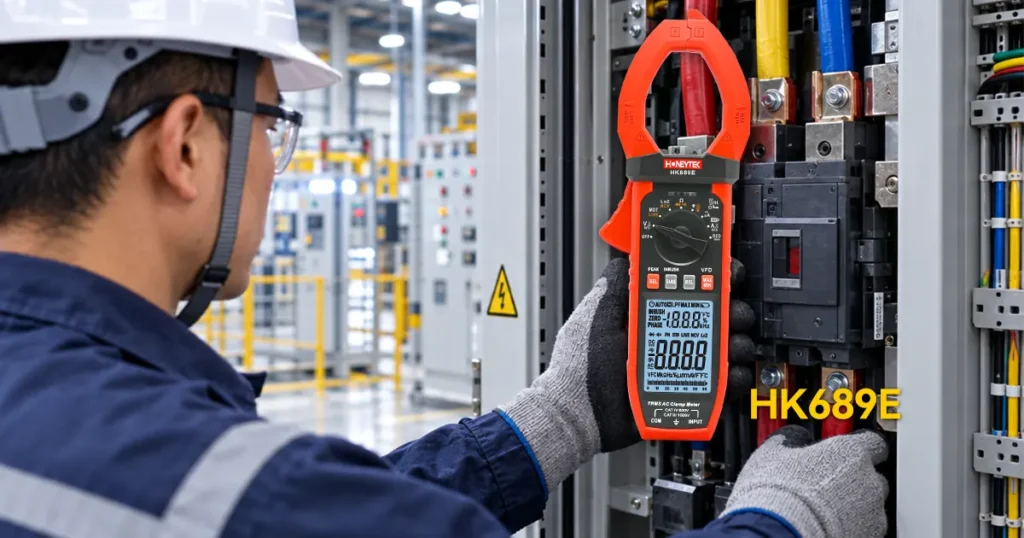
The Honeytek HK689E 1000A True RMS AC/DC clamp meter includes inrush-current testing and peak hold, along with AC/DC current measurement up to 1000 A, VFD mode, and a backlit EBTN display. These features support motor, drive, HVAC, and general electrical maintenance tasks. Confirm the model’s manual and specifications are appropriate for your specific measurement.
Honeytek is a manufacturer and supports OEM/ODM customization for qualified projects. Options may include logo printing, packaging design, and adjustments to parameters, functions, or display options, subject to requirements and order details. Contact Honeytek to discuss your application and customization needs.
Conclusion
Inrush-current measurement gives maintenance teams a clearer view of what happens during startup—an event that a steady running-current reading can miss. Capture the reading with a suitable clamp meter, then evaluate it alongside equipment specifications, supply conditions, and the breaker’s trip curve to guide further troubleshooting.
For inrush testing and broader AC/DC maintenance work, see the Honeytek HK689E product details or contact Honeytek about OEM/ODM customization.
