
About the Author
Liu Gang — Product Quality Director at Honeytek, 16 years specializing in test and measurement instrumentation. Certified per IEC 61010 and IEC 61557 standards. Oversees the design, calibration, and compliance verification for Honeytek’s entire insulation tester product line. Has personally validated >800 instruments across manufacturing, power utility, and industrial maintenance applications.
Technically reviewed by Chen Wei — Senior Electrical Engineer, Honeytek. IEC 61010 certified. 14 years specializing in electrical safety compliance and digital instrument calibration.
Key Takeaway: The Honeytek HK4432 series of digital insulation resistance testers addresses a fundamental gap in the mid-range electrical testing market: accessible instruments that combine high-voltage test capability (100V–2500V, depending on model), wide measurement range (up to 200GΩ), DAR/PI automatic calculation, and CAT III 600V safety in a single handheld device. Three models — HK4432A (routine maintenance), HK4432B (precision verification with adjustable output voltage), and HK4432C (high-voltage equipment with 2500V test capability) — cover the full spectrum of insulation testing from appliance safety checks to transformer preventive maintenance.
Why Insulation Resistance Testing Matters — and Why a Multimeter Cannot Replace It
Electrical insulation degrades. Moisture ingress, thermal cycling, mechanical vibration, and chemical exposure all take their toll over months and years of operation. The failure mode is silent: a motor that ran perfectly yesterday can develop a winding-to-ground short tomorrow. A cable that passed visual inspection can arc under load because its insulation has micro-fractures invisible to the naked eye.
The multimeter limitation: A standard digital multimeter measures resistance using a test voltage of approximately 3V–9V from its internal battery. This low voltage cannot stress insulation to its working level. A cable with severely degraded insulation might still read “infinite” on a 9V multimeter — and then fail catastrophically at 480V under load. This is why IEC 60364, IEEE 43, and national electrical codes in every major market specifically mandate megohmmeter testing for insulation verification.
An insulation resistance tester — historically called a “megger” or hand-cranked “megohmmeter” — applies a known high DC voltage to the circuit under test and measures the resulting leakage current. Ohm’s law then gives the insulation resistance: higher resistance = better insulation. Modern digital instruments like the HK4432 series automate this process, adding DAR (Dielectric Absorption Ratio) and PI (Polarization Index) calculations that provide insight into insulation quality beyond a single resistance value.
HK4432 Series Overview: One Platform, Three Capability Levels
The HK4432 series shares a common hardware platform — 6000-count digital display, auto/manual dual-mode ranging, True RMS, data hold, backlight, automatic power-off, low-battery indicator, and a built-in rechargeable lithium battery with charging port. The three models are differentiated by test voltage range and maximum measurable resistance:
| Model | Test Voltages | Max Resistance | Key Differentiator | Target User |
|---|---|---|---|---|
| HK4432A | 100V / 250V / 500V / 1000V | 100 GΩ | Fixed voltage outputs | Facility maintenance, appliance testing |
| HK4432B | 100V / 250V / 500V / 1000V | 100 GΩ | Adjustable output voltage per range | Commissioning, quality inspection |
| HK4432C | 100V / 250V / 500V / 1000V / 2500V | 200 GΩ | 2500V test voltage + 200GΩ range | Transformer, cable, MV equipment |
All three models share these core specifications:
- Accuracy: ±(3%+3d) for insulation resistance measurement
- Display: 6000-count backlit LCD
- Ranging: Automatic and manual modes
- Safety: CAT III 600V per IEC 61010
- Functions: DAR, PI, True RMS AC voltage, data hold
- Power: Built-in rechargeable lithium battery with charging port
- Protection: Auto power-off, low battery warning
Model-by-Model Deep Dive
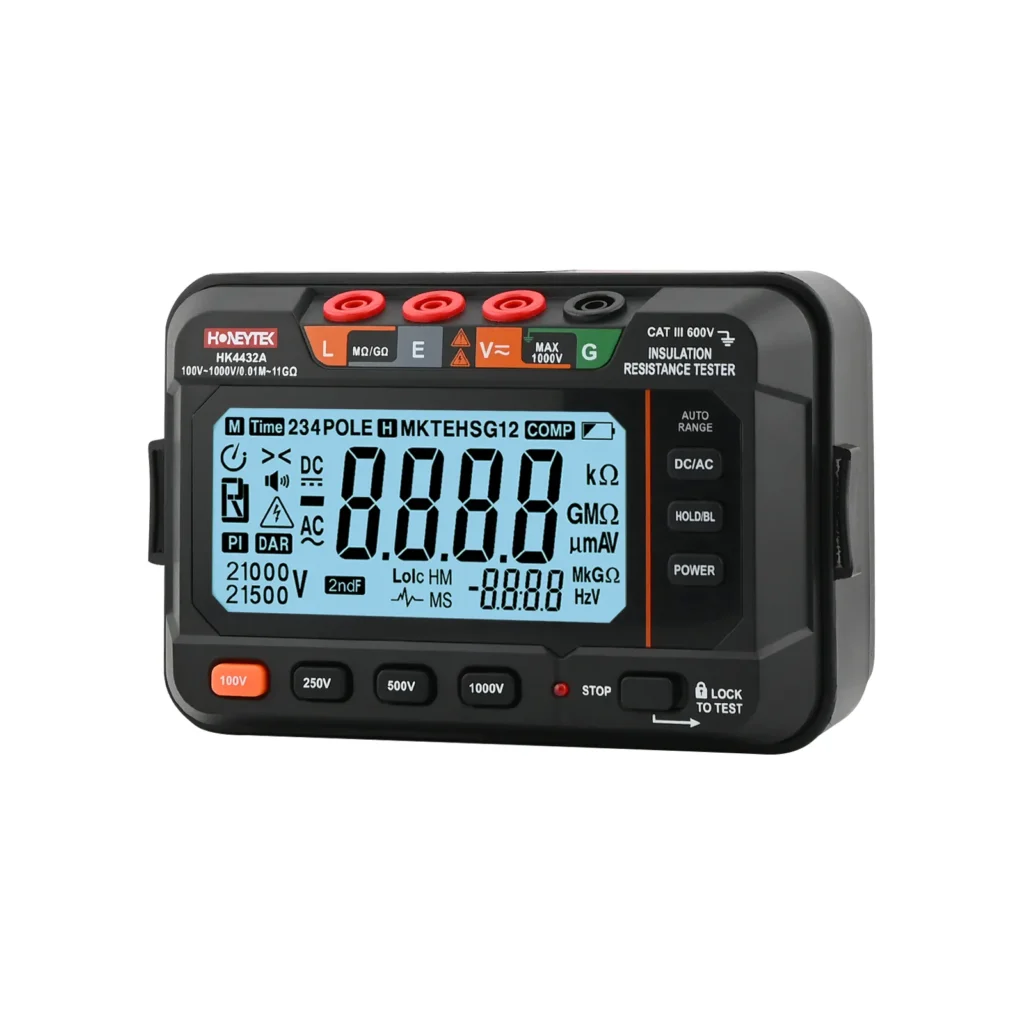
HK4432A — The Daily Driver for Routine Maintenance
The HK4432A’s four fixed test voltages (100V, 250V, 500V, 1000V) cover the vast majority of low-voltage electrical maintenance scenarios. Measuring up to 100GΩ, it handles everything from appliance safety checks to motor winding diagnostics.
For a facility maintenance team managing dozens of motors, pumps, and HVAC units, the HK4432A’s workflow is straightforward: select the test voltage matching the equipment’s rated voltage, connect the probes, start the test, and read the result. The auto-ranging display eliminates the need to estimate expected values, and the data hold function captures readings for documentation.
Typical users: Facility electricians, property maintenance teams, appliance repair technicians, HVAC service providers.
HK4432B — Precision Adjustability for Commissioning and QA
The HK4432B’s defining feature is adjustable output voltage on each test range. For example, on the 500V range, you can fine-tune the output to 400V, 450V, 500V, 550V, or 600V. This granularity serves a specific professional need: testing insulation performance at both rated voltage and at the upper tolerance limit.
In new cable commissioning, standards often require testing at both the nominal system voltage and at a 10–20% higher voltage to verify safety margin. With a fixed-voltage tester, you need two instruments or a more expensive variable supply. The HK4432B handles it in one unit. Similarly, quality inspection teams use the adjustable output to characterize insulation behavior across a voltage sweep — identifying weaknesses that only manifest near the breakdown threshold.
Typical users: Cable commissioning engineers, quality assurance teams, electrical testing laboratories, R&D departments.

HK4432C — High-Voltage Capability for Critical Equipment
The HK4432C adds a 2500V test voltage range and extends the maximum measurable resistance to 200GΩ. These capabilities are essential for testing equipment rated above 1000V — distribution transformers, medium-voltage switchgear, 10kV and 35kV class cables, and large industrial motors above 500kW.
In a utility substation or an industrial plant, preventive maintenance on a 10kV transformer requires a 2500V insulation resistance test, with DAR and PI values calculated to assess insulation aging. The 200GΩ upper limit provides headroom even for large, well-insulated transformers where a 100GΩ meter might saturate. The extended range also supports trend tracking: a transformer that reads 150GΩ today versus 180GΩ six months ago is showing measurable degradation — even though both values are far above minimum thresholds.
Typical users: Utility maintenance crews, industrial plant electrical engineers, transformer service companies, data center facility managers.
Test Voltage Selection Guide: What Voltage for What Equipment?
Selecting the appropriate test voltage is critical. Too low, and you will not stress the insulation sufficiently to reveal developing faults. Too high, and you risk damaging voltage-sensitive components. These are the widely accepted guidelines per IEEE 43, IEC 60364, and industry practice:
| Test Voltage | Equipment Type | Examples | Recommended Model |
|---|---|---|---|
| 100V–250V | Telecom, control circuits | Telecom cables, PLC I/O, instrument wiring | HK4432A |
| 500V | Low-voltage equipment (220V–480V) | Motors, pumps, appliances, LV switchgear | HK4432A / B |
| 1000V | 600V-class equipment, LV cables | Chillers, LV distribution cables, VFD-fed motors | HK4432A / B |
| 2500V | Medium-voltage equipment (>1kV) | Transformers, MV cables, switchgear, large motors | HK4432C |
Complete Specifications Comparison
| Specification | HK4432A | HK4432B | HK4432C |
|---|---|---|---|
| Display Count | 6000 | 6000 | 6000 |
| Test Voltages | 100/250/500/1000V | 100/250/500/1000V + adjustable | 100/250/500/1000/2500V |
| Insulation Resistance Range | 0.01MΩ ~ 100GΩ | 0.01MΩ ~ 100GΩ | 0.01MΩ ~ 200GΩ |
| Accuracy (Insulation) | ±(3%+3d) | ±(3%+3d) | ±(3%+3d) |
| DAR / PI Function | Yes | Yes | Yes |
| True RMS AC Voltage | Yes | Yes | Yes |
| Ranging | Auto / Manual | Auto / Manual | Auto / Manual |
| Safety Rating | CAT III 600V | CAT III 600V | CAT III 600V |
| Power | Rechargeable Li-ion | Rechargeable Li-ion | Rechargeable Li-ion |
| Backlight | Yes | Yes | Yes |
| Data Hold | Yes | Yes | Yes |
| Auto Power-Off | Yes | Yes | Yes |
Three Field-Testing Scenarios from Our Validation Program
Scenario 1: Motor Preventive Maintenance (HK4432A)
A 380V, 55kW pump motor undergoes quarterly insulation testing as part of a facility PM program. The technician uses the HK4432A’s 500V range. Phase-to-ground reading: 85MΩ — well above the 1MΩ minimum. Six months later, same test: reading has dropped to 12MΩ. The trend triggers further investigation: inspection reveals moisture ingress through a worn shaft seal. The motor is dried and resealed during a scheduled shutdown, avoiding an unplanned failure that would have stopped the production line. Key lesson: the trend matters more than any single reading.
Scenario 2: New Cable Commissioning (HK4432B)
A newly installed 600V feeder cable must pass commissioning tests before energization. The testing engineer uses the HK4432B to measure insulation resistance at 500V (standard) and 600V (upper limit). Standard test: 2.3GΩ, well above the minimum. Upper limit test: 1.1GΩ — still acceptable but showing a notable drop at the higher voltage. The B model’s adjustable output reveals a marginal insulation characteristic that a fixed-voltage tester would have missed. The engineer documents the finding and schedules a re-test at 3 months to ensure the reading stabilizes rather than degrades further.
Scenario 3: Transformer Preventive Testing (HK4432C)
A 10kV/400V distribution transformer undergoes annual preventive testing. Using the HK4432C’s 2500V range, the technician measures the high-voltage winding to ground: initial reading at 2500V — 180MΩ. DAR (60s/30s): 1.42, PI (10min/1min): 2.8. Both ratios exceed the minimum thresholds (DAR > 1.3, PI > 2.0), confirming the insulation is dry and in good condition, despite the absolute resistance being modest for a large transformer. The 200GΩ maximum range provides headroom for comparison with the commissioning baseline (which read 220MΩ). The 40MΩ degradation over 3 years of service is within expected aging — no immediate action needed, but the trend is flagged for closer monitoring.
Dual Selection Guide: How to Choose Your HK4432
Choose the HK4432A if:
- Your work is primarily low-voltage equipment maintenance (220V–480V)
- You need a reliable instrument for routine PM programs on motors, pumps, and appliances
- You do not require high-voltage (>1kV) testing capability
- Budget sensitivity is a factor — HK4432A delivers the core feature set at the most accessible price point
Choose the HK4432B if:
- You perform commissioning or quality inspection on new installations
- You need to test insulation at both rated and upper-tolerance voltages
- Your testing procedures require precise output voltage control
Choose the HK4432C if:
- You work on equipment rated above 1000V — transformers, MV switchgear, HV cables
- You need the 2500V test voltage and 200GΩ measurement range
- You perform preventive maintenance on critical infrastructure where insulation trend analysis is required
Related tools for a complete electrical testing kit:
Pair the HK4432 megohmmeter with a professional multimeter for daily voltage/current diagnostics — see our HK33 Series Digital Multimeter Review or our HK32T Beginner Multimeter Guide.
What Users Are Saying
“Our maintenance team switched to HK4432C for transformer testing two years ago. The 2500V range and auto-DAR calculation cut our preventive testing time by half compared to the old manual crank megger we used before. Having the readings displayed digitally also eliminated the parallax errors we used to get with analog meters.”
— R. Chen, Electrical Maintenance Supervisor, Industrial Park, Zhejiang
“The adjustable voltage on the HK4432B solved a specific problem for our cable commissioning work. We need to test at both 500V nominal and 600V upper limit. Previously we carried two instruments. Now one tool does both, and the rechargeable battery means no more hunting for 9V cells in the middle of a job.”
— K. Wong, Testing & Commissioning Engineer, Hong Kong
“I use the HK4432A for HVAC motor diagnostics. A quick 500V insulation test takes under 30 seconds, and I immediately know whether a compressor motor fault is insulation-related or mechanical. The rechargeable battery is a genuine advantage — my previous alkaline-powered tester would die at the worst moments.”
— M. Lim, HVAC Service Technician, Singapore
Frequently Asked Questions
Why can’t I use a regular multimeter to test insulation resistance?
A multimeter measures resistance at low voltage (3V–9V). Damaged insulation often behaves normally at low voltage but breaks down under operating voltage. A megohmmeter applies high DC voltage (100V–2500V) that stresses the insulation to real-world levels, revealing faults invisible to a multimeter. This is why safety standards mandate megohmmeter testing — not multimeter testing — for insulation verification.
What is DAR and PI, and when should I use them?
DAR (Dielectric Absorption Ratio) compares the 60-second to 30-second insulation reading (DAR > 1.3 is good). PI (Polarization Index) compares the 10-minute to 1-minute reading (PI > 2.0 is good). These ratios detect moisture and contamination that a single-point reading might miss. Use DAR for routine maintenance testing; use PI for critical equipment (transformers, large motors, generators) where a thorough assessment is justified.
Is a single insulation resistance reading enough?
No. A single reading confirms a pass/fail condition against a minimum threshold, but the trend over time is far more diagnostic. A motor that drops from 85MΩ to 12MΩ in six months needs attention even though 12MΩ is above the 1MΩ minimum. We recommend logging readings quarterly and investigating any drop greater than 50% between consecutive measurements.
What safety precautions should I take when using a megohmmeter?
Always de-energize and lock out the equipment before testing. Verify zero energy with a voltage tester before connecting the megohmmeter. Never touch the probes or conductors during a test — the output voltage (up to 2500V) can deliver a dangerous shock. Discharge the circuit after testing: capacitive equipment like long cables and large motors can retain a dangerous charge. The HK4432 series includes auto-discharge circuitry, but always verify with a voltage tester before handling conductors.
How often should insulation resistance testing be performed?
IEEE and NETA standards recommend: critical rotating machinery (generators, large motors) — quarterly to semi-annually; distribution transformers — annually; LV motors and pumps — semi-annually to annually; new installations — at commissioning and after 3 months of service. Adjust frequency based on equipment criticality, operating environment (moisture, dust, vibration), and trending data.
Ready to equip your team? Explore the HK4432 series or contact us for volume procurement:
