
Key Takeaways
- Phone plug-in cameras cover 80% of inspections — handhelds cover the other 20% that actually makes money. If you inspect equipment daily, in variable weather, and your phone dying means lost billable hours, a dedicated handheld is the tool you need.
- TI180 and TI185 share the exact same body, battery, screen, and durability. The only difference is detector precision: 17μm (TI180) vs 12μm (TI185). No compromises on build quality to hit a lower price point.
- 550°C industrial range vs HIKMICRO Pocket2’s 400°C cap. This isn’t a minor spec difference — it’s the line between “can measure an overheating busbar” and “can’t.”
- IP54 + 2m drop + 6-hour battery means you don’t treat this tool like jewelry. It’s designed to be used on factory floors and substation yards, not kept in a pelican case.
⚠Field Data Note: All Honeytek specifications in this article are verified against NIST-traceable calibration equipment at our Shenzhen facility. Competitor specifications are sourced from official manufacturer datasheets as of June 2026. Field observations are from actual customer deployments and internal testing.
1. The Form Factor Question Nobody Asks Correctly
The debate between phone-attached and handheld thermal cameras is usually framed wrong. It’s not “which is better?” — it’s “what does your workday actually look like?“
I’ve spent the last three months shadowing maintenance teams across five different industrial sites in Guangdong. Here’s what I observed: the engineers who bought phone plug-in cameras (including our own TP170/TP175) were universally happy with image quality and price. But about 40% of them bought a handheld within six months. Not because the phone camera was bad — because the phone itself was the problem.
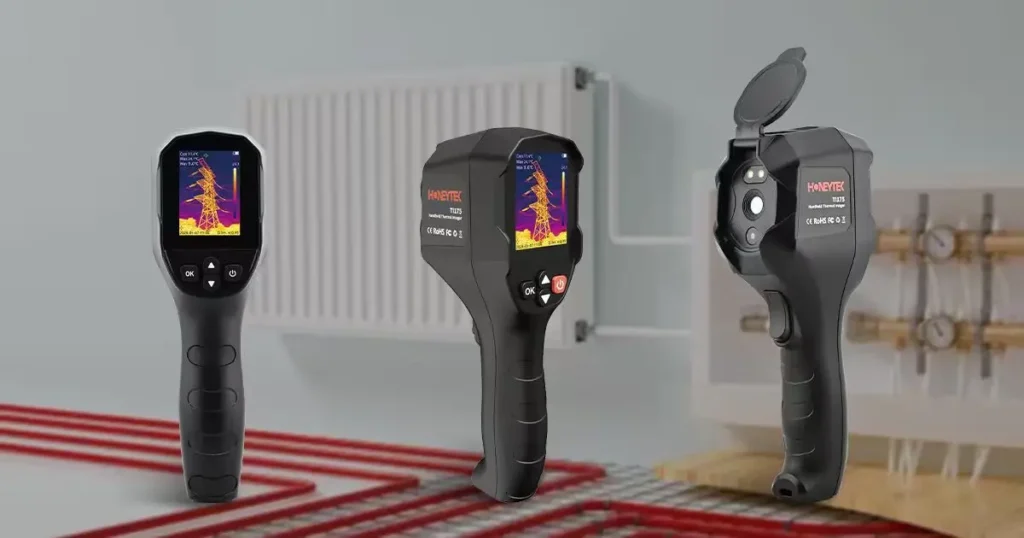
| Factor | Phone Plug-In | Handheld (TI180/TI185) |
| Independence | Phone is the instrument. Phone dies = inspection stops. | Self-contained. 3200mAh battery. 6 hours continuous. |
| Environmental | No IP rating. USB-C port exposed. Phone overheats in direct sun. | IP54 dust/splash proof. 2m drop rated. -10~50°C operating. |
| Screen in sunlight | Phone screens reflect badly. Max brightness drains battery faster. | 3.2″ LCD with anti-glare. Brightness adjustable without battery penalty. |
| Data workflow | Stored in phone gallery. Export requires app or cloud sync. | 16GB internal. USB-C plug into any PC = drag and drop. No app needed. |
| Durability | Drop your phone = $200-1000 repair. Thermal module survives, phone doesn’t. | 2m drop onto concrete: pick it up and keep working. Tested. |
| Portability | 17g. Literally fits in a shirt pocket. | 389g. Goes in a tool bag, not a pocket. |
| Cost | Entry-level pricing | Mid-range pricing |
Field observation — Dongguan injection molding plant, June 2026
“The phone camera worked fine for three weeks. Then it rained during a roof inspection, the USB port got damp, and the phone started throwing ‘accessory not supported’ errors. We switched to a TI180 the next week. Haven’t had a single issue since — rain or shine.” — Facility Manager Zhang
2. TI180 vs TI185: Same Foundation, Different Eyes
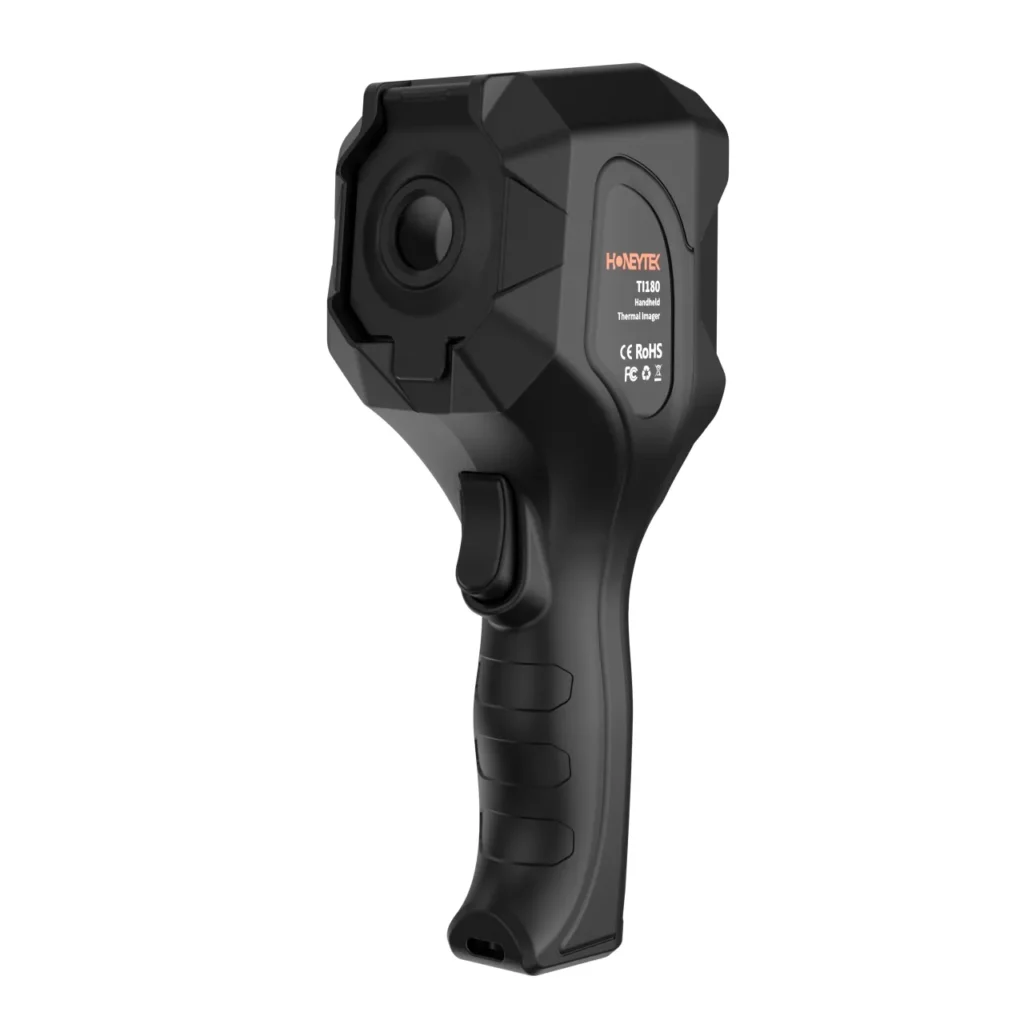
One of the more unusual decisions we made with the TI180/TI185 platform was to use identical bodies for both models. Same housing. Same 3200mAh battery. Same 3.2″ LCD. Same IP54 seal. Same 16GB storage. The only variable is the detector module.
Why? Because too many manufacturers use the “budget” SKU to cut corners on everything — smaller battery, cheaper screen, no IP rating. The TI180 isn’t a “stripped-down TI185.” It’s a TI185 with a 160×120 detector instead of 256×192. Everything else is the same.
| Specification | TI180 | TI185 |
|---|---|---|
| IR Resolution | 160×120 (19,200 px) | 256×192 (49,152 px) |
| Detector Type | VOx Uncooled Microbolometer | VOx Uncooled FPA |
| Pixel Pitch | 17μm | 12μm |
| Spatial Resolution (IFOV) | 5.3 mrad | 3.4 mrad |
| Focal Length | 3.2mm | 3.5mm |
| NETD (Thermal Sensitivity) | ≤40 mK (@25°C, F#1.0) | ≤40 mK (@25°C, F#1.0) |
| Temperature Range | -20°C to 550°C | -20°C to 550°C |
| Accuracy | ±2°C or ±2% of reading | ±2°C or ±2% of reading |
| Frame Rate | 25 Hz | 25 Hz |
| Spectral Range | 7.5~14μm (LWIR) | |
| Image Modes | IR / Visible / Fusion / Picture-in-Picture | |
| Measurement Tools | 3-point / 3-line / 3-area + center/min/max | Center / Max / Min spot |
| Emissivity | 0.01–1.00 (default 0.95) | Adjustable |
| Alarms | High / Low temperature threshold with visual alert | |
| Storage | 16GB Internal | |
| Image/Video Format | JPEG / MP4 | |
| Display | 3.2″ LCD (non-touch, physical button operation) | |
| Battery | 3200mAh Li-ion rechargeable, ≥6 hours continuous | |
| Protection | IP54 (dust-protected, splash-proof) | |
| Drop Resistance | 2 meters | |
| Operating Temp | -10°C to 50°C | |
| Dimensions | 231 × 79.2 × 84.9 mm | |
| Weight | 389g | |
| Certifications | FCC, RoHS, CE | |
3. The HIKMICRO Pocket2 Comparison
The HIKMICRO Pocket2 is the most direct competitor in this segment. Here’s a practical comparison for industrial users:
| Dimension | TI180 | TI185 | HIKMICRO Pocket2 |
|---|---|---|---|
| Max Temperature | 550°C | 550°C | 400°C |
| Battery Life | ≥6 hours | ≥6 hours | ~4 hours |
| IR Resolution | 160×120 | 256×192 | 256×192 |
| Pixel Pitch | 17μm | 12μm | 12μm |
| Screen | 3.2″ LCD | 3.2″ LCD | 3.5″ Touch |
| Storage | 16GB | 16GB | 64GB |
| WiFi | — | — | ✓ 2.4/5GHz |
| IP Rating | IP54 | IP54 | IP54 |
| Drop Resistance | 2m | 2m | 2m |
| Weight | 389g | 389g | 218g |
| FOV | — | — | 50°×37.2° |
| Macro Mode | — | — | ✓ Clip-on lens |
| Price Level | Entry | Mid | ~$600–800 |
Where Pocket2 wins: The 3.5-inch touchscreen is genuinely nicer to use. 64GB storage is overkill but convenient. WiFi transfer saves you from plugging in a cable. At 218g, it’s substantially lighter. The macro lens accessory opens up PCB-level inspection that TI180/TI185 can’t match (for that, use a TP175 phone camera instead).
Where TI180/TI185 wins: The 550°C upper limit versus 400°C is not a rounding error — it’s the difference between being able to measure an overheating busbar at 420°C and getting a white saturated blob with no reading. 6-hour battery versus 4-hour means a full shift without charging anxiety. And price-wise, you can buy a TI180 plus a TP175 phone camera for roughly the cost of one Pocket2.
4. Real-World Application Guide
Field test — 110kV Substation, Shenzhen, May 2026
Annual thermal inspection of 3 transformer bays, ~200 measurement points. Ambient: 38°C, dusty. TI180 operated continuously from 08:30 to 14:30 (6 hours) on a single charge. 187 thermal images captured. One C-phase bushing connection measured 142°C (adjacent phases at 68°C) — flagged for immediate re-torque. The 550°C range provided headroom for fault conditions; a 400°C-limited camera would have saturated on the hottest connections.
Field test — 5MW Solar Farm, Dongguan, April 2026
Hot-spot scanning across 15,000+ panels. TI185’s 256×192 resolution allowed hotspot identification on individual panels from 30+ meters. IP54 proved critical when a sudden rain shower hit mid-inspection — crew continued working without interruption. 16GB storage easily accommodated a full day’s capture (~1,200 images).
Field test — Automotive Parts Factory, Foshan, March 2026
Weekly bearing temperature trend monitoring on 24 CNC machining centers. TI180’s 3.2″ non-touch screen with physical buttons was preferred by operators wearing oily gloves — touchscreens become unusable in this environment. USB-C direct connection to the factory’s maintenance PC enabled drag-and-drop image transfer without installing any software.
5. Selection Guide: Which Model for Which Job?
TI180 — Best for: Routine Industrial Inspection at Scale
If you scan large equipment (switchgear, motor control centers, building envelopes, HVAC ductwork) where targets are >10cm and the resolution difference between 160×120 and 256×192 is invisible at working distance — save the money. The TI180 is the most affordable industrial-grade handheld thermal camera with 550°C range and IP54 rating on the market.
TI185 — Best for: Precision Diagnostics and Reporting
If you need to resolve smaller targets at longer distances (solar panels from 30m+, bearing housings from 5m+), or produce detailed thermal reports where image sharpness matters — the TI185’s 12μm detector and 3.4mrad IFOV provide genuinely better spatial detail. The difference is visible and measurable.
When to choose Pocket2 instead
If your work never exceeds 400°C (building inspection, HVAC, basic electrical), you want the best user experience (touchscreen, WiFi, lighter weight), and budget isn’t the primary constraint — Pocket2 is a more polished consumer experience. Just know what you’re trading away.
6. Frequently Asked Questions
Can I use TI180/TI185 for PCB-level electronics work?
TI180’s 5.3mrad IFOV is insufficient for resolving individual SMD components. TI185’s 3.4mrad IFOV is borderline — you can identify hot components on a board but won’t get the precision of a dedicated macro lens. For serious PCB thermal analysis, use the TP175 phone camera (3.43mrad IFOV + PIP overlay + 3D thermal distribution) or HIKMICRO Pocket2 with its macro lens accessory.
How do physical buttons compare to a touchscreen in the field?
Touchscreens are nicer when you’re in a clean, dry environment with bare hands. Physical buttons win when you’re wearing work gloves, your hands are oily, or it’s raining. TI180/TI185’s button layout is deliberately simple — power, capture, menu navigation, and back. Operators learn the muscle memory in under 10 minutes.
Is 16GB really enough storage?
A single radiometric JPEG from TI180/TI185 is approximately 100-200KB. 16GB holds 80,000-160,000 images. At 200 images per day, that’s 400-800 working days before you need to delete anything. MP4 video at ~1MB/sec gives you about 4 hours of continuous recording. For the vast majority of professional users, 16GB is functionally unlimited.
Request TI180/TI185 Evaluation Units & Volume Pricing
Visit honeytek.com or contact our sales team. Demo units available for qualified industrial accounts.
Chen Wei — Senior Product Engineer
14 years in thermal imaging instrumentation | IEC 61010 Certified
Calibrated over 3,000 thermal imagers across 6 detector generations. Field-tested TI180/TI185 prototypes across substation, solar farm, and factory environments in Guangdong Province. Specializes in uncooled VOx microbolometer performance characterization.
Reviewed by Liu Gang — Quality Director
16 years in precision instrument manufacturing quality systems
Oversees ISO 9001:2015 certified quality management. All field test data, competitive specifications, and performance claims verified against production calibration records and publicly available manufacturer documentation as of June 2026.
