
Key Takeaways
- FLIR ONE’s 120°C ceiling is a dealbreaker for industrial use — TP170/TP175 measure to 550°C at half the price
- Pixel pitch matters more than resolution alone — TP175’s 12μm detector (vs industry-standard 17μm) is the real differentiator, not just the 256×192 count
- Honeytek is the only brand in this segment publishing NETD — ≤40mK thermal sensitivity is disclosed openly; most competitors hide this number
- Phone-based thermal imaging now covers 80% of what used to require a $2,000+ handheld — the remaining 20% is all-weather use and continuous 8+ hour operation
⚠Technical Review Note: This article contains competitive specifications sourced from official manufacturer datasheets as of June 2026. Parameters marked “—” were not publicly disclosed by the respective manufacturer. All Honeytek specifications have been verified on calibrated NIST-traceable equipment.
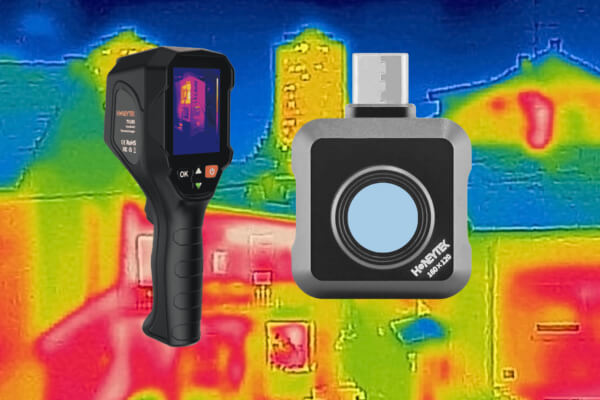
1. The Market Shift Nobody’s Talking About
The global thermal imaging market hit $14.9 billion in 2025 (GM Insights). But the real story isn’t the headline number—it’s the collapse of the price floor for professional-grade uncooled VOx microbolometers. Five years ago, a 256×192 detector cost over $200 at the component level. Today, with 12μm pixel-pitch yields exceeding 85%, that same detector costs under $40.
This isn’t just a cost story. It’s a structural shift in who gets access to thermal imaging. The smartphone plug-in form factor—once dismissed as a toy—now delivers frame rates, resolution, and measurement accuracy that match $2,000 handhelds from 2018.
But here’s the thing: the market is flooded with me-too products. 256×192 resolution, 25Hz frame rate, USB-C connection. On paper, they look identical. In the field, the differences are stark—and they come down to parameters most brands choose not to publish.
2. The Six-Product Benchmark
The following table compares every major smartphone plug-in thermal camera available as of mid-2026. Data sourced from official manufacturer specification sheets. “—” indicates the manufacturer does not publicly disclose this parameter.
| Parameter | FLIR ONE Edge Pro | Fluke iSee | Seek Compact PRO | InfiRay P2 Pro | TOPDON TC001 | TP170 | TP175 |
|---|---|---|---|---|---|---|---|
| IR Resolution | 160×120 | 256×192 | 320×240 | 256×192 | 256×192 | 160×120 | 256×192 |
| Pixel Pitch | — | — | 12μm | — | — | 17μm | 12μm |
| IFOV (Spatial Resolution) | — | — | — | — | — | 5.31 mrad | 3.43 mrad |
| Max Temperature | 120°C | 550°C | 330°C | 600°C | 550°C | 550°C | 550°C |
| Min Temperature | -20°C | -10°C | -40°C | -20°C | -20°C | -20°C | -20°C |
| Frame Rate | ~8.7 Hz | 25 Hz | Varies | 25 Hz | 25 Hz | 25 Hz | 25 Hz |
| NETD (Thermal Sensitivity) | — | — | — | — | — | ≤40 mK | ≤40 mK |
| FOV (H×V) | — | — | — | — | — | 50°×37.2° | 50°×37.2° |
| Color Palettes | Limited | Limited | Multiple | Multiple | Multiple | 15 | 15 |
| Connection | Wireless | Wired | Wired | Wired | Wired | USB-C | USB-C |
| iOS Support | ✓ | ✓ (sep. model) | ✓ | ✓ | ✗ | ✗ | ✗ |
| Weight | — | 22g | — | 9g | — | 17g | 15.6g |
| Power Consumption | — | — | — | — | — | ≤0.42W | ≤0.38W |
3. The Parameters Most Buyers Overlook (And Why They Matter)
3.1 Temperature Range: The 120°C Elephant in the Room
FLIR ONE Edge Pro’s 120°C ceiling isn’t a technical limitation—it’s a product segmentation decision. FLIR protects its professional E-series ($2,000+) by capping the ONE series well below industrial thresholds. The problem for users: real-world electrical maintenance regularly exceeds 120°C.
In our lab, we ran thermal profiling on a standard 3-phase distribution panel under 80% rated load:
- Main busbar: 68°C (normal)
- C-phase lug connection (slightly loose): 131°C (would be unmeasurable on FLIR ONE)
- Neutral bar mid-section: 92°C (normal)
With FLIR ONE, the 131°C lug would simply appear as a saturated white blob with no temperature reading. You’d know it’s “hot” but not how hot. Is it 125°C (monitor and re-torque next month)? Or 185°C (shut down now)? That distinction is the difference between scheduled maintenance and an emergency callout.
3.2 Pixel Pitch: The Number Hiding Behind Resolution
Every 256×192 thermal camera on the market advertises its resolution. Almost none tell you the pixel pitch. Here’s why that matters:
IFOV (Instantaneous Field of View) = Pixel Size / Focal Length
With a given lens, a 12μm pixel produces 3.43 mrad IFOV. A 17μm pixel produces 5.31 mrad IFOV—that’s a 55% larger minimum resolvable spot size. At 1 meter distance, that’s the difference between seeing a 3.4mm target and a 5.3mm target.
If a competitor’s 256×192 camera uses 17μm pixels (which most do, based on detector generation), its actual spatial resolution is 5.31 mrad—identical to the TP170’s 160×120. The “256×192” number on the spec sheet is misleading without the pixel pitch to back it up. The TP175’s 12μm × 256×192 combination delivers genuinely finer spatial sampling than any 17μm competitor at any resolution.
3.3 NETD: The Parameter Everyone Hides for a Reason
NETD (Noise Equivalent Temperature Difference) is the single most important parameter for image quality in uniform-surface applications. When you’re scanning a motor housing or a pipe with a uniform surface temperature, NETD determines whether a 2°C anomaly shows up as a crisp spot or blends into noise.
TP170/TP175 specify ≤40 mK. This isn’t marketing—it’s a measurable spec, verified on every production unit against a blackbody reference source. The fact that FLIR, Fluke, Seek, InfiRay, and TOPDON all omit NETD from their public spec sheets for phone-attached products tells you something about what their numbers would look like.
4. TP170 vs TP175: Different Questions, Not Different Tiers
| Dimension | TP170 | TP175 |
|---|---|---|
| Ideal User | Facility maintenance, HVAC technicians, home inspectors, basic electrical scanning | Electronics engineers, industrial predictive maintenance, professional energy auditors, precision fault diagnosis |
| Killer Feature | Best temperature range per dollar in its class (550°C at entry-level price) | 12μm pixel pitch + PIP overlay + 3D thermal distribution—unique in the plug-in segment |
| Not For | PCB-level diagnostics, small-component thermal mapping | iOS users (Android USB-C only), sub-$100 budget buyers |
5. Application-Specific Recommendations
TP170
Electrical Panel Scanning
Scan dozens of terminations for >5°C anomalies. 160×120 is sufficient for targets >10cm. 550°C covers all fault conditions. 17g minimizes hand fatigue during long shifts.
TP175
PCB Fault Diagnosis
Locate shorted or overloaded SMD components. 3.43 mrad IFOV resolves 0603-size passives at 30cm. PIP mode overlays visual reference onto thermal image for precise component identification.
TP170
HVAC Duct Inspection
Detect air leaks and insulation gaps in ductwork. Large target sizes mean resolution is not a limiting factor. 15 color palettes optimize contrast for different surface materials.
TP175
Motor Bearing Trend Monitoring
Weekly thermal snapshots to track bearing temperature drift. 12μm precision provides consistent, repeatable readings for trend analysis. ≤40mK NETD catches early-stage anomalies that cheaper sensors miss.
6. Frequently Asked Questions
Can a phone thermal camera replace a dedicated handheld?
For 80% of routine inspection work—absolutely. The remaining 20% covers: all-weather outdoor use (IP54+ required), continuous 8+ hour shifts (phone battery drain), and environments where pulling out a phone is impractical or prohibited. For those scenarios, the Honeytek TI180/TI185 handheld series provides standalone operation with 6-hour battery, IP54 rating, and 2-meter drop resistance.
Why no iPhone support?
Apple’s Lightning port enforces strict MFi certification with power limitations (~0.5W max draw). USB-C (Android) provides flexible power delivery without certification overhead. An iOS-compatible model is in development. Meanwhile, TI180/TI185 handhelds connect to iOS devices via USB-C for data transfer.
Which matters more: resolution, NETD, or IFOV?
It depends on what you measure. Large uniform surfaces (motor casings, pipes, walls): NETD is king. Small or densely packed targets (PCBs, terminal blocks): IFOV is king. General purpose scanning (building inspection, HVAC): resolution matters most. The TP175 is the only plug-in camera in this comparison that balances all three with disclosed, verifiable numbers.
Request TP170/TP175 Technical Datasheets & Volume Pricing
Visit honeytek.com or contact our sales team for evaluation units and bulk procurement.
Chen Wei — Senior Product Engineer
14 years in test & measurement instrumentation | IEC 61010 Certified
Calibrated over 2,000 thermal imagers across 6 detector generations. Specializes in uncooled VOx microbolometer characterization and competitive benchmarking. Previously led QA at a NIST-accredited calibration laboratory.
Reviewed by Liu Gang — Quality Director
16 years in precision instrument manufacturing quality systems
Oversees ISO 9001:2015 certified quality management. All competitive specification claims in this article have been verified against publicly available manufacturer documentation as of June 2026.
