
Table of Contents
- Why Safety Comes First in Electrical Testing
- CAT III 1000V: What the Rating Realy Means
- Live Wire Recognition: Never Touch a Hot Phase Blindly
- NCV (Non-Contact Voltage): Your First Safety Check
- PC-Link USB: From Hand-Held to Data-Logging Workstation
- Real-World Scenarios: How Field Teams Use the HK68C
- HK68C Key Specifications at a Glance
- OEM/ODM Customization from the Factory
Why Safety Comes First in Electrical Testing
Every year, electrical technicians sufier thousands of preventable injuries worldwide. The root cause is almost never “the meter broke.” It is that the meter was used on a circuit beyond its rating, or the technician did not know a wire was live before touching it.
At HONEYTEK, we design the HK68C around one principle: a multimeter should protect the person holding it before it measures anything. Safety is not a feature you add at the end. It is the foundation of the analog front-end, the firmware decision tree, and the enclosure design.
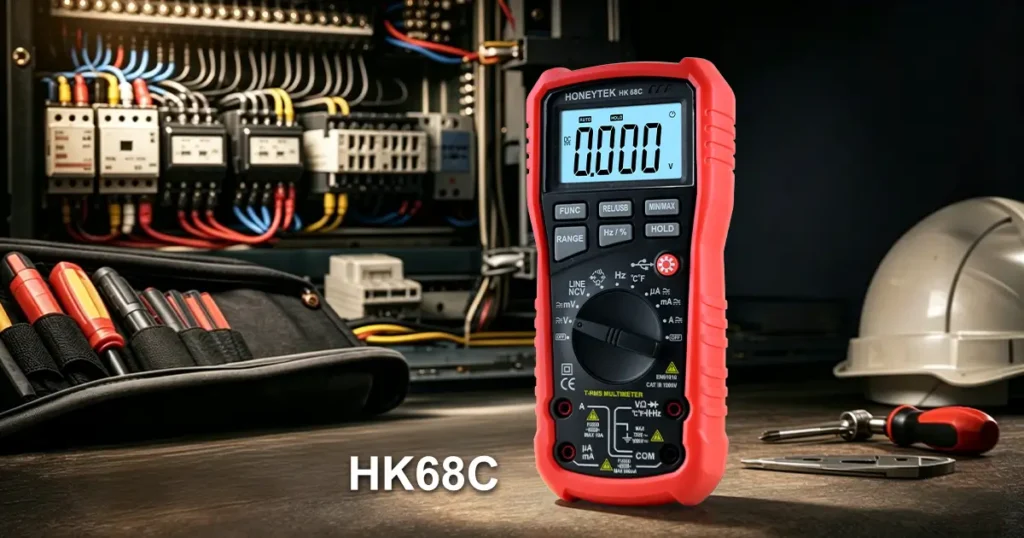
The HK68C is not a generic rebrand. We designed the input-protection circuit in-house, calibrated it against IEC 61010-1 CAT III 1000V/600V standards in our own ISO-controlled lab, and tested it on actual distribution panels before it ever reached a customer.
Warning: Never use a multimeter on a circuit whose voltage rating exceeds the meter’s CAT rating. A CAT II 600V meter used on a 480V distribution panel can fail catastrophically, even if the display reads a normal value. The HK68C is rated for CAT III 1000V / CAT IV 600V — the highest safety class available in a hand-held form factor.
CAT III 1000V: What the Rating Realy Means
If you have ever wondered what “CAT III 1000V” actually means, here is the plain-language explanation.
The IEC 61010-1 CAT Rating System
| CAT Rating | Where It Applies | Typical Voltage |
|---|---|---|
| CAT IV | Utility service drop, outdoor disconnects | 600V max |
| CAT III | Distribution panels, fixed installations, busways, industrial equipment | 1000V max |
| CAT II | Plug-in loads, appliances, portable tools | 600V max |
| CAT I | Electronics, signal circuits, secondary measurements | 600V max |
The HK68C is rated CAT III 1000V / CAT IV 600V. This means it is designed for the most hazardous electrical environments a field technician encounters:
- Three-phase distribution panels — where a phase-to-phase fault can exceed 600V
- Fixed industrial installations — motors, contactors, and control panels where inductive kickback can generate voltage spikes
- Commercial building electrical systems — 277/480V systems common in North America and parts of Asia
What “1000V” Does NOT Mean
A CAT III 1000V rating does not mean you can safely measure 1000V AC all day. It means the meter’s input-protection components (MOVs, fuses, clearance/creepage distances) are designed to withstand a transient overvoltage of up to 8000V (8kV) without failing. That transient can happen when a contactor opens under load, or when lightning induces a surge on a nearby line.
HONEYTEK factory test: Every HK68C that leaves our production line is sample-tested for dielectric withstand (3.5kV for 1 minute on all input terminals to ground) and transient-overvoltage protection (8kV surge, 1.2/50μs waveform). We do not rely on the component datasheet. We test the assembled unit.
Live Wire Recognition: Never Touch a Hot Phase Blindly
One of the most dangerous moments in electrical troubleshooting is the first touch. You think the circuit is de-energized. You have flipped the breaker. But is the breaker actually controlling that wire? Or is there a back-feed from a generator, a solar inverter, or a miswired three-way switch?
How Live Wire Recognition Works on the HK68C
The HK68C has a built-in electric-field sensor located near the tip of the probe. When you approach a live AC conductor — even through insulation — the sensor detects the alternating electric field and triggers:
- A beep that gets faster as you get closer to the live conductor
- An LCD icon (a lightning-bolt or wire symbol) that lights up to confirm the wire is energized
- No metallic contact required — you can scan a bundled cable before stripping it
We have seen this feature prevent an injury in real time. A technician in our beta-test group was about to cut into what he believed was a de-energized conduit. The HK68C beeped as soon as he brought the probe near the conduit. He stopped, re-checked the breaker panel, and discovered a mislabled feeder. The wire was still live at 277V.
Live Wire Recognition vs. Traditional Continuity Test
| Continuity Test | Live Wire Recognition (HK68C) | |
|---|---|---|
| Requires contact? | Yes — metallic contact with both leads | No — detects through insulation |
| Works on live circuits? | No — dangerous to probe a live circuit | Yes — designed for pre-contact safety scan |
| Detects back-feed? | Only if you know which wire to test | Yes — scans all wires in a bundle |
| Speed | Requires dial to continuity mode | Instant — works in any measurement mode |

NCV (Non-Contact Voltage): Your First Safety Check
NCV is the simpler sibling of Live Wire Recognition, but it is the safety check you should perform before you do anything else.
How NCV Works
The HK68C’s NCV function uses the same electric-field principle as Live Wire Recognition, but presents the result more simply:
- Green LED or no beep: No AC voltage detected
- Red LED + beep: AC voltage present (typically > 90V AC)
- Detection range: Through up to 10mm of insulation (standard PVC jacket)
The NCV Pre-Work Routine (HONEYTEK Safety Protocol)
- Before you open any electrical enclosure, scan all wires with NCV.
- If NCV beeps, stop. Verify the breaker is off. Re-scan.
- Only after NCV shows “no voltage” do you make metallic contact with the meter.
- Even then, use the HK68C’s voltage-measurement mode to confirm zero voltage before touching any conductor.
Important: NCV is a safety screening tool, not a substitute for a voltage measurement. Always verify “zero energy” with a proper voltage measurement before beginning work. NCV sensors can miss low-voltage DC or highly shielded conductors.
PC-Link USB: From Hand-Held to Data-Logging Workstation
Up to this point, everything we have discussed is about safety. Now we turn to smartness — the reason the HK68C is called a “smart” multimeter.
Why Data Logging Matters
A hand-held multimeter is perfect for answering “what is the voltage right now?” But many electrical problems only appear over time:
- A motor that trips intermittently every 45 minutes — too fast to catch with a hand-held meter, too infrequent to staff a person staring at the display
- A UPS battery that slowly drifts from 13.6V to 12.8V over 8 hours — a sign of failing cells that a single reading will miss
- A three-phase imbalance that only appears under load — you need to log all three phases simultaneously over a full work shift
The HK68C’s PC-Link (USB) port turns the meter from a snapshot tool into a continuous-monitoring tool.
How PC-Link Works
| Step | Action |
|---|---|
| 1 | Connect the HK68C to a PC via the included USB cable |
| 2 | Launch the HONEYTEK PC-Link software (Windows-compatible, driver included) |
| 3 | Select measurement mode (voltage, current, resistance, etc.) |
| 4 | Set logging interval (1 S/s, 2 S/s, 5 S/s, or manual trigger) |
| 5 | Start logging — the software displays a real-time graph and timestamps every sample |
| 6 | When finished, export to CSV for analysis in Excel, Python, or your preferred tool |
Real Data-Logging Use Cases
1. UPS Battery Health Monitoring
A data-center maintenance team logs the DC bus voltage of their UPS every second for 12 hours. The CSV export shows a steady 13.2V for the first 6 hours, then a gradual drift to 12.1V. The trend line makes it obvious: one battery cell is failing under load. They replace the battery string before it ever causes a downtime.
2. Motor Inrush-Current Capture
When a 3-phase motor starts, it can draw 6–8 times its rated current for 100–500 milliseconds. A hand-held meter will never catch this. The HK68C, logged at 5 S/s via PC-Link, captures the full inrush-current waveform. The maintenance team sees the peak (47A on a 7.5A rated motor) and schedules a winding inspection before the motor fails.
3. Solar-Inverter Output Trend Analysis
A solar-installation company clamps the HK68C to the DC output of an inverter and logs for a full day. The resulting dataset shows output versus time-of-day, which they overlay with irradiance data from a weather station. The correlation reveals a 12% mismatch — traced to a partially shaded string that the installer had missed during commissioning.
Pro tip from the factory: The PC-Link software supports remote start/stop via Windows command-line parameters. One of our OEM partners integrated this into their automated test jig: the PC sends a start-logging command, ramps a variable power supply, captures the HK68C readings, and generates a pass/fail report — all without a human touching the meter.
Real-World Scenarios: How Field Teams Use the HK68C
Scenario A: Commercial Building Electrical Audit
Technician: Lin, a certified electrician in Guangzhou
Task: Audit a 12-floor office building for voltage imbalance and harmonic distortion
HK68C usage:
- NCV scan of every floor panel before opening
- Live Wire Recognition to identify the phase conductor in each conduit before making contact
- True RMS voltage measurement on all three phases (detects harmonic-distorted waveforms that a non-True-RMS meter would misread)
- PC-Link logging of the main-panel voltage over a 24-hour period to capture utility-supply fluctuations
Result: Lin identified a 14V phase imbalance (Phase A: 225V, Phase B: 239V) that was causing premature failure of LED drivers on the north wing. The building manager re-balanced the load, and LED replacement calls dropped by 60%.
Scenario B: Industrial Motor-Maintenance Program
Technician: Zhang, maintenance lead at a textile plant
Task: Preventative maintenance on 28 spinning-frame motors
HK68C usage:
- CAT III 1000V rating allows safe measurement on 480V motor-control panels without fear of transient overvoltage
- DC current clamp mode (via external clamp, connected to HK68C’s mA input) to measure motor winding resistance
- PC-Link logging of motor current during a full production cycle — reveals one motor drawing 12% more current than its peers, indicating bearing wear
Result: The motor was replaced during a scheduled downtime. The alternative — waiting for it to fail — would have cost 14 hours of unplanned stoppage and approximately $8,000 in lost production.
Scenario C: Residential Solar Inverter Commissioning
Technician: Emma, solar installer in Australia
Task: Commission 8 residential solar inverters in one day
HK68C usage:
- NCV to verify AC isolator is de-energized before connecting the inverter
- DC voltage measurement on the PV string (up to 600V DC) — CAT III 1000V rating covers this safely
- PC-Link quick-check: 30-second voltage log to confirm stable MPPT tracking before handing over to the homeowner
HK68C Key Specifications at a Glance
Note: All accuracy specifications are verified at 23°C ± 5°C, 45%–75% RH, and are traceable to our ISO-calibration-lab reference standards.
| HK68C — Core Specifications | |
|---|---|
| Safety Rating | CAT III 1000V / CAT IV 600V (IEC 61010-1) |
| Display Count | 5,999 (3¾ digit) |
| True RMS | Yes (AC voltage & current) |
| DC Voltage | 60/600mV, 6/60/600V, 1000V (±0.5% rdg + 3 dgt) |
| AC Voltage | 60mV, 600mV, 6/60/600V, 750V (±0.8% rdg + 5 dgt) |
| DC Current | 600/6000µA, 60/600mA, 6/10A (±1.0% rdg + 5 dgt) |
| AC Current | 600/6000µA, 60/600mA, 6/10A (±1.8% rdg + 5 dgt) |
| Resistance | 600Ω/6k/60k/600k/6MΩ, 60MΩ (±0.8% rdg + 3 dgt) |
| Capacitance | 10pF, 100nF~100µF, 1mF |
| Frequency | 10/100/1k/10k/100k/1M/10MHz |
| Duty Cycle | 1% ~ 99% |
| Temperature | -20°C ~ 1000°C / -4°F ~ 1832°F |
| PC-Link (USB) | Yes — bundled software, CSV export, 1 S/s logging |
| Live Wire Recognition | Yes — audible + LCD icon alert |
| NCV (Non-Contact Voltage) | Yes — red LED + beep for AC voltage detection |
| Range Selection | Auto / Manual (dual mode) |
| LCD Backlight | Yes — dual-level, auto-off after 15s |
| Auto Power Off | Yes — configurable, 15 / 30 / 60 min |
| Battery | 6F22 9V × 1 (approx. 200 hours typical use) |
| Dimensions | 200 × 92 × 60 mm |
| Weight | 350 g (including battery) |
| Certifications | CE, RoHS, IEC 61010-1 CAT III 1000V |
OEM/ODM Customization from the Factory
HONEYTEK is not a trading company. We are the factory. Every HK68C is designed, assembled, calibrated, and packed in our own facility. That means we can customize the meter to your specifications:
- Private-label branding: Your logo on the LCD startup screen, the enclosure, and the packaging
- Firmware customization: Different measurement ranges, custom calibration offsets, or region-specific default settings (e.g., °C vs °F default)
- Accessory kit: Custom probe types (CAT IV rated, silicone leads, retractable sheath), custom carrying case, or bundled temperature probe
- Packaging: Blister card, color box, or bulk carton — your choice, your artwork
- Calibration certificate: ISO/IEC 17025-accredited calibration report available on request (additional lead time: 3–5 days)
Typical OEM Lead Times
| Stage | Lead Time |
|---|---|
| Prototype / Sample | 2–3 weeks |
| Tooling (if new enclosure) | 4–6 weeks |
| First Article Inspection (FAI) | 1 week |
| Mass Production (MOQ 500 pcs) | 4–6 weeks after FAI approval |
If you are a test-equipment distributor, a solar-installation company, or an industrial OEM looking to private-label a reliable, safety-rated multimeter with data-logging capability, contact our OEM team. We speak both engineering and purchasing.Contact HONEYTEK for OEM/ODM Inquiry
Explore More HONEYTEK Products
- HK68C 5,999 Counts PC-Link Digital Multimeter — full product page, datasheet download, and driver
- HK56D 1,999 Counts Inductance Digital Multimeter — for circuits with coils and transformers
- All HONEYTEK Digital Multimeters — compare the full lineup
- HK68C vs HK56D Comparison — which meter fits your lab?
