
Introduction: Choosing the Right Multimeter for Everyday Automotive Diagnostics
For any automotive hobbyist or technician, a reliable multimeter is one of the most valuable tools in the toolbox. From checking voltage and resistance to diagnosing sensors and alternators, the right device can save time, reduce guesswork, and improve safety during every repair.
Two of the most popular models among DIY enthusiasts are Honeytek’s A616 and A600 automotive digital multimeters. Both are compact, durable, and built for precision — but they cater to slightly different users.
In this article, we’ll compare the A616 vs A600 in depth, focusing on measurement functions, usability, safety, durability, and value, helping you choose the best fit for your workshop or garage.
Brand Overview – Honeytek’s Automotive Diagnostic Legacy
Honeytek is a global manufacturer of digital multimeters, clamp meters, and electronic measuring instruments, serving professionals and OEM/ODM clients worldwide.
The brand is recognized for:
- Robust build quality and high measurement accuracy
- Automotive-specific functions such as RPM, dwell, duty cycle, and temperature
- Compliance with international safety standards (CAT III / CAT IV)
- Excellent value for money in the professional and DIY market
The A600 and A616 continue this tradition — simple yet powerful tools tailored for everyday automotive diagnostics.

Technical Overview of A616 and A600
| Feature | Honeytek A600 | Honeytek A616 |
|---|---|---|
| Measurement Type | Manual ranging | Auto-ranging |
| Voltage Range | Up to 700V AC/DC | Up to 700V AC/DC |
| Current, Resistance, Frequency | ✔ | ✔ |
| Temperature Measurement | – | ✔ |
| RPM & Dwell Angle | ✔ | ✔ |
| Display Type | Standard LCD | Large backlit LCD |
| Additional Features | Compact design | Auto range, MAX/MIN hold, flashlight |
| Safety Rating | CAT III 1000V | CAT III 1000V |
| Best For | Entry-level users | General users & DIYers seeking speed and ease |
Both models share a durable design and core automotive diagnostic functions, but the A616 builds on the A600 with automation, visibility, and convenience — features that make daily testing smoother and faster.
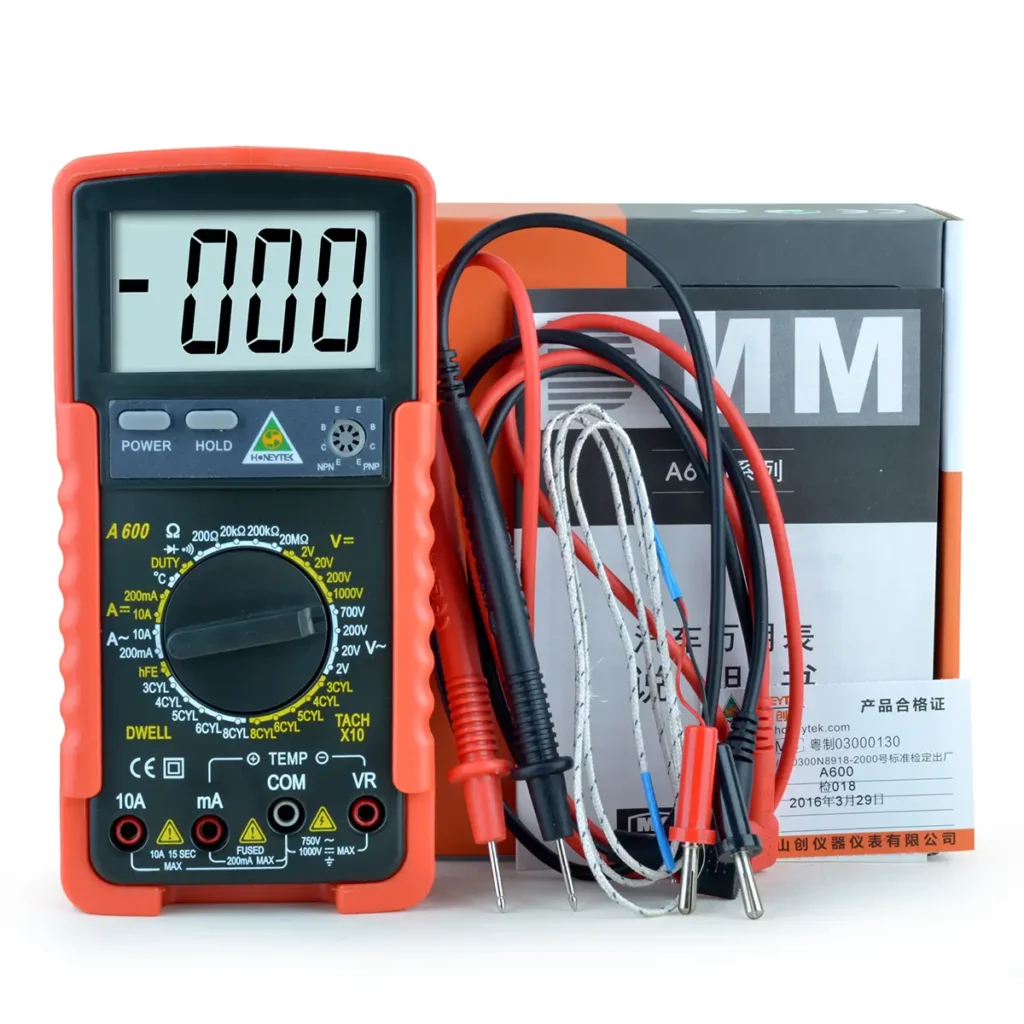
Function Comparison – Accuracy and Convenience in Action
1. Measurement Range and Performance
The A600 covers essential measurement needs, including DC/AC voltage up to 700V, current, resistance, dwell angle, and RPM — sufficient for most car systems and sensors.
The A616, however, takes this further with auto-ranging capability, meaning it automatically detects the correct measurement range. This saves time and eliminates manual range switching — especially handy during quick multi-point testing around an engine bay.
Verdict:
For users who prefer full manual control, the A600 is reliable. For those who value speed and convenience, the A616 clearly wins.
2. Data Logging and Display Readability
- A600: Equipped with a standard LCD, it provides clear, basic readouts suitable for workshops with stable lighting.
- A616: Features a larger backlit LCD that enhances visibility in dark environments — perfect for under-dash or under-hood work.
The A616 also includes MAX/MIN hold, enabling users to capture peak values during dynamic tests — a small but powerful advantage for diagnosing fluctuating signals or short voltage drops.
Verdict:
The A616 provides a more professional display and data-handling experience, ideal for those who work in varied conditions.
3. Response Speed and Measurement Stability
Both models are engineered for fast sampling, but the auto-ranging circuit in the A616 improves workflow efficiency. It automatically adjusts the internal range, providing quicker, smoother readings without manual adjustment.
The A600, while slightly slower when switching ranges, offers stable and precise output once set correctly. It’s great for controlled environments like bench testing or classroom use.
Verdict:
For mobile, on-vehicle diagnostics, the A616’s faster auto-detection gives it the edge.
Safety and Durability – Built for the Automotive Environment
1. Outer Casing and Impact Resistance
Both meters feature shock-resistant outer housings designed to survive drops, vibrations, and workshop wear. Honeytek’s reinforced casing design prevents internal board flexing and enhances tool longevity.
2. Safety Certification
Both the A600 and A616 are CAT III 1000V rated — ensuring protection against transient voltage spikes common in vehicle electrical systems. This makes them safe for use on 12V, 24V, and even 48V hybrid systems, as long as proper test leads are used.
3. Thermal Management
Honeytek designs its meters with optimized heat dissipation pathways to maintain stability during extended measurement sessions. Even in hot engine compartments, both models maintain consistent accuracy.
Verdict:
Both A600 and A616 meet Honeytek’s high standards for safety and endurance. For users handling frequent on-site diagnostics, A616’s reinforced insulation and lighting features add extra convenience and peace of mind.
User Experience and Ease of Operation
1. Menu and Control Layout
- A600: Manual ranging requires selecting ranges via a dial — ideal for learning users who want to understand voltage behavior.
- A616: Simplified interface with auto-ranging, intuitive dial positions, and a flashlight button for low-light operation.
2. Display and Readability
The A616’s backlit display significantly improves readability in dim or outdoor environments. The larger digits and contrast ratio enhance data clarity.
3. Stability and Comfort
Both models have stable reading refresh rates, minimizing flicker and ensuring measurement confidence. The rubberized side grips improve handling and reduce the risk of accidental drops.
Verdict:
For beginners, the A600 provides a traditional, tactile learning experience. For experienced DIYers who prioritize usability and speed, the A616 feels smoother and more efficient.
Price and Value for Money
The Honeytek A600 is positioned as an entry-level automotive multimeter, typically priced more affordably, making it a great starting point for students, home garages, or light repair shops.
The A616 sits slightly higher in price but adds auto-ranging, flashlight, MAX/MIN capture, and backlight, offering significant value for the difference.
Verdict:
- Best Value Choice: A616 (offers more advanced features at a small price step-up)
- Budget Choice: A600 (ideal for basic voltage and sensor checks)
Both models maintain Honeytek’s reputation for delivering professional-grade precision at accessible prices.
Recommended Use Scenarios
| Scenario | Recommended Model | Reason |
|---|---|---|
| Basic car maintenance & battery checks | A600 | Simple, affordable, accurate |
| DIY hobby projects & garage diagnostics | A616 | Auto-ranging + backlight ease |
| Learning automotive electronics | A600 | Manual range for understanding circuits |
| Quick fault isolation & voltage drop checks | A616 | Fast, bright, user-friendly |
| Classroom or training center use | A600 | Durable and cost-effective |
Expert Perspective – A Step Up from Basic to Smart Diagnostics
For anyone transitioning from casual to advanced DIY automotive diagnostics, the Honeytek A616 represents the ideal middle ground — bridging the simplicity of the A600 with features closer to professional models like the Honeytek HK78M TRMS.
It’s also worth noting that both A616 and A600 maintain the same CAT III 1000V protection level — a mark of Honeytek’s consistent engineering across all product tiers.
Summary – Which One Should You Choose?
| Feature | A600 | A616 |
|---|---|---|
| Ranging Type | Manual | Auto |
| Display | Standard | Large backlit |
| Flashlight | No | Yes |
| MAX/MIN Capture | No | Yes |
| Price Range | Lower | Mid |
| Ideal User | Beginners, students | DIYers, technicians |
In short:
- Choose A600 if you’re starting out and prefer manual control.
- Choose A616 if you want faster, easier operation with better visibility.
Either way, both deliver accurate, safe, and dependable performance backed by Honeytek’s decades of expertise in test and measurement technology.
Frequently Asked Questions (FAQ)
Q1: What’s the main difference between Honeytek A600 and A616?
The A616 adds auto-ranging, MAX/MIN hold, flashlight, and backlit display for convenience and speed. The A600 is manual-ranging, perfect for basic tasks and learning environments.
Q2: Are both meters safe for automotive use?
Yes, both are CAT III 1000V certified, providing robust protection for automotive and light industrial diagnostics.
Q3: Can these meters measure engine RPM and dwell angle?
Yes, both support RPM and dwell angle measurement, which are essential for older ignition systems and performance tuning.
Q4: Is the A616 worth the price difference?
For frequent users, the auto-ranging and backlight features significantly enhance workflow efficiency — making the A616 well worth the upgrade.
Q5: Does Honeytek support OEM/ODM production?
Absolutely. Honeytek is an experienced OEM/ODM manufacturer of multimeters, clamp meters, and electronic measurement tools for global brands.
The Honeytek A600 and A616 both deliver precision and reliability in compact designs tailored for automotive applications.
The A600 remains an excellent choice for learners, students, and home garages — offering great accuracy at an affordable price.
Meanwhile, the A616 steps up with user-friendly automation, improved visibility, and time-saving features that suit daily technicians and passionate DIYers alike.
Whatever your skill level, Honeytek multimeters provide dependable measurement solutions backed by quality manufacturing and international certification.
Ready to upgrade your diagnostic experience?
Explore the full range of Honeytek automotive multimeters, including the A600, A616, and HK78M TRMS series.
Visit Honeytek’s Official Website or contact our sales team today to learn about OEM/ODM partnership opportunities and professional distributor programs worldwide.
