
Introduction: Small Components, Big Impact
In the world of automotive diagnostics, precision is everything. Technicians often focus on choosing the right multimeter, but one crucial part of the measurement system is frequently overlooked — the test leads.
Test leads are more than just connecting wires; they are the lifeline between your multimeter and the vehicle’s electrical system. A poor-quality test lead can introduce resistance, distort readings, or even pose a safety hazard in high-voltage environments like hybrid or electric vehicles.
Whether you’re a professional technician or a DIY enthusiast, understanding how to choose reliable and durable test leads can make a real difference in diagnostic accuracy, safety, and tool longevity.
Why Test Leads Are Critical in Automotive Diagnostics
1. The Link Between Tool and Truth
A multimeter is only as accurate as its connection. Test leads carry the electrical signal from the component under test to the meter’s internal circuitry. Any impedance, noise, or signal loss caused by inferior test leads can result in false readings or unstable measurements.
2. Safety in High-Voltage Systems
When working on hybrid or electric vehicles, voltage levels can reach up to 800V. High-quality test leads with the correct CAT safety rating (CAT III or CAT IV) protect users from potential electric shock and equipment damage.
3. Consistent Performance Over Time
Repeated flexing, twisting, and exposure to oil or heat can degrade cheap PVC cables. Automotive environments are tough — only durable, silicone-insulated test leads maintain consistent performance across temperature extremes and daily use.

Advantages of High-Quality Silicone Test Leads
1. Superior Flexibility
Silicone test leads remain soft and pliable even in cold environments, unlike PVC cables that stiffen or crack. This flexibility allows technicians to move freely around tight engine bays without cable strain or interference.
2. Exceptional Durability
High-quality silicone insulation resists tearing, abrasion, and mechanical fatigue. It withstands frequent bending, coiling, and pulling — essential for long service life in busy workshops.
3. Excellent Heat and Cold Resistance
Silicone can tolerate extreme temperature ranges (often from -40°C to +200°C). This makes it perfect for both engine compartment testing and outdoor diagnostics in various climates.
4. Enhanced Electrical Safety
Premium silicone insulation provides superior dielectric strength, minimizing the risk of leakage current and accidental short circuits. Combined with CAT III or CAT IV safety certification, it ensures maximum protection.
5. Comfortable Grip and Tangle-Free Handling
Soft-touch silicone test leads are not only safer but also more comfortable to handle, reducing hand fatigue during prolonged diagnostic sessions.
How Conductor, Insulation, and Clip Design Affect Measurement Accuracy

1. Conductor Material: The Core of Precision
The conductor determines how efficiently electrical signals travel from the test point to the multimeter.
- Oxygen-free copper (OFC) or tinned copper conductors offer the best conductivity and corrosion resistance.
- Inferior alloys can increase resistance and distort readings, especially in low-voltage or high-precision measurements.
2. Insulation Layer: The Guardian of Safety
Insulation thickness and material quality define a lead’s voltage rating and durability.
- Silicone insulation provides flexibility and long-term reliability.
- Double-layer insulation adds extra safety in high-voltage applications.
3. Probe and Clip Design: Stability Meets Usability
The quality of the probe tip, banana plug, or alligator clip directly affects connection stability.
- Gold-plated or nickel-plated terminals prevent oxidation and maintain clean contact.
- Replaceable probe tips improve lifespan and allow switching between pointed and hooked ends for different diagnostic scenarios.
Stable connections ensure consistent readings — critical when testing sensitive automotive sensors or circuits.
Choosing the Right Test Lead Length and Flexibility
1. Length and Voltage Drop
Longer test leads can cause voltage drop, especially when measuring small signals. For most automotive applications, 1 to 1.5 meters (3–5 feet) is ideal.
However, when working with larger vehicles or remote components, slightly longer leads may be necessary. Always balance reach with signal accuracy.
2. Flexibility and Stress Resistance
Repeated bending around sharp engine edges or suspension components can stress cables. Choose leads rated for tensile and torsional endurance to prevent internal wire fatigue.
3. Environmental Resistance
Automotive workshops expose test leads to oil, sweat, brake fluid, and temperature variations. Silicone insulation resists these contaminants better than PVC or rubber, maintaining safe insulation integrity.
Compatibility: Ensuring the Right Fit Between Test Leads and Multimeter
1. Connector Type
Most professional multimeters, including Honeytek models, use standard 4mm banana plug interfaces. However, variations exist:
- Shrouded plugs add safety insulation for CAT-rated instruments.
- Straight vs. right-angle plugs depend on workspace layout and tool handling preference.
2. Probe and Clip Interchangeability
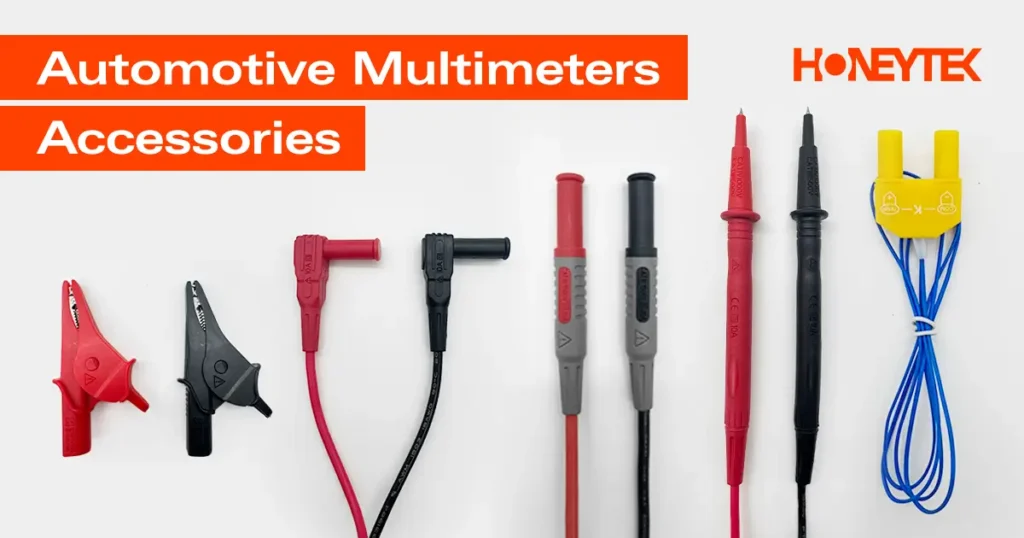
Ensure your test lead set includes interchangeable probe tips, alligator clips, and needle probes for versatility across diagnostics — from sensor pins to battery terminals.
3. Voltage Rating Compatibility
Match your test leads’ CAT rating with your multimeter’s certification.
For example:
- CAT III 1000V / CAT IV 600V for hybrid and EV diagnostics.
- CAT III 1000V for conventional automotive and workshop use.
Never use leads with a lower CAT rating than the multimeter itself.
How to Identify High-Quality Test Leads
1. Look for Certification Labels
Check for markings such as IEC 61010, CE, or CAT III/IV printed directly on the cable or packaging. These indicate compliance with international safety standards.
2. Choose Reputable Brands
Established manufacturers like Honeytek use tested materials, certified designs, and strict quality control — ensuring safety and accuracy.
3. Inspect Build Quality
- Even, thick insulation without bubbles or cuts
- Firm, well-molded plug grips
- Smooth insertion and removal from multimeter jacks
4. Read User Reviews and Field Feedback
Professional forums and user testimonials provide real-world insight into durability, flexibility, and long-term reliability.
5. Beware of Counterfeits
Avoid unbranded or suspiciously low-priced test leads. Substandard insulation or connectors can cause inaccurate readings or dangerous failures during high-voltage tests.
Honeytek: Reliable Test Leads for Automotive Professionals
As a global manufacturer of electronic measuring tools, Honeytek designs and produces professional-grade digital multimeters, clamp meters, and test accessories trusted by technicians worldwide.
Honeytek test leads are built with:
- High-purity copper conductors for precision signal transmission
- Double-layer silicone insulation rated for CAT III / CAT IV environments
- Ergonomic grips and replaceable probe tips
- Oil- and heat-resistant materials for demanding automotive use
Designed to pair perfectly with Honeytek’s automotive multimeters, these test leads ensure consistent performance, user safety, and measurement confidence.
Recommended Honeytek Multimeters for Automotive Testing
Honeytek HK78M TRMS Automotive Multimeter
- CAT IV 600V / CAT III 1000V safety rating
- True RMS accuracy for AC readings
- Measures temperature, frequency, dwell, and RPM
- Ideal for hybrid and EV diagnostics
- Best suited for professional workshops
Honeytek A600 Manual Digital Multimeter
- CAT III 1000V protection
- Measures RPM, dwell angle, temperature
- Manual range selection
- Compact and durable — great for entry-level technicians and students
Honeytek A616 Auto-Ranging Multimeter
- CAT III 1000V certified
- Includes auto-ranging, MAX/MIN hold, flashlight, large LCD
- Designed for everyday car checks and maintenance tasks
Each of these models is engineered to deliver accuracy, durability, and safety, especially when paired with certified Honeytek test leads.
Frequently Asked Questions (FAQ)
Q1: Why do test leads affect multimeter readings?
Low-quality leads can introduce resistance or unstable contact, resulting in inaccurate readings. High-quality silicone test leads ensure better conductivity and stable measurements.
Q2: How can I test if my leads are faulty?
Set your multimeter to continuity mode and connect the two leads together. If the reading fluctuates or shows high resistance, the leads may be damaged.
Q3: Are all test leads interchangeable between multimeter brands?
Not always. Ensure the connector size and CAT rating match your multimeter’s specifications. Honeytek test leads are designed for universal 4mm banana plug systems.
Q4: Can I use PVC test leads for automotive work?
PVC leads may work for basic low-voltage tasks but are less durable and flexible. Silicone test leads are strongly recommended for professional and EV applications.
Q5: How long do professional test leads last?
With proper care, high-quality silicone leads can last several years. Regularly inspect for cracks, cuts, or loose terminals to maintain safety.
Test leads might seem like minor accessories, but in automotive diagnostics, they are the foundation of measurement accuracy and technician safety.
Choosing high-quality silicone test leads with certified CAT ratings ensures consistent performance and long-term reliability — especially in modern hybrid and electric vehicle systems.
Paired with professional-grade Honeytek multimeters, these test leads offer the confidence to measure, diagnose, and repair with precision.
Measure with confidence. Choose Honeytek.
Explore Honeytek’s full range of automotive multimeters and certified silicone test leads for professionals.
Visit Honeytek’s Official Website or contact our sales team to discuss OEM/ODM partnerships and global distribution opportunities today.
