
Introduction: Safety First in the EV and Hybrid Era
As the global shift toward hybrid and electric vehicles accelerates, technicians face new challenges in vehicle diagnostics. Modern EVs and hybrids operate on high-voltage systems, often exceeding 400V or even 800V, making electrical safety more critical than ever.
In such environments, not all tools are created equal. Using a standard multimeter for high-voltage vehicle testing can expose technicians to severe electric shock, equipment failure, or inaccurate readings.
This is where CAT safety ratings come in — a standardized system that defines the maximum safe voltage and energy capacity a multimeter can handle in specific environments. Understanding these categories helps technicians choose the right tool for each diagnostic task and ensures maximum protection while working on high-voltage hybrid or electric vehicle systems.
What Are CAT Safety Ratings and Why They Matter
The “CAT” rating (short for Category) is an international safety classification defined by IEC 61010-1, a standard for measurement and test equipment.
These ratings specify the type of electrical environment a multimeter can safely operate in, taking into account the potential transient voltage spikes that can occur during measurement.
Key Differences Between CAT I, CAT II, CAT III, and CAT IV
| Category | Environment Type | Typical Use Case | Voltage Transient Level |
|---|---|---|---|
| CAT I | Electronic circuits with low energy | Circuit boards, battery-powered devices | Up to 600V (low transient) |
| CAT II | Single-phase appliances | Household electronics, small power tools | Up to 1,000V (moderate transient) |
| CAT III | Fixed installations and distribution panels | Industrial equipment, vehicle wiring, power distribution | Up to 1,000V (high transient) |
| CAT IV | Main power sources and outdoor connections | Utility connections, EV charging stations, hybrid high-voltage systems | Up to 600V (very high transient) |
The higher the CAT level, the better the protection against sudden voltage surges — such as those that can occur when disconnecting a high-voltage battery pack or testing an inverter circuit in an EV.
Why Hybrid and Electric Vehicles Require Higher CAT Safety Protection
Electric and hybrid vehicles operate with high-voltage circuits that deliver significant amounts of current to traction motors, inverters, and power electronics. These systems can easily reach up to 800V DC in modern models.
Unlike low-voltage automotive circuits, high-voltage EV systems pose serious risks if not properly isolated or measured with rated tools.
Here’s why CAT III and CAT IV multimeters are essential for EV and hybrid diagnostics:
- Protection Against Dangerous Transients:
High-voltage systems can generate transient spikes capable of exceeding 1,000V. CAT IV multimeters are designed to withstand these conditions safely. - Insulation Integrity:
Higher CAT-rated meters use reinforced internal insulation and creepage distances to prevent arcing or internal breakdown. - Accurate Measurement in Harsh Environments:
In EV power electronics, switching frequencies and ripple voltages can affect measurement stability. A True RMS multimeter (like the Honeytek HK78M) ensures precise readings under such nonlinear loads. - Compliance and Certification:
Using tools rated below the environment’s voltage category can lead to non-compliance with safety regulations — and void insurance or warranty coverage in case of accidents.
Simply put: Hybrid and electric vehicles demand CAT IV protection when testing primary circuits, charging systems, or battery packs.
High-Voltage Testing Safety Guidelines
Working on EV or hybrid systems is not just about having the right tools — it’s also about following safe practices. Here are key precautions every technician should follow:
1. Always De-Energize Before Testing
Ensure the vehicle’s high-voltage system is powered down. Disconnect the service plug or battery interlock before connecting any test leads.
2. Verify the Meter’s CAT Rating and Condition
Check your multimeter’s CAT label, input jacks, and test leads for wear or cracks. Replace damaged leads immediately with CAT-rated accessories.
3. Use Personal Protective Equipment (PPE)
Always wear insulated gloves, eye protection, and flame-resistant clothing when working on high-voltage circuits.
4. Keep One Hand Behind Your Back
This minimizes the risk of electric current passing through your chest in case of accidental contact.
5. Follow OEM Safety Protocols
Each manufacturer defines specific lockout/tagout procedures for their hybrid or EV systems. Always adhere to them.
These measures, combined with the correct CAT-rated Honeytek multimeter, ensure technician safety and diagnostic reliability.
How to Choose the Right CAT Rating for Your Diagnostic Needs
Choosing the right automotive multimeter depends on the vehicle type and diagnostic environment. Below is a simple guide to help determine which CAT rating suits your needs.
| Vehicle Type / Application | Recommended CAT Level | Suggested Honeytek Model | Key Features |
|---|---|---|---|
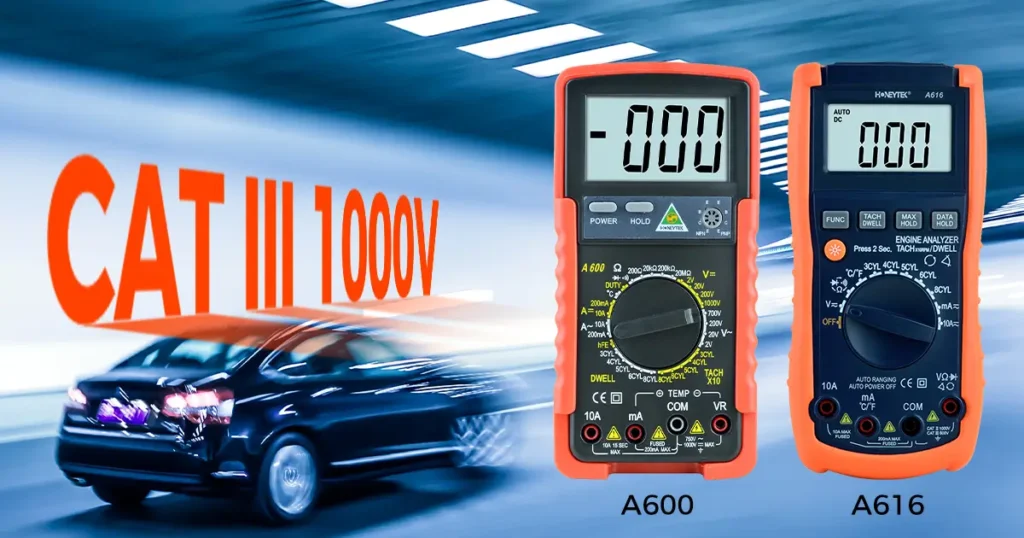
| Low-voltage automotive systems (12V/24V) | CAT III | Honeytek A600 / A616 | Safe up to 1000V, accurate, compact |
| Hybrid vehicles (up to 400V) | CAT III 1000V / CAT IV 600V | Honeytek HK78M | True RMS accuracy, temperature, duty cycle |
| Full electric vehicles (400–800V+) | CAT IV 600V | Honeytek HK78M | Advanced diagnostics for EV systems |
Product Highlights: Honeytek Multimeters with Certified CAT Protection
HK78M TRMS Automotive Multimeter — Designed for EV and Hybrid Professionals
The Honeytek HK78M is built for high-performance diagnostics in the most demanding environments.
- True RMS measurement for AC accuracy
- Voltage Range: 1000V DC / 600V AC
- Temperature: -40°C to 1000°C
- Capacitance, frequency, duty cycle, dwell & tach (RPM)
- Auto/manual range selection
- Safety Rating: CAT IV 600V / CAT III 1000V
Perfect for hybrid and electric vehicle diagnostics, where voltage precision and technician safety are critical.
A600 Manual Digital Multimeter — Reliable for Basic Automotive Use
Designed for students, home garages, and entry-level users, the Honeytek A600 provides essential functions for conventional automotive systems.
- Manual ranging up to 700V AC/DC
- Measures RPM, dwell angle, temperature
- CAT III 1000V safety rating
- Compact and durable design for everyday use
An ideal choice for basic maintenance and low-voltage diagnostics.
A616 Auto-Ranging Multimeter — Convenience Meets Performance
The Honeytek A616 combines simplicity and professional precision for general technicians.
- All A600 functions plus auto-ranging
- MAX/MIN hold, flashlight, and large LCD
- CAT III 1000V protection
- User-friendly design for routine vehicle checks
A dependable tool for workshops that value speed, clarity, and safety.
Why Choose Honeytek Multimeters for EV Safety
Honeytek has earned a reputation as a global manufacturer of electronic measuring instruments, including digital multimeters, clamp meters, and automotive diagnostic testers.
What Sets Honeytek Apart
- Global Safety Compliance: Certified CAT III and CAT IV designs meeting IEC 61010-1 standards.
- OEM/ODM Capability: Full customization for global distributors and training institutions.
- True RMS Accuracy: Reliable readings under complex automotive waveforms.
- Durability: Reinforced housing and insulation for workshop and field conditions.
- Innovation for EV Systems: Ready for hybrid and fully electric vehicle diagnostics.
With Honeytek, technicians can work confidently knowing their tools are designed for precision, protection, and performance.
Frequently Asked Questions (FAQ)
Q1: What is the meaning of CAT IV in a multimeter?
CAT IV indicates the multimeter can safely measure very high-energy circuits, such as power distribution panels or EV high-voltage systems, protecting users from dangerous voltage spikes.
Q2: Can I use a CAT II multimeter on an electric vehicle?
No. CAT II meters are not designed for high-voltage or transient environments like EV systems. Always use CAT III or CAT IV rated meters.
Q3: Why is True RMS important in automotive diagnostics?
True RMS ensures accurate readings even when measuring nonlinear signals — common in EV inverters and PWM-controlled systems.
Q4: How often should I inspect my test leads and multimeter?
Before every use. Replace any damaged or worn test leads immediately to maintain full safety compliance.
Q5: Does Honeytek offer OEM/ODM solutions?
Yes. Honeytek supports OEM/ODM customization for brands, training schools, and tool distributors worldwide.
In the evolving world of hybrid and electric vehicles, safety and precision are non-negotiable. Understanding CAT safety ratings helps technicians make informed decisions, protect themselves, and ensure reliable diagnostics.
Whether you’re handling a 12V starter circuit or an 800V battery system, choosing a Honeytek CAT-rated automotive multimeter guarantees the accuracy, durability, and protection you need.
With models like the HK78M TRMS, A600, and A616, Honeytek provides trusted solutions for every level of expertise — from students to EV specialists.
