
Introduction
Both instruments measure voltage, current, and resistance — yet they serve distinct purposes. Choosing the right one depends on your application, accuracy needs, and safety requirements.
In this guide, we’ll break down everything you need to know — from how each tool works to which one fits best for your tasks — so you can make a confident, informed purchase.
What Is a Digital Multimeter (DMM)?

A digital multimeter (DMM) is a versatile electronic measuring tool that combines several measurement functions into one device. It typically measures:
- Voltage (AC/DC)
- Current (AC/DC)
- Resistance (Ω)
- Continuity and diode testing
- Capacitance and frequency (on advanced models)
- Temperature (in professional-grade models)
How It Works
A DMM connects in series or parallel with the circuit, depending on what you’re measuring. The probes directly contact test points, allowing the meter to detect and display precise electrical readings on a digital screen.
Typical Use Cases
- Electronic circuit diagnostics
- PCB testing
- Household appliance repair
- Automotive diagnostics
- Industrial maintenance
For example, Honeytek’s HK78BT TRMS Bluetooth Digital Multimeter allows users to log data wirelessly to a smartphone or PC — ideal for modern, data-driven electrical maintenance.
What Is a Clamp Meter?
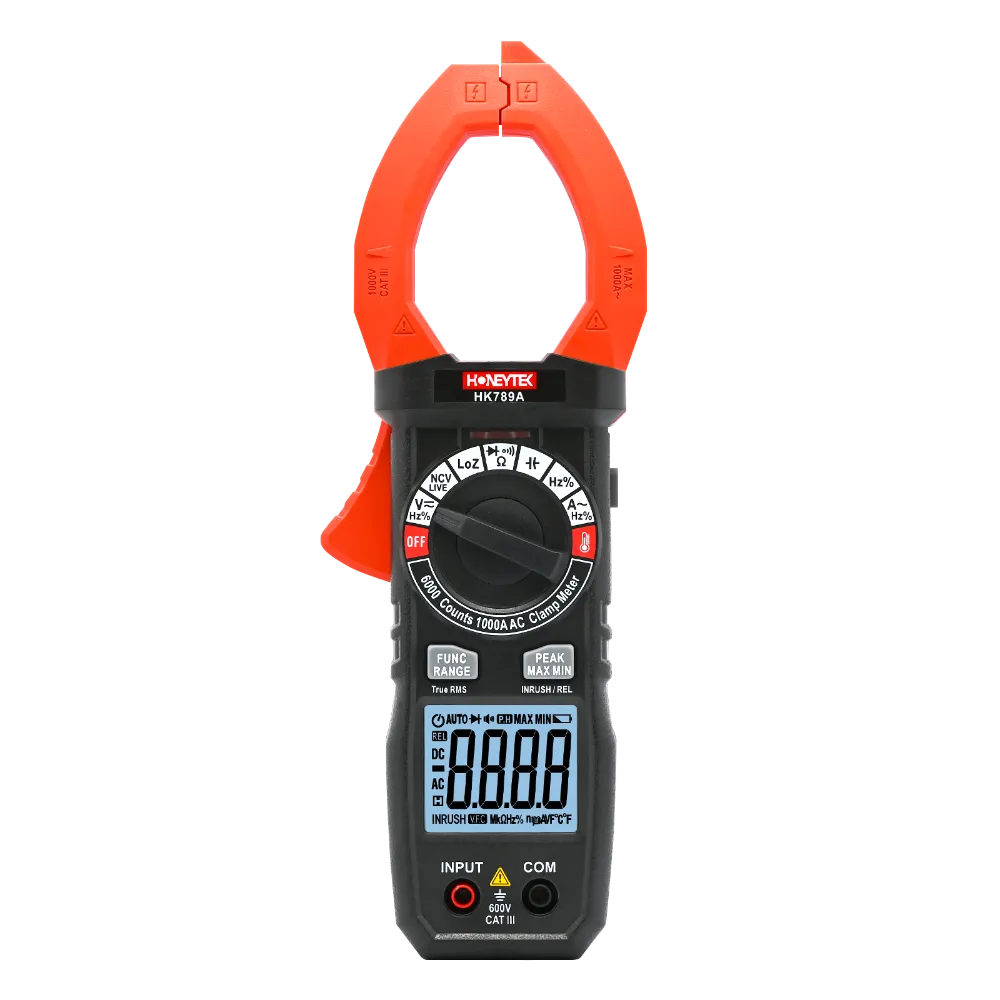
A clamp meter measures electrical current without touching or disconnecting the circuit. It does this through magnetic induction — when a conductor carrying current passes through the clamp jaw, it generates a magnetic field that the meter translates into an electrical reading.
Core Measurements
Modern clamp meters can measure far more than current alone. Advanced models include:
- AC/DC current (up to 2000 A)
- Voltage, resistance, and continuity
- Frequency and inrush current
- Temperature (with K-type probe)
- True RMS readings for accurate AC measurements
Typical Use Cases
- Industrial equipment testing
- Power distribution maintenance
- HVAC systems
- Automotive charging systems
- Solar PV installations
For instance, Honeytek’s HK888D 2000A TRMS Solar PV Clamp Meter is engineered for high-voltage renewable energy systems, offering 2000 V DC measurement and CAT IV 600 V safety rating — perfect for solar engineers and field technicians.
Key Differences Between Clamp Meter and Multimeter
| Feature | Digital Multimeter (DMM) | Clamp Meter |
|---|---|---|
| Primary Function | Measures voltage, resistance, and small currents | Measures high AC/DC current without circuit contact |
| Measurement Method | Requires direct connection to circuit | Measures current via magnetic field (non-contact) |
| Safety | Must break circuit to measure current | Safer – current measured without disconnection |
| Current Range | Typically up to 10 A | Up to 2000 A or more |
| Accuracy (Low Current) | More accurate for small electronic signals | Less accurate at very low current |
| Portability | Compact, ideal for benchtop or handheld use | Slightly larger but rugged |
| Best For | Electronics, small devices, detailed analysis | Industrial systems, maintenance, HVAC, power circuits |
In short:
- Choose a multimeter for precision and electronics.
- Choose a clamp meter for safety and high-current measurement.
Pros and Cons at a Glance
✅ Advantages of a Multimeter
- High precision for small circuits
- Wide measurement functions
- Compact and affordable
- Ideal for electronics and hobbyists
❌ Limitations
- Requires direct circuit contact
- Limited current range (usually < 10 A)
✅ Advantages of a Clamp Meter
- Non-contact current measurement
- High-current capability (hundreds to thousands of amps)
- Safer for live power systems
- Quick and convenient testing
❌ Limitations
- Less accurate for milliamps or microamps
- Bulky for tight circuit boards
True RMS: A Key Feature to Look For
If you’re measuring signals in non-linear loads (like VFDs, inverters, or power supplies), always choose a True RMS meter.
True RMS ensures accurate readings even when the waveform isn’t a perfect sine wave — essential for modern power systems.
Example:
Honeytek’s HK689B 1000A/1700V TRMS Clamp Meter filters noise from variable frequency drives using a Low-Pass Filter (LPF), ensuring precise readings on industrial inverters and PV systems.
When to Use Each Tool
Use a Multimeter When:
- Working on electronics, sensors, or automotive ECUs
- You need precise voltage or resistance readings
- Diagnosing small circuits and continuity
- Testing diodes, capacitors, or frequency response
Use a Clamp Meter When:
- Measuring high current in industrial circuits
- Troubleshooting power panels or motors
- Working on HVAC or renewable energy systems
- You prioritize safety and convenience
Combined Clamp Multimeters — The Best of Both Worlds
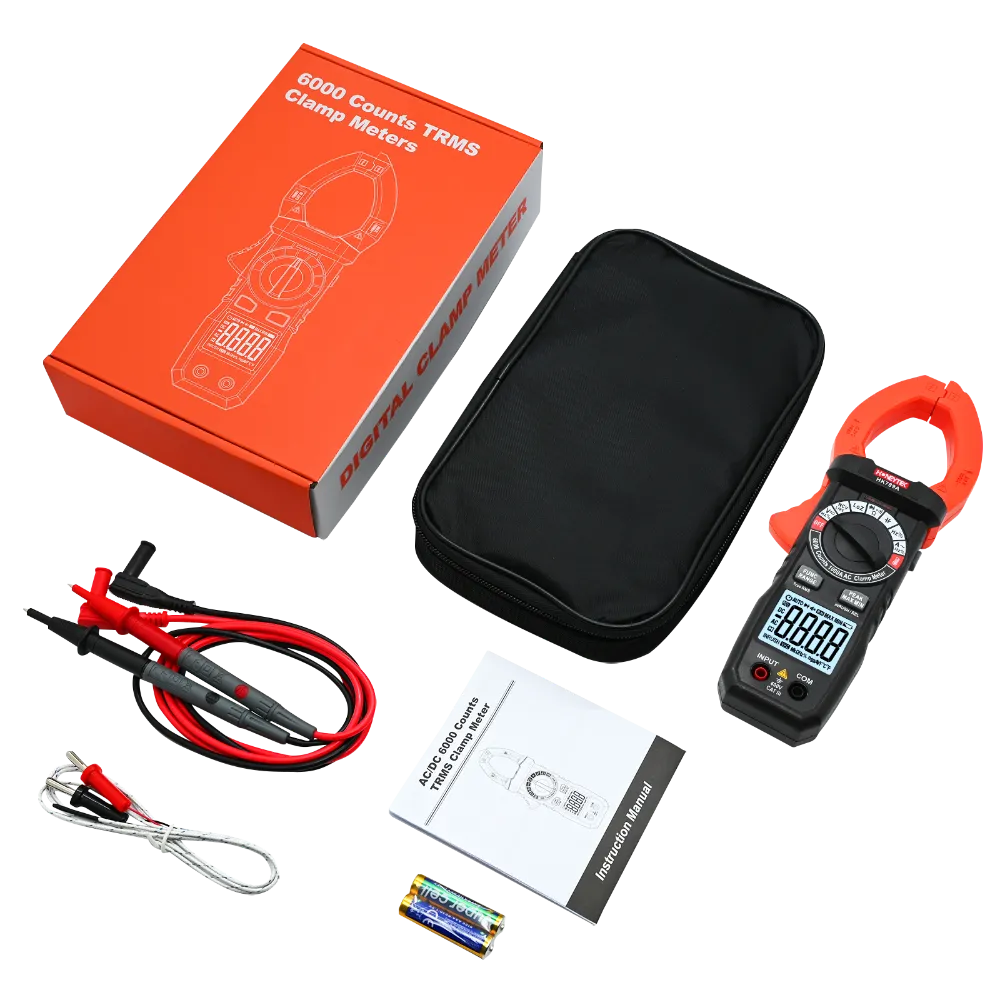
Some professional meters combine both functions — offering voltage, resistance, and high-current measurement in a single device.
For example, Honeytek’s HK788D TRMS Clamp Meter integrates a full multimeter function set (voltage, resistance, frequency) with large-jaw current measurement — ideal for electricians who want one tool for everything.
Buying Guide: How to Choose the Right Tool
1. Define Your Application
Are you testing small circuits or large power systems?
- For electronics or automotive, pick a DMM.
- For HVAC, industrial, or PV systems, go with a clamp meter.
2. Check Measurement Ranges
- Voltage: At least 600 V AC/DC
- Current: Up to 1000 A (for clamp meters)
- Resistance: ≥ 60 MΩ for versatility
3. Prioritize Safety Ratings
Always check the CAT rating:
- CAT II: Household appliances and sockets
- CAT III: Distribution panels, building wiring
- CAT IV: Main supply lines, outdoor installations
4. Accuracy and Display
Higher count displays (e.g., 6000 counts or 10,000 counts) provide better resolution. Backlit LCD and auto-range are must-have features for professionals.
5. Extra Features to Consider
- True RMS measurement
- Bluetooth data logging
- Low-pass filter for noisy circuits
- Temperature measurement
- NCV (Non-Contact Voltage) detection
Real-World Examples
| Scenario | Recommended Tool | Honeytek Model |
|---|---|---|
| Solar PV system maintenance | Clamp Meter | HK888D |
| Automotive diagnostics | DMM | HK78M |
| Industrial power analysis | Clamp Meter | HK689D |
| Lab electronic testing | DMM | HK78BT |
| Field inspection / HVAC | Clamp Meter | HK788A |
Expert Tip: Always Verify Calibration
No matter which instrument you choose, annual calibration ensures long-term accuracy and compliance with safety standards (IEC 61010, CE, or UL).
Honeytek provides factory-calibrated instruments with certification available for OEM/ODM customers.
Frequently Asked Questions (FAQ)
1. Can a clamp meter measure voltage like a multimeter?
Yes. Most modern clamp meters also measure voltage, resistance, and continuity — making them partial replacements for a DMM in field work.
2. Is a clamp meter less accurate than a multimeter?
Generally, yes — for low currents, a DMM is more accurate. But for high current systems, clamp meters are safer and more practical.
3. What is True RMS, and why does it matter?
True RMS measures the actual effective value of AC signals, even if distorted — critical for systems with inverters or variable frequency drives.
4. Can I measure DC current with any clamp meter?
No. Only models with Hall-effect sensors can measure DC current. Check your specifications before purchase.
5. Which tool is safer for live circuits?
Clamp meters are safer because they measure current without breaking the circuit, minimizing shock risk.
6. Should I buy both?
If your work involves both electronics and power systems, yes — or choose a hybrid model like Honeytek’s HK788D.
Final Verdict: Which One Should You Buy?
| Your Need | Recommended Tool |
|---|---|
| Electronics, small components | Digital Multimeter |
| Industrial, HVAC, or PV systems | Clamp Meter |
| Both environments | Dual-function TRMS Clamp Multimeter |
If you value precision, go for a DMM.
If you prioritize safety and high current testing, pick a Clamp Meter.
And if you want versatility, a True RMS Clamp Multimeter gives you both worlds.
Why Choose Honeytek?
As a leading manufacturer of digital multimeters, clamp meters, insulation testers, and thermal imaging tools, Honeytek offers:
- Factory-direct production with attractive pricing — delivering high-value instruments without middlemen markups.
- Professional quality and reliability that meet international safety standards (CE, FCC, ETL).
- OEM/ODM customization for global brands and distributors.
- Comprehensive technical support and calibration services to ensure long-term accuracy and confidence.
Whether you’re an industrial electrician, automotive technician, or solar PV engineer, Honeytek provides professional-grade measurement tools that combine precision, durability, and exceptional value — trusted by engineers and industries worldwide.
