
Introduction
When working with live electrical systems, measuring current accurately and safely is often a challenge. Many beginners ask:
“Can I just use a multimeter to measure current, or do I need a clamp meter?”
The answer depends on your situation.
While a digital multimeter (DMM) provides high precision for low-current testing, certain field environments demand non-intrusive, high-current measurement — where only a clamp meter is appropriate.
This guide explains the scenarios that require a clamp meter, key safety precautions, and how to combine clamp meters with multimeters for professional diagnostics.
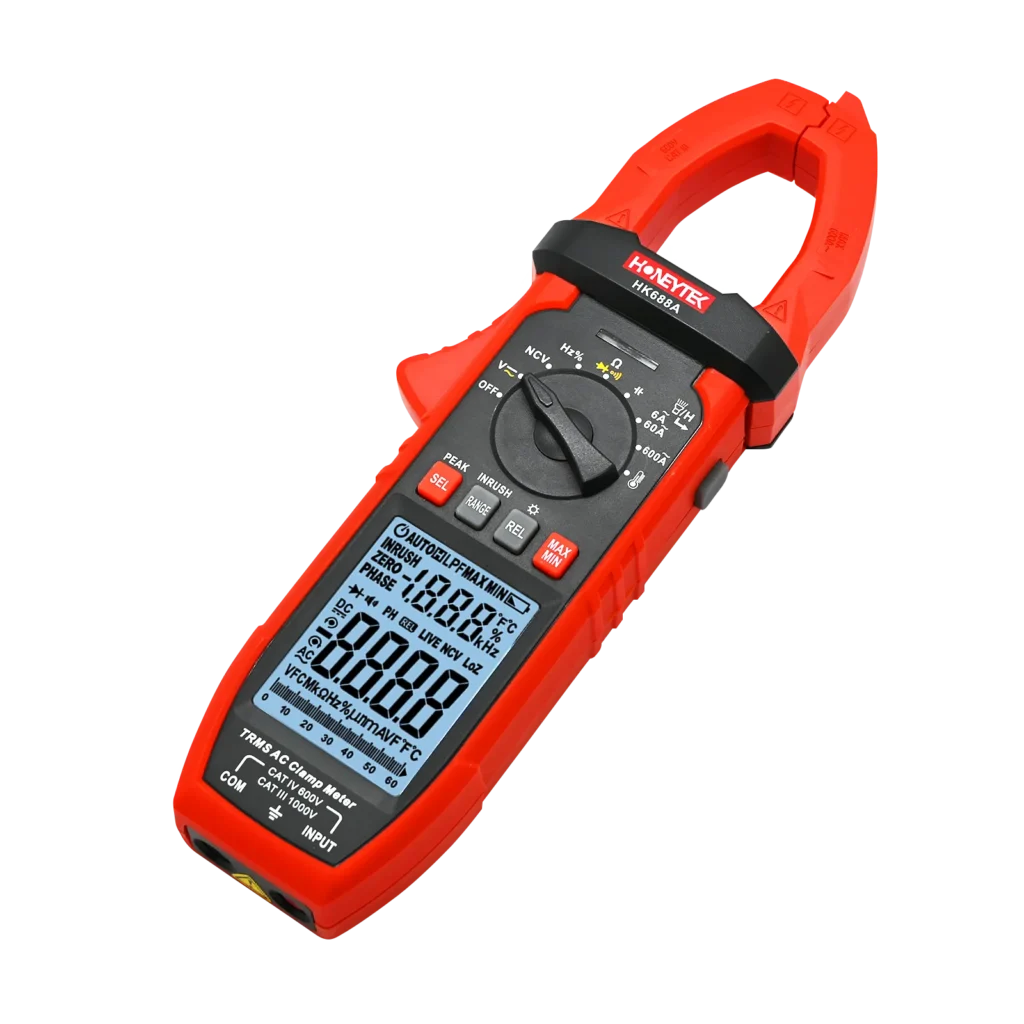
What Makes a Clamp Meter Different?
A clamp meter measures current by detecting the magnetic field around a single conductor, eliminating the need to disconnect or break the circuit.
This non-contact design allows electricians and engineers to measure high currents (hundreds or thousands of amps) safely, quickly, and efficiently — even when power remains on.
In contrast, a multimeter measures current by routing electricity through the meter’s internal circuit, which often requires disconnecting wires or interrupting the system — an unsafe or impractical step in many industrial environments.
When You Must Use a Clamp Meter
1. Routine Field Inspection and Maintenance
During facility inspections, technicians must often detect abnormal current flow, short circuits, or load imbalance while the system remains energized.
A clamp meter lets you:
- Measure current on live conductors instantly
- Identify overloaded circuits or faulty equipment
- Monitor three-phase balance without shutdown
This is especially valuable in factories, distribution boards, and maintenance workshops.
2. High-Voltage or High-Current Lines
In power distribution panels, busbars, transformers, or motor circuits, the current is typically too large for a DMM to handle.
Clamp meters designed for 1000 A to 2000 A (like the Honeytek HK888D TRMS Clamp Meter) can safely test these circuits without contact or risk of arcing.
You can even determine current direction or phase load differences in real time — critical for maintenance engineers.
3. Continuous System Operation
In environments such as server rooms, production lines, or HVAC systems, you cannot afford to power down equipment.
A clamp meter allows you to:
- Monitor current draw under actual load conditions
- Diagnose efficiency and thermal issues
- Evaluate motor startup behavior and inrush current
This helps ensure uninterrupted operation while still performing essential diagnostics.
4. Cable Routing and Hidden Load Detection
Clamp meters can also locate concealed loads or abnormal branches without opening panels.
By clamping around wire bundles, you can detect:
- Unexpected current flow
- Unauthorized equipment connections
- Leakage or ground faults
This non-destructive inspection method saves time and prevents unnecessary disassembly.
5. Compliance and Safety Regulations
Certain safety codes recommend or require non-contact current measurement to minimize electric shock risk.
In high-current or high-voltage circuits, breaking the circuit can be extremely dangerous — using a clamp meter helps maintain compliance with IEC 61010 and CAT III / CAT IV safety standards.
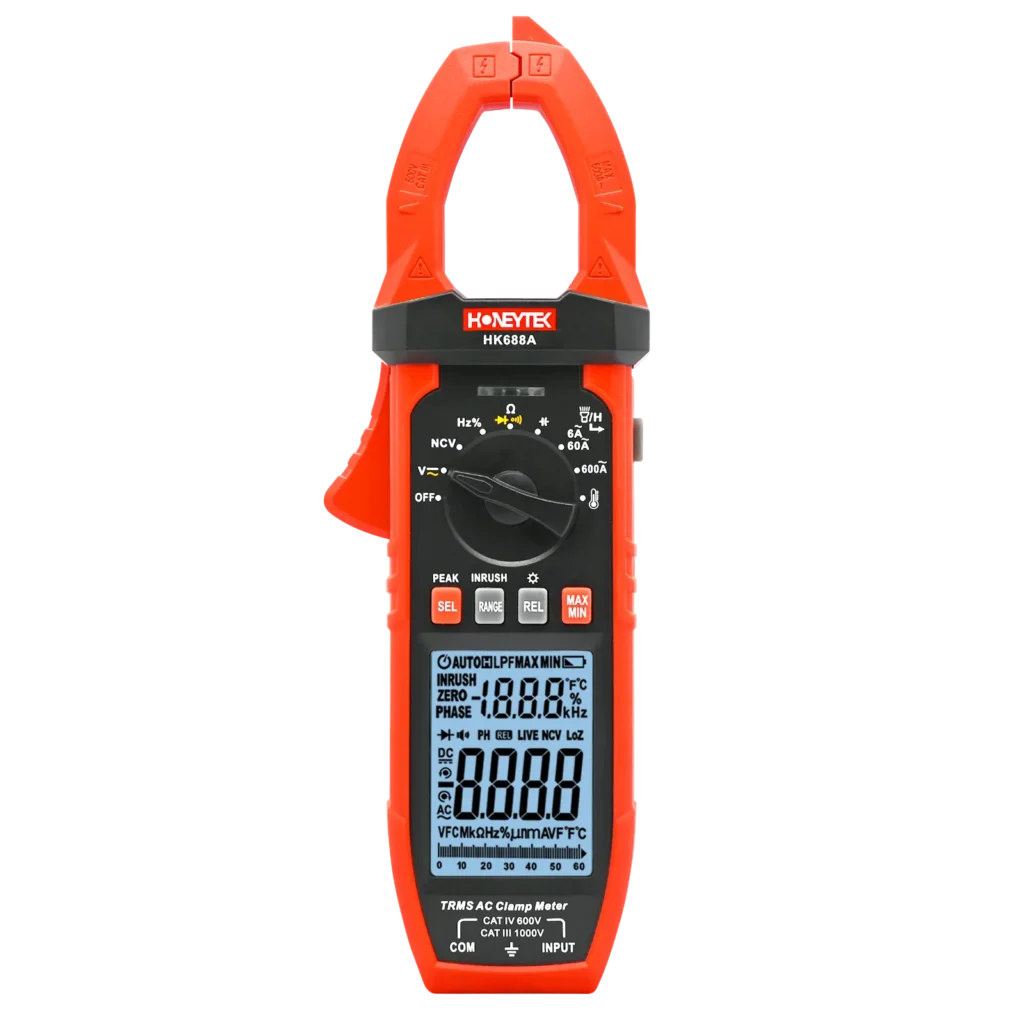
Safety Precautions and Proper Usage
1. Measure One Conductor at a Time
A clamp meter can only measure one live conductor accurately.
If you clamp around two wires (phase + neutral), their magnetic fields cancel out — producing a near-zero reading.
✅ Tip: Always separate the conductor you wish to test before measurement.
2. Select the Correct Range
Before measurement:
- Estimate expected current
- Start from a higher range to prevent overload
- Use meters rated above the circuit’s maximum current (e.g., 1000 A or 2000 A models for industrial systems)
Honeytek clamp meters include auto-range and overrange protection, ensuring safety during initial testing.
3. Check Safety and Insulation Ratings
Use meters with certified safety categories:
- CAT III 1000 V / CAT IV 600 V for industrial panels
- Properly insulated jaws and double-molded housings
Wear insulated gloves and boots, and stand on dry, non-conductive flooring when working on live circuits.
4. Understand When Contact Is Still Required
Clamp meters are ideal for current measurement, but when testing:
- Voltage
- Resistance
- Continuity
you must still use test leads or a digital multimeter and follow standard lockout/tagout (LOTO) procedures before contact.
5. Maintain Accuracy Through Calibration
Temperature, waveform distortion, and frequency can affect readings.
Schedule annual calibration or use built-in zeroing and self-test features to maintain accuracy.
In high-frequency or pulsed-current environments, select clamp meters with appropriate bandwidth and response time.
6. Environmental Awareness
Avoid measurement in:
- Humid or dusty environments
- Areas with strong magnetic interference or vibration
Extreme heat or cold can also shift readings. Always store your instrument in a protective case after use.
7. Follow Worksite Safety Protocols
Never touch bare conductors while measuring.
In explosive or corrosive atmospheres, select meters with the correct IP protection rating and anti-spark certification.
8. Record Data for Traceability
Document:
- Conductor ID and location
- Rated voltage/current
- Environmental conditions
- Range setting and timestamp
Honeytek’s Bluetooth-enabled clamp meters allow wireless data logging directly to a smartphone or PC — simplifying later analysis.
How to Combine Clamp Meters and Multimeters
Each tool excels in different areas:
| Purpose | Best Tool | Why |
|---|---|---|
| Quick field inspection / large current | Clamp meter | Non-contact, fast, and safe |
| Precision testing / low current | Digital multimeter | Higher resolution and accuracy |
| Continuity and resistance testing | Digital multimeter | Direct probe connection |
| System diagnostics (overview) | Both | Clamp meter locates issue, multimeter confirms values |
A typical troubleshooting process:
- Scan with a clamp meter to identify overload or imbalance.
- Pinpoint issues with a multimeter for precise voltage and resistance verification.
This complementary use saves time and enhances safety during complex fault analysis.
Key Buying Factors
✅ For Clamp Meters
- Wide current range: at least 1000 A AC/DC
- True RMS measurement: accurate on distorted waveforms
- Sampling rate and bandwidth: suitable for pulsed or inverter loads
- Safety rating: CAT III/CAT IV certification
- Durability: impact-resistant, ergonomic design
- Sensor type: Hall-effect for DC current, or transformer for AC only
✅ For Multimeters
- High accuracy and resolution for small-signal testing
- Comprehensive measurement parameters: voltage, current, resistance, capacitance, frequency, temperature
- Auto-range and data hold functions
- Additional features: phase rotation, continuity buzzer, NCV detection
- Robust insulation and safety category compliance
Honeytek’s professional series — such as the HK78BT TRMS Bluetooth Multimeter and HK689D Clamp Meter — integrate these capabilities for industrial, automotive, and solar applications.
Common Mistakes to Avoid
- Clamping around both conductors of a power cable (reading = 0)
- Using the wrong range or exceeding the meter’s rating
- Forgetting to zero or calibrate before DC measurement
- Ignoring environmental temperature or external magnetic fields
- Using unverified meters without safety certification
By understanding these fundamentals, you’ll get reliable data while keeping yourself safe.
Frequently Asked Questions (FAQ)
1. Can a clamp meter measure voltage or resistance?
Yes, many modern clamp meters also measure voltage, resistance, and continuity — but their core advantage remains non-contact current measurement.
2. What’s the difference between AC and DC clamp meters?
AC-only models use transformer jaws; DC-capable ones use Hall-effect sensors.
If you need to measure DC (e.g., solar PV or EV systems), always confirm the meter supports it.
3. Can I use a clamp meter for small currents?
Clamp meters are less precise below ~1 A. For milliamps or microamps, use a DMM or a low-current probe.
4. Why is True RMS important?
True RMS ensures accuracy when measuring non-sinusoidal signals, such as variable-frequency drives or inverter outputs — common in modern industry.
5. How often should I calibrate my clamp meter?
At least once per year, or after heavy use in harsh environments, to maintain compliance and ensure data traceability.
6. Are clamp meters safe for live circuits?
Yes — that’s their biggest advantage.
Always check the CAT rating and ensure the instrument’s insulation and jaw gap are suitable for the circuit voltage.
7. What if I need both precision and convenience?
Consider a dual-function True RMS clamp multimeter, which combines high-current clamps with full multimeter functions — ideal for electricians and maintenance engineers.
Summary: When a Clamp Meter Is Essential
| Scenario | Why You Need It |
|---|---|
| Live-system measurement | No shutdown required |
| High-current lines | DMM cannot handle large current safely |
| Continuous operation (servers, HVAC) | Monitor without downtime |
| Hidden cable tracing | Locate branches or leakage |
| Safety compliance | Non-contact, low-risk measurement |
In short:
Use a clamp meter whenever you need to measure high current, live circuits, or inaccessible wiring — and combine it with a digital multimeter for detailed analysis.
Why Choose Honeytek
As a professional manufacturer of digital multimeters, clamp meters, insulation testers, and thermal imaging tools, Honeytek provides:
- Factory-direct production with attractive pricing, offering professional performance at exceptional value
- Certified safety and quality that meet global standards (CE, FCC, ETL)
- OEM/ODM customization for brands and distributors worldwide
- Full technical support and calibration services for long-term reliability
Whether you’re maintaining industrial equipment, automotive systems, or solar PV installations, Honeytek instruments deliver precision, durability, and confidence trusted by professionals in over 60 countries.
Ready to upgrade your toolkit?
Explore Honeytek’s range of True RMS Clamp Meters and Digital Multimeters today.
