
Introduction
Clamp meters are essential diagnostic tools in air-conditioning and refrigeration servicing. They allow HVAC technicians to measure current without disconnecting wires, making compressor troubleshooting faster and safer. This guide explains how to correctly measure compressor running current, capture inrush (starting) current, and evaluate the start capacitor’s health using a clamp meter. These procedures apply to both residential and commercial air-conditioning systems.
Honeytek manufactures professional digital multimeters and clamp meters—including the HK33D HVAC multimeter and HK266 series clamp meters—designed specifically for air-conditioning, heat pump, and refrigeration diagnostics.
Why Clamp Meters Are Essential in HVAC Electrical Diagnostics
Clamp meters make it possible to diagnose a wide range of compressor-related electrical problems:
• Measuring compressor running current
• Measuring inrush current during startup
• Verifying start and run capacitor performance
• Checking line voltage
• Detecting leakage current
• Identifying current imbalance in three-phase systems
• Troubleshooting compressor start failures
The Honeytek HK266/HK266C/HK266F clamp meters also support temperature, micro-amp flame sensor testing, capacitance, continuity, and other HVAC-specific functions.

How to Measure AC Compressor Running Current
To determine whether an air-conditioning compressor is operating normally, technicians compare the actual current draw with the rated running load amps (RLA) shown on the compressor nameplate.
Preparation and Safety
Before performing any measurements:
• Ensure proper protective equipment is worn
• Confirm the work area is dry and insulated
• Identify the correct supply wire (typically L1)
• Verify that only one conductor will be clamped
• Review compressor nameplate data: rated voltage, RLA, and LRA
Selecting the Clamp Meter Setting
Set the clamp meter to AC current (ACA).
If the meter uses manual ranging, select the range just above the expected current.
Ensure the clamp jaws close completely for accurate readings.
Taking the Measurement
Clamp only one conductor.
Position the wire in the center of the clamp.
Restore power and start the system.
The reading should stabilize near the compressor’s rated RLA.
How to Interpret the Results
• Current within ±10% of RLA → Normal operation
• Higher current → Dirty condenser coil, airflow restrictions, low refrigerant charge, mechanical resistance
• Lower current → Weak start capacitor, incorrect voltage, inefficient compressor
Technicians should repeat the measurement two or three times to confirm accuracy.
How to Measure AC Compressor Starting (Inrush) Current
Inrush current is the surge of current drawn the moment the compressor begins to start, often two to seven times higher than the normal running current.
Measuring Inrush with a Clamp Meter
If your clamp meter supports inrush mode—such as the Honeytek HK266 series—enable the “INRUSH” function.
Clamp the L1 wire, then restore power and observe the peak current as the compressor starts.
What the Inrush Reading Means
• High but brief inrush → Normal
• Abnormally low inrush → Weak or failing start capacitor
• High and prolonged inrush → Seized compressor, faulty relay, mechanical binding
These patterns are powerful indicators of compressor health and system readiness.
How to Test an AC Start Capacitor Using a Clamp Meter
Start capacitors provide the torque needed for the compressor to start. A failing capacitor can lead to hard starts, overheating, repeated motor trips, or complete failure to start.
Capacitor Diagnosis Using Current Behavior
The easiest field method is to observe inrush current:
• Low inrush → Not enough starting torque
• Long starting time → Weak capacitor
• Compressor humming but not starting → Capacitor failure likely
Running Current Method
A weak capacitor causes the compressor to draw more current during operation.
If running current is significantly higher than expected, inspecting the start capacitor is necessary.
Direct Measurement Method (Most Accurate)
For the most reliable result:
- Disconnect power
- Discharge the capacitor
- Remove at least one terminal
- Measure the capacitance using an HVAC multimeter such as Honeytek HK33D
- Compare with rated value
Deviation greater than ±10% generally indicates a failing capacitor.
Common Electrical Problems Identified with a Clamp Meter
Clamp meter readings help pinpoint several issues quickly:
| Symptom | Likely Cause |
|---|---|
| Low inrush current | Weak start capacitor |
| High running current | Low refrigerant, airflow restriction, mechanical load |
| High inrush with failure to start | Bad relay, locked compressor |
| Current imbalance in 3-phase loads | Phase loss or faulty wiring |
| Zero current | Open circuit, tripped breaker, faulty contactor |
These insights make the clamp meter a critical tool for HVAC field diagnostics.
Recommended Honeytek Tools for HVAC Compressor Testing
Honeytek provides reliable, durable, and technician-focused instruments:
Honeytek HK33D HVAC Digital Multimeter
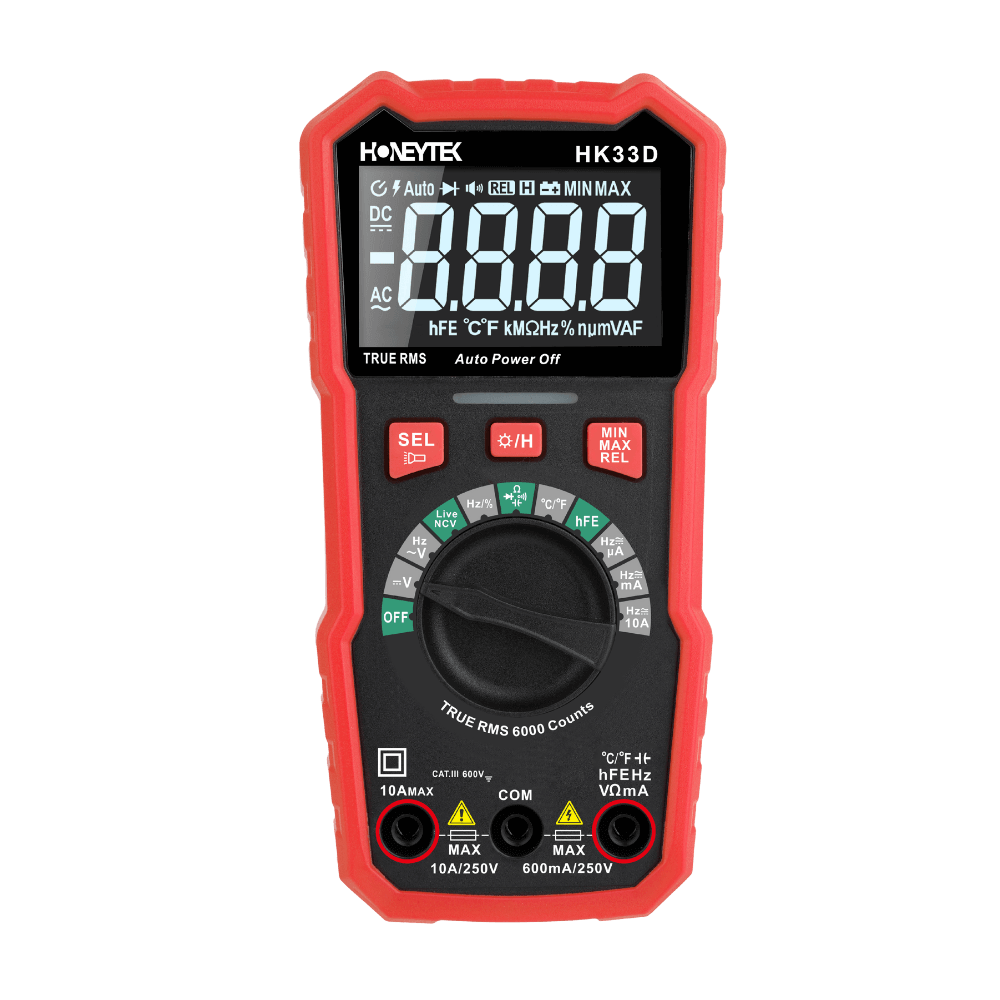
• Measures micro-amp current for flame sensors
• Built-in thermometer for HVAC temperature diagnostics
• LoZ mode for eliminating ghost voltage
• Capacitance, continuity, resistance, and frequency measurement
• Bright backlit display for low-light environments
Honeytek HK266 / HK266C / HK266F Clamp Meters
• Ideal for compressor and motor diagnostics
• Measures start and run capacitors
• Supports inrush current capture
• Detects equipment leakage current
• Measures supply and load-side voltage and current
• Balanced measurement for three-phase systems
• Suitable for both installation and daily service
Safety Tips When Using Clamp Meters on HVAC Systems
• Never clamp multiple wires simultaneously
• Keep fingers behind safety barriers
• Avoid measurement in wet environments
• Ensure the clamp jaw closes completely
• Never exceed rated voltage/current
• Follow manufacturer instructions
Working safely prevents accidental shock, damage to equipment, or inaccurate readings.
Frequently Asked Questions
Why is compressor current higher than the nameplate rating?
Common reasons include poor airflow, dirty coils, refrigerant imbalance, or mechanical wear.
Can a start capacitor be tested without removing it?
Yes. Evaluating inrush behavior provides a quick indication, but capacitance measurement gives the most accurate result.
What happens if a capacitor’s microfarad value decreases?
The compressor loses starting torque, overheats, and may fail to start reliably.
Why clamp only one wire?
Clamping multiple conductors cancels magnetic fields, resulting in zero or inaccurate readings.
How often should capacitors be inspected?
At least once per year during routine HVAC maintenance.
Conclusion
Accurate measurement of compressor running current, inrush current, and capacitor performance is essential for HVAC troubleshooting. With a reliable clamp meter, technicians can quickly identify electrical and mechanical problems, prevent equipment failure, and maintain system efficiency.
Honeytek designs and manufactures high-quality digital multimeters, HVAC meters, and clamp meters trusted by professionals worldwide.
To explore Honeytek clamp meters and HVAC diagnostic tools, visit:
www.honeytek.com
For OEM/ODM cooperation, reach out to us anytime.
