
When working with voltage testers and multimeters in live environments, verifying instrument functionality is not optional—it is a mandatory safety step. A proving unit provides a known, stable voltage source to confirm that your tester is operating correctly before and after measurement.
This article provides a technical, engineer-focused comparison between Honeytek proving units—specifically the HK690—and widely used Martindale units, helping you make a rational selection based on real-world electrical testing workflows.
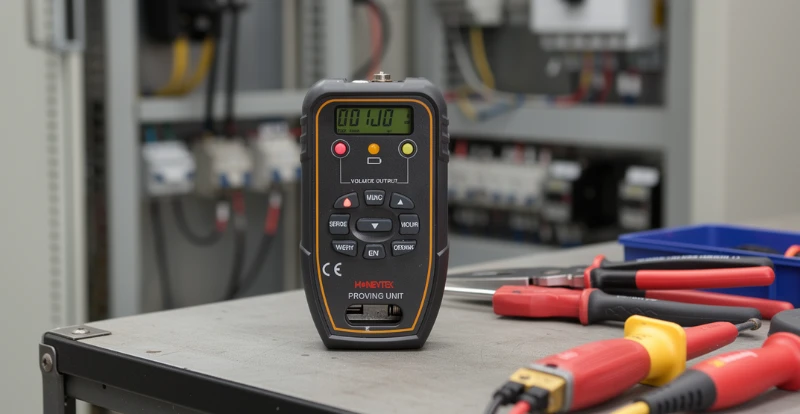
What Is a Proving Unit and Why It Matters
A proving unit is a portable voltage source designed to validate that voltage indicators (such as two-pole testers or multimeters) are functioning correctly.
In professional practice:
- It supports safe isolation procedures
- It ensures compliance with lockout/tagout (LOTO) protocols
- It reduces false negatives caused by faulty instruments
Without a proving unit, you are relying on assumed instrument integrity, which introduces unacceptable risk in energized systems.
Honeytek HK690 Proving Unit: Technical Overview
The Honeytek HK690 is engineered as a compact, battery-powered proving solution for field electricians and technicians.
Key Specifications
- Output Voltage: 690V AC (50Hz) constant output
- Compatibility: High and low impedance testers
- Application Scope:
- Two-pole voltage testers
- Digital multimeters
- Indication: High-visibility LED indicators
- Power Supply: 6 × AA alkaline batteries
- Mechanical Design: Lightweight, rugged enclosure
Engineering Analysis: Honeytek vs Martindale
1. Output Stability and Test Integrity
Both Honeytek and Martindale proving units are designed to provide a stable AC reference voltage.
- Honeytek HK690:
Maintains a consistent 690V AC output, sufficient for industrial and commercial testing scenarios. - Martindale Units:
Typically offer multiple voltage steps (e.g., 50V–690V), which may be advantageous for staged verification.
Engineering Insight:
If your workflow primarily involves high-voltage confirmation, a fixed 690V output (HK690) is efficient and reduces complexity. Multi-step outputs are beneficial for calibration-level diagnostics, but not always necessary in routine field verification.
2. Instrument Compatibility (Hi-Z / Lo-Z Testing)
Modern testers vary in impedance characteristics.
- Honeytek HK690:
Explicitly designed to validate both high-impedance and low-impedance instruments, ensuring broader compatibility. - Martindale:
Also supports standard testers, with strong legacy adoption in compliance-heavy markets.
Engineering Insight:
Compatibility with low-impedance testers is critical for avoiding ghost voltage misinterpretation. HK690 meets this requirement effectively.
3. Portability and Power Architecture
- Honeytek HK690:
- Battery-powered (6 × AA)
- Fully portable, no mains dependency
- Suitable for field, rooftop PV, and remote industrial sites
- Martindale:
- Available in both battery-powered and mains-powered variants
Engineering Insight:
Battery-powered units like HK690 are more flexible in distributed testing environments, especially where grid access is unavailable or restricted.
4. User Interface and Feedback Mechanism
- Honeytek HK690:
- Bright LED indicators for immediate visual confirmation
- Minimal interface reduces user error
- Martindale:
- Often includes multi-level LED arrays for voltage gradation
Engineering Insight:
For quick verification, binary confirmation (pass/fail) is often preferable. Complex indication systems are useful but can introduce interpretation overhead under time pressure.
5. Mechanical Durability and Field Suitability
- Honeytek HK690:
- Lightweight yet rugged enclosure
- Designed for daily transport and repetitive use
- Martindale:
- Known for robust build quality, widely trusted in UK/EU markets
Engineering Insight:
Durability is comparable; selection should depend more on ergonomics and workflow fit than brand perception.
Where the Honeytek HK690 Fits Best
The HK690 is particularly well-suited for:
- Industrial electricians performing routine verification
- Solar PV technicians needing portable validation tools
- Maintenance engineers working across distributed assets
- Field service teams requiring lightweight, battery-powered solutions
Manufacturer Context: Honeytek’s Engineering Scope
Honeytek is not limited to proving units. As a measurement instrument manufacturer, its portfolio includes:
- Infrared thermal imagers (for predictive maintenance and fault detection)
- Digital multimeters (TRMS, high-voltage, industrial-grade)
- Clamp meters (AC/DC current diagnostics)
This broader product ecosystem allows for integrated toolchain consistency, which is often overlooked when mixing brands across measurement categories.
Practical Selection Guidance
From an engineering standpoint:
- Choose Honeytek HK690 if you need:
- A simple, reliable, portable proving unit
- Consistent high-voltage verification
- Field-ready battery operation
- Consider Martindale if you require:
- Multi-voltage step verification
- Region-specific compliance familiarity (e.g., UK standards)
FAQ
1. Do I need a proving unit if my multimeter is new?
Yes. Even new instruments can fail or be damaged. A proving unit verifies actual operational status, not assumed reliability.
2. Can the HK690 test both multimeters and two-pole testers?
Yes. It is designed to validate both high-impedance and low-impedance devices, including standard multimeters and voltage testers.
3. Why is 690V output important?
690V AC aligns with industrial voltage levels, ensuring your tester can handle real-world conditions safely.
4. Is battery operation reliable for a proving unit?
Yes. Battery-powered designs like HK690 provide stable output while improving portability and safety isolation from mains supply.
5. How often should I use a proving unit?
Best practice:
- Before and after every critical voltage test
This ensures continuous verification and aligns with safety protocols.
From a purely engineering perspective, the Honeytek HK690 delivers a focused, field-efficient solution for voltage tester verification. It avoids unnecessary complexity while maintaining compatibility, portability, and reliability—key factors in real-world electrical work.
If you are evaluating proving units or building a complete electrical testing toolkit:
- Assess your voltage range requirements
- Prioritize portability vs feature depth
- Ensure compatibility across your instruments
For engineers and distributors looking for OEM/ODM measurement solutions, Honeytek offers a full range of thermal imagers, digital multimeters, clamp meters, and proving units designed for global markets.
