
In electrical testing, one of the most overlooked risks is false confidence in a faulty tester. This is exactly why proving units exist. If you’ve ever asked “what is a proving unit for electrical testers?” or “do I need a proving unit for safe isolation?”, this guide provides a clear, engineering-level explanation.
What Is a Proving Unit for Electrical Testers?

A proving unit is a portable voltage source designed to verify that a voltage tester or multimeter is functioning correctly before and after testing a live circuit.
It is not a calibration device. Instead, it is a functional verification tool used in accordance with safe isolation procedures.
Key Definition
- Purpose: Confirm tester operation (not accuracy calibration)
- Output: Known, stable voltage (AC and/or DC)
- Users: Electricians, maintenance engineers, solar PV technicians
- Compliance Role: Supports safe isolation standards (e.g., GS38 practices)
Proving Unit vs Multimeter Calibration (Common Confusion)
This is a frequent misunderstanding in the field.
| Function | Proving Unit | Calibration |
|---|---|---|
| Objective | Verify tester works | Verify measurement accuracy |
| Method | Apply known voltage | Compare against certified standard |
| Frequency | Before & after every test | Periodic (e.g., annually) |
| Use Case | Safety check | Quality assurance |
Engineering takeaway:
A proving unit answers “Is my tester alive?” — calibration answers “How accurate is it?”
Why You Need a Proving Unit for Safe Isolation
Safe isolation procedures require a three-point test method:
- Test your voltage tester on a known source (proving unit)
- Test the circuit under investigation
- Re-test your tester on the proving unit
Without a proving unit, step 1 and step 3 rely on assumptions.
Risk Without a Proving Unit
- False zero readings
- Damaged tester not detected
- Increased risk of electric shock
For compliance-driven environments, the question is no longer “do I need a proving unit?”—it becomes “why would you work without one?”
Key Features of a High-Quality Proving Unit
When evaluating proving unit specifications for high voltage, engineers typically focus on:
1. Stable Output Voltage
- Must deliver consistent voltage under load
- Common industrial range: up to 690V AC
2. Compatibility (Hi-Z / Lo-Z)
- Should support both:
- High-impedance multimeters
- Low-impedance voltage testers
3. Clear Indication System
- LED indicators for quick confirmation
- Reduces interpretation errors in field conditions
4. Portability
- Battery-powered units preferred for site work
- No dependency on mains supply
5. Rugged Mechanical Design
- Drop resistance
- Suitable for industrial environments
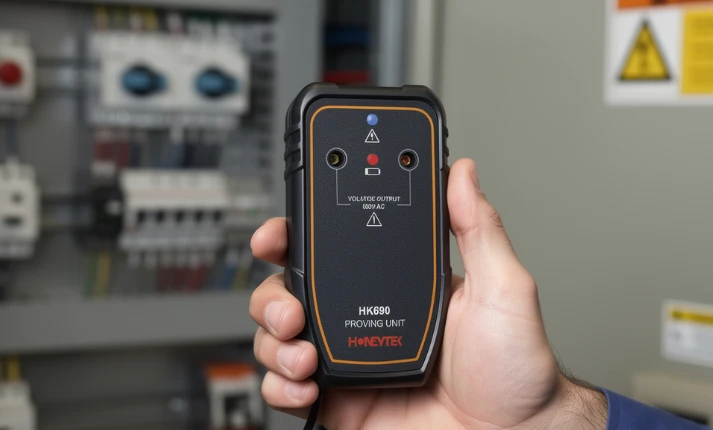
Example: Honeytek HK690 Proving Unit
The Honeytek HK690 is a practical example of a compact proving unit for site work, designed around real-world electrical workflows.
Core Specifications
- 690V AC (50Hz) constant output
- Designed for high and low impedance instruments
- Suitable for:
- Two-pole voltage testers
- Digital multimeters
- Bright LED indicators for clear feedback
- Lightweight, rugged enclosure
- Battery-powered (6 × AA alkaline)
Engineering Perspective
Compared to more complex units (e.g., multi-voltage models like the Fluke PRV240), the HK690 focuses on:
- Single high-voltage verification (690V)
- Reduced complexity → lower user error
- Better suitability for routine field validation
Applications: Where Proving Units Are Used
1. Industrial Electrical Maintenance
- Verifying circuits before servicing
- Ensuring tester reliability in high-voltage panels
2. Construction Sites
- Daily safe isolation checks
- Often paired with 110V systems and portable testers
3. Solar PV Systems
- Critical for high accuracy proving unit for solar PV workflows
- Ensures safe DC/AC system testing
4. Facility Management
- Routine inspection of electrical infrastructure
- Reduces downtime caused by faulty tools
5. Field Service Engineering
- Portable verification tool for distributed assets
- Ideal for environments without fixed power sources
How to Use a Proving Unit (Step-by-Step)
If you’re searching for “how to use a proving unit step by step”, here is the standard method:
- Initial Check
Test your voltage tester on the proving unit → confirm it detects voltage - Test the Target Circuit
Measure the actual circuit - Post-Test Verification
Re-test on the proving unit → confirm tester still works
This 3-step loop is critical for safe isolation compliance.
Selecting the Right Proving Unit
From an engineering standpoint:
- Choose compact proving units for mobile/site work
- Choose multi-voltage units for diagnostic flexibility
- Ensure compatibility with low-impedance testers
- Prioritize battery-powered designs for field safety
About Honeytek (Manufacturer Context)
Honeytek is a professional manufacturer specializing in:
- Infrared thermal imagers (predictive maintenance & diagnostics)
- Digital multimeters (TRMS, industrial-grade)
- Clamp meters (AC/DC current measurement)
- Electrical testing tools, including proving units
This integrated portfolio ensures toolchain consistency for engineers and distributors.
FAQ
1. What is the difference between a proving unit and a voltage source?
A proving unit is a controlled, safe, portable voltage source specifically designed for tester verification, not general power supply.
2. Can I use a proving unit for calibration?
No. A proving unit verifies function, not measurement accuracy. Calibration requires certified lab equipment.
3. Do I need a proving unit for low-voltage work?
Yes. Even low-voltage systems can present risk if your tester fails.
4. Is 690V necessary for all applications?
Not always, but it ensures compatibility with industrial environments, making it a versatile standard.
5. Can a proving unit test both multimeters and voltage testers?
Yes, if it supports both high and low impedance instruments, like the HK690.
6. Is battery-powered operation reliable?
Yes. It improves portability and ensures isolation from mains power.
