
In electrical testing, two concepts are frequently misunderstood—even among experienced technicians: proving units and multimeter calibration.
If you’ve searched for “proving unit vs multimetre calibration”, this guide provides a clear, engineering-level explanation of their differences, roles, and how they work together to ensure both safety and measurement integrity.
1. Core Definition: Two Different Layers of Reliability
What Is a Proving Unit?
A proving unit is a portable voltage source used to verify that a tester (multimeter or two-pole voltage tester) is functioning correctly.
- Focus: Operational status (pass/fail)
- Typical use: Before and after live testing
- Environment: Field / on-site
What Is Multimeter Calibration?
Calibration is a controlled metrology process that compares a multimeter’s readings against a traceable reference standard.
- Focus: Measurement accuracy
- Typical use: Periodic (e.g., annually)
- Environment: Laboratory or certified facility
2. Proving Unit vs Multimeter Calibration
| Parameter | Proving Unit | Multimeter Calibration |
|---|---|---|
| Purpose | Verify functionality | Verify accuracy |
| Output | Known voltage source | Certified reference signals |
| Result | Pass / Fail | Measurement error values |
| Frequency | Before & after every test | Scheduled intervals |
| Location | Field use | Lab / calibration center |
| Safety Role | Critical for safe isolation | Indirect (quality assurance) |
3. Engineering Perspective: Why Both Are Required
From an engineering reliability standpoint, proving units and calibration operate at different system levels:
3.1 Functional Reliability (Proving Unit)
- Detects:
- Dead batteries
- Blown fuses
- Internal circuit failure
- Ensures the tester is alive and responsive
3.2 Measurement Accuracy (Calibration)
- Detects:
- Drift over time
- Component aging
- Measurement deviation
- Ensures readings are within tolerance
Key Insight
A calibrated multimeter can still fail in the field.
A proving unit ensures it hasn’t failed right now.
4. Why Proving Units Are Mandatory for Safe Isolation

In real-world electrical work, the biggest risk is not inaccuracy—it’s false zero readings.
Standard Safe Isolation Procedure
- Test your instrument on a proving unit
- Test the target circuit
- Re-test on the proving unit
This process ensures:
- Your tester worked before measurement
- Your tester did not fail during measurement
Without a proving unit, calibration alone cannot prevent a false-negative hazard.
5. Practical Example: Honeytek HK690 Proving Unit
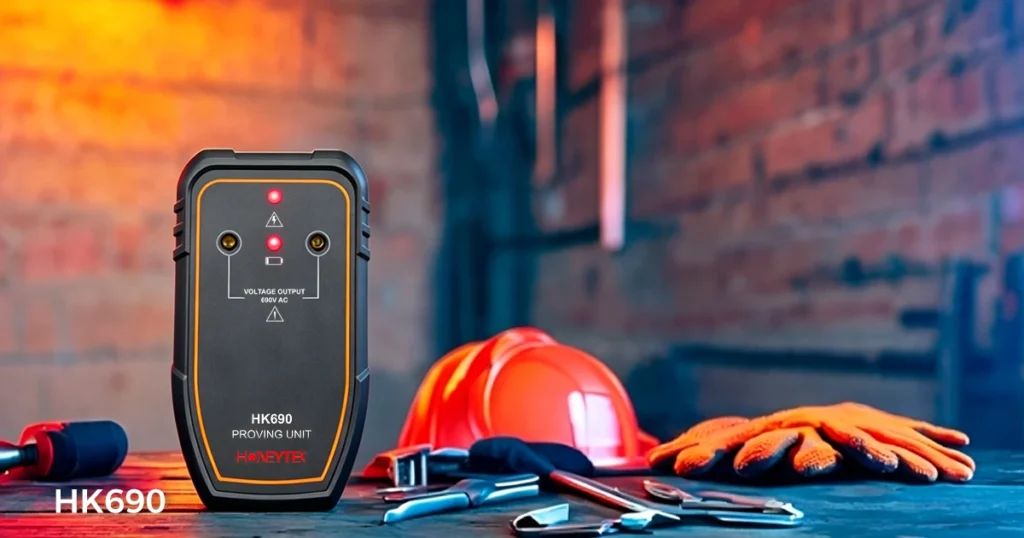
The Honeytek HK690 is designed specifically for field verification tasks, not calibration.
Key Technical Features
- 690V AC (50Hz) constant output
- Compatible with:
- High impedance multimeters
- Low impedance voltage testers
- Supports:
- Two-pole testers
- Digital multimeters
- Bright LED indication for fast feedback
- Battery-powered (6 × AA) for portability
- Rugged enclosure for industrial environments
Engineering Interpretation
- Fixed 690V output → optimized for industrial verification
- No multi-step voltage → reduced complexity
- Battery-powered → ideal for site work and isolation safety
6. When to Use Each (Real-World Workflow)
Use a Proving Unit When:
- Performing live voltage testing
- Following safe isolation procedures
- Working on:
- Industrial panels
- Construction sites
- Solar PV systems
Use Calibration When:
- Maintaining quality standards
- Required by:
- ISO systems
- Audit compliance
- Ensuring long-term measurement reliability
7. Common Mistakes Engineers Make
Mistake 1: “My multimeter is calibrated, so I’m safe”
→ Incorrect. Calibration does not confirm current operational status.
Mistake 2: “I tested voltage earlier, so the tester is fine”
→ Incorrect. Instruments can fail between measurements.
Mistake 3: Using live circuits as a “proving source”
→ Unsafe and non-compliant. A proving unit provides a controlled, known voltage.
8. Selection Insight: Field vs Lab Thinking
If your workflow is:
- Field-based / on-site → prioritize proving unit
- Quality-controlled / lab → prioritize calibration
Most professionals need both, but for daily safety, the proving unit is the first line of defense.
9. Manufacturer Context: Honeytek’s Engineering Capability
Honeytek is a professional manufacturer specializing in:
- Infrared thermal imagers (fault detection & predictive maintenance)
- Digital multimeters (TRMS, industrial-grade)
- Clamp meters (AC/DC current diagnostics)
- Electrical safety tools, including proving units
This integrated product ecosystem ensures:
- Consistent measurement workflows
- Cross-device compatibility
- Scalable OEM/ODM solutions
FAQ
1. What is the difference between a proving unit and calibration?
A proving unit checks if your tester works; calibration checks how accurate it is.
2. Do I need both a proving unit and calibration?
Yes. They address different risks:
- Proving unit → immediate safety
- Calibration → long-term accuracy
3. Can a proving unit replace calibration?
No. It does not measure accuracy or provide traceable results.
4. Can calibration replace a proving unit?
No. A calibrated device can still fail unexpectedly in the field.
5. How often should I use a proving unit?
Before and after every critical voltage test.
