
A solar photovoltaic system can appear to operate normally while experiencing reduced energy production caused by shading, damaged modules, wiring faults, or poor electrical connections.
For solar installation and maintenance professionals, measuring PV string voltage and DC operating current is an essential part of identifying these problems.
A professional AC/DC solar clamp meter allows technicians to evaluate electrical performance without unnecessarily interrupting operating circuits.
This guide explains how to test solar PV string current and voltage, interpret abnormal readings, and use high-voltage measurement instruments such as the Honeytek HK888D and HK888E for professional photovoltaic diagnostics.
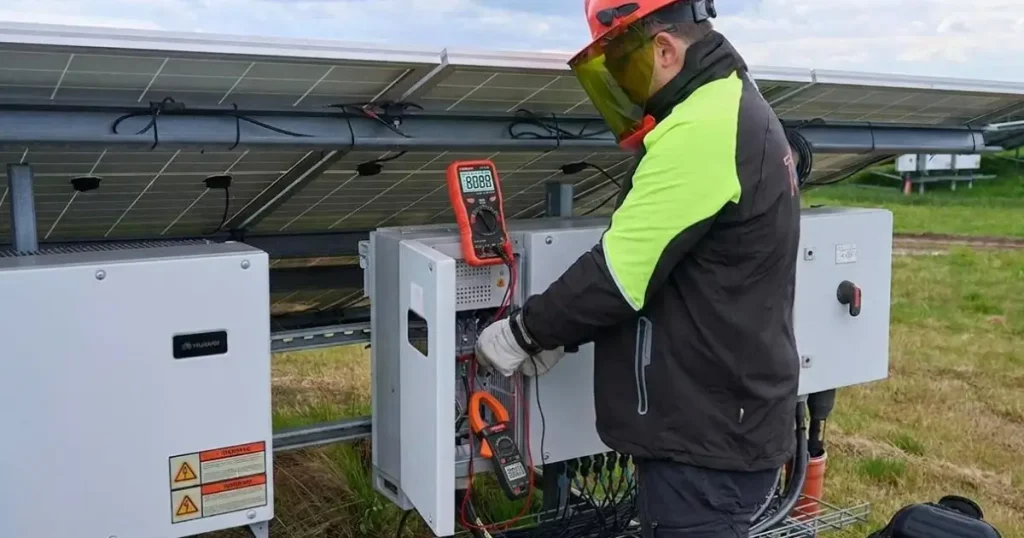
1. What Electrical Parameters Should You Measure on a Solar PV String?
Before testing a photovoltaic string, it is important to understand the difference between open-circuit voltage, operating voltage, short-circuit current, and operating current. Each parameter provides different information about the condition of a solar array.
| Parameter | Definition | Diagnostic Purpose |
|---|---|---|
| Voc | Open-circuit voltage | Checks expected string voltage and module configuration |
| Vmp | Voltage at maximum power point | Evaluates voltage under maximum power operating conditions |
| Isc | Short-circuit current | Evaluates module or string current capability using dedicated equipment |
| Imp | Current at maximum power point | Evaluates current at maximum power operating conditions |
| Operating Current | Actual DC current during operation | Helps identify string performance differences |
| Operating Voltage | Actual DC voltage during operation | Helps evaluate inverter input and string behavior |
For routine solar PV maintenance, operating current and voltage are particularly useful because they reveal how the system behaves under actual working conditions.
Open-circuit voltage is valuable for commissioning and investigating string configuration or voltage abnormalities.
Safety Note: Short-circuit current testing requires appropriately rated equipment and an approved PV testing procedure. Never directly short a high-voltage PV string with ordinary test leads.
2. Preparing for Solar PV String Testing
High-voltage photovoltaic systems can remain electrically energized whenever solar modules are exposed to sunlight, even if the inverter has been switched off.
Testing commercial and utility-scale PV systems must therefore be performed by qualified electrical personnel following approved site-specific safety procedures.
Step 1: Review the PV System Specifications
Collect the relevant system information before beginning measurements:
- Number of modules connected in series.
- Module-rated Voc and Vmp.
- Expected operating current.
- Maximum system voltage.
- Module voltage temperature coefficient.
- Inverter MPPT operating range.
- Historical string performance data.
For modules connected in series, the expected open-circuit voltage is approximately the sum of the individual module open-circuit voltages under equivalent conditions.
PV module voltage increases as cell temperature decreases. Cold-weather voltage calculations must therefore be considered when assessing the maximum expected string voltage.
Step 2: Verify the Clamp Meter and Accessories
A professional solar clamp meter must be suitable for both the measurement range and the electrical environment.
Before testing, qualified technicians should verify:
- Maximum permissible DC input voltage.
- Applicable measurement category and voltage-to-earth limits.
- DC current measurement capability.
- Current resolution and accuracy.
- Test lead and PV connector ratings.
- Instrument condition and battery status.
A 2000V DC measurement range does not automatically mean that an instrument is approved for every 2000V measurement environment.
Always follow the instrument manual and the lowest applicable rating of the complete measurement setup.
For more information about high-voltage measurement safety, read our guide on safe measurement for 1500V PV systems.
3. How to Test Solar Panel Current with a Clamp Meter
DC operating current measurement is one of the most practical methods for comparing the performance of photovoltaic strings.
Unlike conventional series-connected current measurements, clamp measurement detects the magnetic field surrounding a conductor without requiring an electrical connection to the conductor itself.
Step 3: Zero the DC Clamp Meter Before Measurement
DC clamp meters typically use magnetic sensing technology that may be affected by residual magnetism, sensor offset, and external magnetic fields.
The zero or relative measurement function compensates for these offsets.
Technicians should follow the meter manufacturer’s zeroing procedure before taking DC current readings, particularly when comparing relatively low string currents.
Failure to compensate for the offset may introduce errors that could be mistaken for reduced solar panel performance.
Step 4: Measure and Compare Individual String Currents
Using an appropriately rated AC/DC clamp meter, qualified technicians can measure the operating current of an accessible individual insulated PV conductor at an approved measurement location.
The positive and negative conductors of the same circuit should not be enclosed together when measuring normal operating current, because their magnetic fields largely cancel each other.
For meaningful string comparisons, measurements should be taken under similar conditions:
- Comparable solar irradiance.
- Similar module temperature.
- Identical or equivalent module configuration.
- Comparable inverter operating conditions.
- Similar shading and orientation.
A single current reading provides limited diagnostic information. Comparing multiple equivalent strings provides a more useful picture of system performance.
4. How to Measure Open-Circuit Voltage (Voc) on a 1500V Solar String
Open-circuit voltage is the DC voltage produced by a photovoltaic string when it is not supplying current to a load.
Checking Voc can help identify incorrect module counts, unexpected string configurations, wiring problems, and other electrical abnormalities.
Step 5: Establish the Expected String Voltage
The expected string Voc depends on the number of series-connected modules and their temperature-adjusted open-circuit voltage.
For example, consider a hypothetical PV string containing 25 modules, each with a rated Voc of 49V at standard test conditions.
Expected String Voc at STC:
25 × 49V = 1225V DC
If the module voltage temperature coefficient is −0.28% per °C and the cell temperature falls from 25°C to 0°C, the estimated string voltage increases by approximately 7%.
Estimated Cold-Temperature Voc:
1225V × 1.07 = 1310.75V DC
This illustrates why technicians must consider temperature-adjusted voltage rather than relying only on nominal system ratings.
Actual calculations should use the module manufacturer’s specifications, applicable tolerances, minimum design temperature, and local electrical requirements.
Step 6: Evaluate the Actual Open-Circuit Voltage
Voc measurement requires an approved open-circuit test condition established according to the PV system manufacturer’s instructions and the site’s electrical safety procedure.
The measured voltage should then be compared with the calculated temperature-adjusted value and with equivalent strings.
Never disconnect PV connectors under load to create an open-circuit condition.
If the expected voltage exceeds the permissible limits of the instrument or accessories, stop testing and select an appropriate measurement solution.
5. How to Interpret Abnormal Solar PV String Readings
Voltage and current measurements become more valuable when evaluated together.
The following diagnostic reference can help technicians identify potential fault categories.
| Measurement Result | Possible Cause | Recommended Diagnostic Direction |
|---|---|---|
| Normal Voc but low operating current | Shading, soiling, current mismatch, module degradation | Compare irradiance and module conditions |
| Lower-than-expected Voc | Incorrect module count, wiring fault, abnormal module condition | Review string configuration |
| Normal voltage but zero operating current | Open circuit, inverter inactivity, disconnected string | Review inverter status and circuit continuity through approved procedures |
| Unstable voltage or current | Intermittent connection, changing irradiance, MPPT behavior | Correlate readings with operating conditions |
| Higher-than-expected Voc | Low cell temperature, incorrect string configuration | Recalculate temperature-adjusted voltage |
| Similar electrical readings but low energy yield | Inverter limitations, clipping, curtailment, system losses | Review inverter and monitoring data |
These symptoms are diagnostic clues rather than definitive proof of a specific fault.
Example: Identifying an Underperforming PV String
Consider four equivalent PV strings operating under similar sunlight and temperature conditions.
| PV String | Operating DC Current |
|---|---|
| String A | 13.4A |
| String B | 13.2A |
| String C | 8.1A |
| String D | 13.3A |
String C produces approximately 39% less current than the average of the other three strings.
Potential causes include partial shading, module mismatch, soiling, or an electrical connection problem.
Further investigation is necessary before replacing components.
This comparison-based approach helps maintenance teams prioritize inspections and avoid unnecessary equipment replacement.
This example uses hypothetical measurement values for illustration.
6. Common Mistakes When Measuring Solar PV Current and Voltage
Even experienced technicians can obtain misleading readings if measurement conditions are not properly controlled.
Using an AC-Only Clamp Meter
Solar modules generate direct current. An AC-only clamp meter cannot correctly measure steady-state DC string current.
Skipping the DC Zero Function
Residual sensor offset may affect current measurements, particularly at lower current levels.
Comparing Strings Under Different Sunlight Conditions
Passing clouds, shading, module temperature, and orientation can significantly affect PV output.
Confusing Voc with Operating Voltage
Voc is measured under open-circuit conditions, while operating voltage depends on the connected load and inverter operating point.
Selecting a Meter Based Only on Maximum Voltage
A high displayed voltage range does not replace appropriate safety ratings, insulation requirements, and correctly rated accessories.
Overlooking Low-Current Accuracy
A clamp meter with a 2000A maximum current range may be suitable for large conductors, but technicians must also consider its resolution and accuracy when measuring individual PV strings.
For precision comparisons at low current levels, an instrument with an appropriate lower-current range may be more suitable.
7. Recommended Honeytek Clamp Meters for Solar PV String Testing
Honeytek HK888D 2000A AC/DC Solar PV Clamp Meter
The HK888D is designed for photovoltaic installation, solar maintenance, and industrial electrical testing.
Key Highlights:
- DC voltage measurement up to 2000V.
- AC/DC current measurement up to 2000A.
- 6000-count True RMS display.
- 60.5mm maximum jaw opening.
- Inrush current and LoZ measurement.
- Temperature measurement and integrated work light.
View Honeytek HK888D Solar PV Clamp Meter »
Honeytek HK888E Professional Solar PV Clamp Meter
The HK888E provides additional diagnostic capabilities for professionals working across photovoltaic and industrial electrical applications.
Key Highlights:
- Up to 2000V DC and 1500V AC measurement.
- Up to 2000A AC/DC jaw current measurement.
- Extended current measurement with a compatible flexible clamp.
- True RMS and VFD measurement functions.
- Inrush current, LoZ, and MAX/MIN recording.
- Large 60.5mm clamp jaw.
View Honeytek HK888E Professional Solar PV Clamp Meter »
8. Frequently Asked Questions About Solar PV String Testing
Can I test solar panel current with a clamp meter?
Yes. An appropriately rated DC-capable clamp meter can measure solar operating current through an individual accessible conductor without disconnecting the operating circuit.
Why should I zero a DC clamp meter before measuring solar panels?
Zeroing compensates for magnetic sensor offset and residual magnetism, helping improve the reliability of DC current measurements.
Why is my solar string voltage normal but the current is low?
Possible causes include shading, soiling, module mismatch, degradation, connection problems, or reduced irradiance. Comparing equivalent strings under similar conditions can help narrow down the cause.
What is the difference between Voc and Vmp?
Voc is the voltage under open-circuit conditions. Vmp is the voltage at which a photovoltaic module or string operates at its maximum power point.
Can I use a 2000V clamp meter to test a 1500V solar string?
Potentially, provided the instrument, measurement category, accessories, terminal limits, and approved test procedure are suitable for the actual measurement conditions. The maximum measurement range alone is not sufficient.
Can a clamp meter measure solar panel maximum power?
A standard clamp meter can measure voltage and current at an operating point, but it cannot independently determine the true maximum power point without an appropriate load sweep or dedicated PV testing function.
For dedicated module power testing, Honeytek also offers the HK88PV 150V 2200W Solar Panel MPPT Tester for compatible modules within its specified limits.
How often should solar PV strings be tested?
Testing frequency depends on the maintenance plan, system size, operating environment, manufacturer recommendations, and applicable regulations. Measurements are commonly incorporated into commissioning, preventive maintenance, and fault investigations.
Conclusion
Accurate solar PV string testing requires more than measuring voltage or current individually.
By understanding expected string voltage, compensating for DC measurement offsets, comparing equivalent strings, and evaluating environmental conditions, maintenance professionals can identify potential photovoltaic faults more efficiently.
Professional solar clamp meters such as the Honeytek HK888D and HK888E provide versatile measurement capabilities for compatible photovoltaic and industrial electrical applications.
Looking for a Professional Solar PV Clamp Meter Manufacturer?
Honeytek manufactures electrical test and measurement instruments for solar installation professionals, industrial maintenance teams, instrument distributors, and global equipment suppliers.
Our manufacturing services include:
- High-voltage solar PV clamp meters.
- OEM/ODM product customization.
- Private-label branding and packaging.
- Factory-direct wholesale supply.
- Bulk procurement and distributor partnerships.
- Technical documentation and product support.
Contact Honeytek today to request a datasheet, product sample, or customized distributor quotation.
Explore HK888D | Request a Quote

 English
 Português
 Español
 Français
 Deutsch
 العربية
 Русский