
Not every “power clamp meter” is suited to every job. A tool that’s excellent for diagnosing a three-phase distribution panel can be the wrong choice for a solar PV string, and vice versa — the two environments stress different parts of a meter’s spec sheet. Panel work is mostly about AC power quality, phase balance, and safety category. PV work adds high-voltage DC measurement into the mix, which changes the requirements considerably.
This guide separates the two scenarios so you can match a meter to the job rather than assuming one spec sheet covers both, then closes with an honest look at where one specific instrument — the Honeytek HK688A+ AC Power Clamp Meter— fits and where it doesn’t.
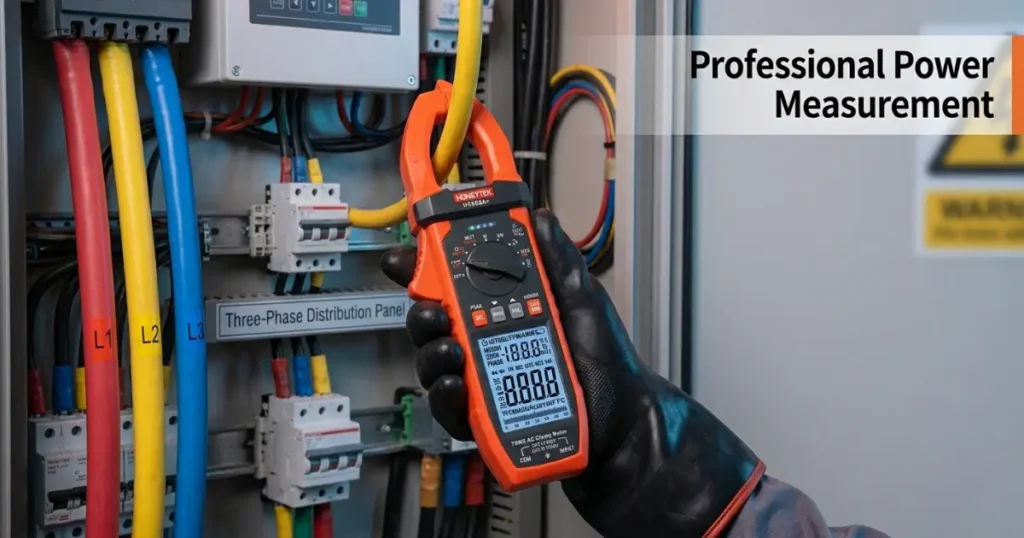
Scenario 1: Three-Phase Distribution Panels
What Matters Most
Safety category first. Fixed panel interiors and permanently wired distribution equipment fall under CAT III; work near the service entrance, main feeders, or outdoor low-voltage distribution should be treated as CAT IV. Confirm the meter’s rating explicitly — this is a safety requirement, not a nice-to-have, given the arc-flash and shock risk inside live panels.
Both three-wire and four-wire support. Distribution panels commonly present as three-phase three-wire (no neutral) or three-phase four-wire (with neutral). A meter used across different panels needs to handle both configurations, including neutral current on four-wire systems.
Simultaneous voltage and current sensing. Clamp-based technologies that read voltage and current together — without separate test leads for voltage — let you derive line-to-line voltage and phase sequence quickly, which speeds up checks for phase imbalance or a missing phase.
Harmonic measurement. Panels feeding VFDs, rectifiers, and other nonlinear loads generate harmonic distortion. A meter that breaks harmonics down by individual order (rather than a single THD figure) helps pinpoint whether a low power factor reading reflects genuine reactive load or harmonic pollution — these call for different fixes.
Energy logging and trend data. For energy audits or ongoing load monitoring on a panel, look for accumulated energy readings, multiple logged measurement sessions, and export capability for reporting.
Key Parameters to Check
- Current range: commonly tens of milliamps up to several hundred amps on the built-in jaw; flexible clamps extend this into the kiloamp range for large feeders.
- Voltage range: should comfortably exceed 380V three-phase line-to-line voltage, with headroom for transients — 1000V display range is typical.
- Measurement set: active/reactive/apparent power, power factor (leading/lagging), phase angle, frequency, phase sequence, and accumulated energy.
Scenario 2: Solar PV Grid-Connection
What Matters Most
Combined AC and DC measurement. PV systems have a DC side (modules, strings, combiner boxes) and an AC side (inverter output, grid interconnection). A meter that measures both AC and DC voltage and current means one instrument can check continuity across the whole chain, from string output to grid injection.
High DC voltage range. Open-circuit string voltage on modern PV strings frequently reaches 1000V DC and increasingly 1500V DC on utility-scale systems. This is the single most common mismatch buyers overlook — a meter rated for standard 600–1000V AC service isn’t automatically rated for 1000V or 1500V DC PV work. Confirm the DC voltage rating and the associated insulation and creepage/clearance design specifically, since arcing behavior differs between AC and DC.
Adequate DC current range. String and combiner-box currents are typically in the tens of amps. A meter whose DC current function tops out in the microamp or milliamp range — common on general-purpose multimeters designed for small-signal DC testing — cannot measure string current at all, regardless of how good its AC current range is. This is worth checking explicitly rather than assuming “DC current” coverage scales the same way “AC current” does on a given model.
Safety rating suited to the installation. PV work often happens on rooftops or near outdoor combiner/distribution equipment. CAT III 1000V or higher, with attention to lead and clamp insulation rated for the DC voltages involved, is the baseline to look for.
Power and power quality on the AC side. For inverter output and grid-tie quality checks, active/reactive/apparent power and power factor measurement still apply, same as on the panel side.
Logging for generation and audit records. Energy yield tracking, performance audits, and troubleshooting all benefit from data logging and export, same rationale as panel monitoring.
Key Parameters to Check
- DC voltage range: 1000V or 1500V DC, matching your string configuration.
- DC current range: tens of amps for string-level work; AC current sized to inverter output capacity.
- Measurement set: AC/DC voltage, AC/DC current, power, power factor, frequency, and accumulated energy.
Side-by-Side Comparison
| Requirement | Distribution Panels | Solar PV Grid-Tie |
|---|---|---|
| Safety category | CAT III (panel), CAT IV (service entrance) | CAT III 1000V+, DC-rated insulation |
| Wiring support | 3-phase 3-wire and 4-wire | AC output + DC string/combiner side |
| Voltage range | Up to ~1000V AC | Up to 1000–1500V DC, plus AC output |
| Current range | Amps to hundreds of amps, AC | Tens of amps DC (strings), AC per inverter rating |
| Harmonics | High priority (VFDs, rectifiers) | Useful on AC/inverter side |
| Data logging | Energy trend, audit reporting | Generation yield, performance audit |
Where the Honeytek HK688A+ AC Power Clamp Meter Fits — and Where It Doesn’t
The Honeytek HK688A+ TRMS AC Power Clamp Meter is a strong match for the distribution panel scenario, and it’s worth being equally clear about where it stops being the right tool for PV work.
For distribution panels, it covers the core requirements well:
- Safety rating: CAT III 1000V / CAT IV 600V, appropriate for panel interiors and work closer to the service entrance.
- Power measurement: Active power to 4000W, apparent power to 750kW, reactive power to 750kVAR, and power factor (0.3–1), measured true-RMS.
- Phase sequence detection for verifying correct rotation before energizing three-phase loads.
- Harmonic breakdown across the 1st through 20th order, useful for tracing distortion from VFDs and similar nonlinear loads back to a specific harmonic band.
- AC current to 600A, covering typical panel feeder currents.
- Data hold, max/min capture, relative measurement, and Bluetooth export for logging and reporting.
For PV grid-connection work, the fit is partial, and this matters for an accurate recommendation:
- Its DC voltage range tops out at 1000V, which covers many PV strings but not 1500V DC systems increasingly used in utility-scale installs — check your string voltage against this limit before relying on it.
- Its DC current range is limited to 200µA/2000µA — designed for small-signal DC testing, not the tens-of-amps currents found on PV strings and combiner boxes. This meter cannot measure PV string DC current; a dedicated DC clamp or a PV-specific clamp meter is needed for that part of the job.
- Its AC-side capabilities (power, power factor, harmonics, frequency) do apply to inverter output and grid-tie quality checks, so it can still play a role in the AC portion of a PV commissioning or diagnostic workflow.
Bottom line: for three-phase distribution panel diagnostics — phase balance, power quality, harmonics, and safe CAT III/IV work — the HK688A+ is a well-rounded, single-instrument choice. For solar PV work, it’s useful on the AC/inverter side but should not be relied on for DC string current measurement or 1500V DC systems; pair it with a DC-capable PV clamp meter for the direct-current portion of the installation.
