
The global solar industry is undergoing a fundamental voltage shift. What began as a move from 600V to 1000V photovoltaic (PV) systems is now accelerating toward 1500V PV systems as the new standard for utility-scale and large commercial projects.
For solar operators, this transition delivers clear benefits—but it also introduces new safety and measurement challenges that cannot be ignored.
For O&M managers and technical directors, one question has become unavoidable:
Are your current multimeters truly safe for 1500V solar environments?
The Global Shift: From 1000V to 1500V PV Systems
Over the past decade, PV system voltage has steadily increased to improve efficiency and reduce balance-of-system costs.
Key drivers behind the 1500V trend include:
- Lower system losses through reduced current
- Longer string lengths, fewer combiner boxes, and simplified layouts
- Reduced cable and installation costs
- Faster ROI for utility-scale solar farms
As a result, 1500V PV systems are now widely adopted across North America, Europe, the Middle East, and emerging solar markets.
However, higher voltage fundamentally changes the risk profile of routine maintenance and troubleshooting.
Why Standard Multimeters Are a Hidden Risk in High-Voltage PV Systems
Many multimeters still in use on solar sites were designed for 1000V or below. When applied to 1500V DC environments, they expose technicians to serious hazards.
Key Risks of Using Inadequate Multimeters
- Internal Arc Flash & Explosion
Multimeters without sufficient CAT ratings may fail catastrophically under high-energy DC faults. - Insulation Breakdown
Test leads, input jacks, and PCB clearances not designed for 1500V DC can carbonize or short internally. - False Sense of Safety
A meter that “can measure 1000V” is not necessarily safe in PV arrays where fault energy is far higher.
In solar maintenance, measurement accuracy matters—but safety ratings matter more.
What Safety Ratings Really Matter for Solar PV Maintenance
When working in high-voltage solar installations, the most critical specification is the CAT (Measurement Category) rating, not just the voltage range.
Recommended Safety Levels for PV Applications
- CAT III 1500V
Required for string-level and combiner box measurements in 1500V PV systems. - CAT IV 1000V
Suitable for measurements closer to the source, such as utility connections.
A Solar PV Multimeter must be designed specifically for high-energy DC environments, not adapted from general electrical meters.
Recommended Electrician Professional Tool Kit for Solar PV Maintenance
A modern Electrician Professional Tool Kit for solar O&M should include instruments purpose-built for high-voltage PV systems. Below are two complementary tools from HONEYTEK, a professional Multimeter Manufacturer / Factory with decades of experience in electrical test equipment.
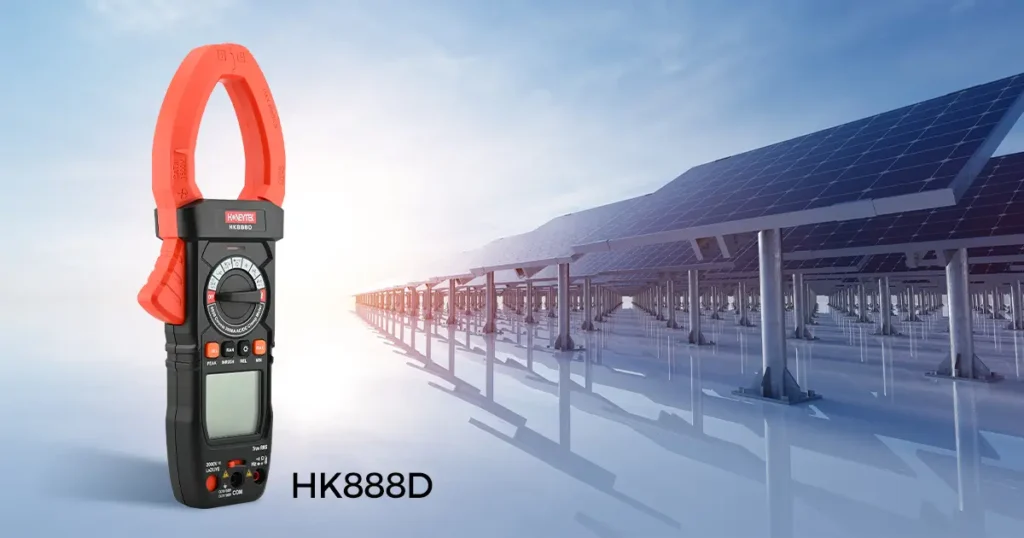
1. HONEYTEK HK888D – Digital Clamp Meter for Photovoltaic Installation
The HK888D is engineered specifically for 1500V solar PV systems, making it a core instrument for advanced solar maintenance teams.
Key Advantages for Solar Maintenance
- CAT III 1500V / CAT IV 1000V safety rating
- 2000A AC/DC clamp measurement for inverter and string current analysis
- True RMS accuracy for modern power electronics
- Inrush current & Peak capture for startup diagnostics
- NCV & Live Wire detection for rapid safety checks
- MC4 PV test leads, eliminating unsafe adapters in the field
- Built-in spotlight for low-light outdoor conditions
Ideal for:
Utility-scale PV plants, commercial solar rooftops, inverter commissioning, and fault diagnostics in 1500V PV systems.
2. HONEYTEK HK78G – 2000V True RMS Digital Multimeter

The HK78G complements a clamp meter by covering precision electrical measurements beyond current testing.
Key Advantages
- Up to 2000V DC measurement range
- True RMS auto-ranging for accurate AC/DC readings
- Resistance, capacitance, frequency, duty cycle, and temperature functions
- NCV, continuity buzzer, MAX/MIN, and data hold
- Compact, field-ready design for daily solar maintenance tasks
Ideal for:
PV string voltage checks, inverter input/output testing, control circuits, and commissioning verification.
Why Solar O&M Teams Should Choose a Specialized PV Multimeter Manufacturer
Selecting tools from an experienced Multimeter Manufacturer / Factory matters in high-voltage solar environments.
HONEYTEK instruments are designed with:
- Dedicated high-voltage DC insulation architecture
- Reinforced creepage and clearance distances
- Strict compliance with IEC safety standards
- Proven reliability in harsh outdoor PV conditions
For professional solar maintenance, generic meters are no longer sufficient.
Conclusion: Measurement Safety Is Now a Strategic Decision
As the industry fully enters the 1500V PV system era, upgrading measurement tools is no longer optional—it is a risk-management necessity.
For solar O&M managers and technical directors, investing in a Solar PV Multimeter with proper CAT ratings protects:
- Technicians in the field
- Expensive inverters and balance-of-system equipment
- The long-term reliability of the solar asset itself
A modern Electrician Professional Tool Kit, built around instruments like the HONEYTEK HK888D and HK78G, ensures your team is prepared for today’s high-voltage solar reality—and tomorrow’s growth.
FAQ – Solar PV Multimeters and 1500V Systems
What is a Solar PV Multimeter?
A Solar PV Multimeter is a test instrument specifically designed for photovoltaic systems, featuring high DC voltage ratings, appropriate CAT safety levels, and functions optimized for solar installation and maintenance.
Can a 1000V multimeter be used on a 1500V PV system?
No. Using a 1000V-rated multimeter on a 1500V system can result in insulation failure, arc flash, or meter explosion. Always use meters rated CAT III 1500V or higher for string-level PV work.
Why is CAT III 1500V important for solar maintenance?
CAT III 1500V ensures the meter can safely withstand high-energy transients present in PV strings, combiner boxes, and inverter inputs.
Is a clamp meter necessary for solar PV maintenance?
Yes. A clamp meter allows safe, non-intrusive current measurement—especially critical for high-current DC strings and inverter diagnostics.
Why choose a dedicated multimeter manufacturer instead of generic tools?
Professional multimeter manufacturers design products with reinforced safety, accuracy, and durability required for high-voltage applications like solar PV systems.
Looking for reliable test tools for modern photovoltaic systems?
As a professional Multimeter Manufacturer / Factory, Honeytek provides purpose-built instruments for solar PV installation, commissioning, and maintenance, including solutions for 1500V PV systems.
You may like these:
- How to Choose a Photovoltaic CAT III 1500V Clamp Meter
- Auto-Ranging vs Manual-Ranging Multimeters: A Beginner’s Guide to Choosing the Right One
- Smart SMD Tester vs Handheld LCR Meter: Advantages, Limitations, and How to Choose
- How to Measure Capacitance and ESR with Smart Tweezers
- What Is a Smart SMD Tester?
