
Three-phase power measurement trips up a lot of electricians and maintenance engineers the first time they try it — not because the theory is hard, but because not every clamp meter on the market is actually built for the job. A single-phase clamp meter can read voltage or current just fine, but the moment you need power (kW), power factor, phase sequence, or harmonics on a three-phase feeder, the instrument’s design starts to matter a great deal.
This guide walks through the technical criteria that actually separate a capable three-phase-ready power clamp meter from a basic amp clamp, based on how these instruments are specified and used in the field. It closes with a practical recommendation for teams that need solid single-circuit power and quality diagnostics without stepping up to a full multi-channel power analyzer.
1. Confirm What Wiring Configuration You Actually Need to Measure
Three-phase systems come in two common configurations: three-phase three-wire and three-phase four-wire (the latter includes a neutral). This distinction matters because it changes what the meter needs to measure and how many probes it needs.
- Dedicated three-phase power analyzers typically let you configure each channel independently for single-phase 2-wire, single-phase 3-wire, three-phase 3-wire, or three-phase 4-wire setups.
- Four-wire systems require monitoring neutral current as well, which is why full three-phase analyzers often ship with four flexible current probes (L1, L2, L3, and N).
- A single clamp meter, by contrast, measures one conductor at a time. For three-phase work, this means taking sequential readings on each phase (and neutral, if present) rather than one simultaneous multi-channel capture.
Before buying anything, be clear about which of these two scenarios describes your actual job — a lot of buyer’s remorse in this category comes from assuming a single clamp will behave like a multi-channel analyzer.
2. Check Whether the Meter Reads Voltage and Current Together to Calculate Power
This is the feature that actually defines a “power clamp meter” versus a standard current clamp. Traditional clamps measure current only, forcing you to separately measure voltage and calculate power (P = V × I × PF) by hand. Newer power clamp meters integrate voltage test leads with the current clamp jaw so that a single instrument captures both signals and computes real power, apparent power, reactive power, and power factor directly on the display.
Some higher-end tools go further, using clamp-based voltage sensing to derive phase-to-phase voltage and phase sequence from a few sequential single-phase measurements — useful on job sites where wiring conditions make traditional lead-based voltage testing awkward. When evaluating a spec sheet, look specifically for simultaneous V+I inputs and built-in power calculation, not just current ranging.
3. Verify the Full Set of Power Measurement Parameters
A meter marketed for “power” measurement on three-phase equipment should, at minimum, cover:
- Real (active) power (W/kW)
- Apparent power (VA/kVA)
- Reactive power (VAR/kVAR)
- Power factor, ideally distinguishing leading vs. lagging
- Voltage and current frequency
- Phase sequence detection
These parameters matter because they diagnose different problems. Power factor and reactive power point to inductive or capacitive load issues (common with motors and VFDs); phase sequence detection prevents miswiring that can damage three-phase motors on installation or after maintenance.
4. Look for Harmonic Measurement Capability
Variable frequency drives, switch-mode power supplies, LED drivers, and other nonlinear loads inject harmonic distortion into three-phase feeders. This shows up as a mismatch between measured power factor and actual energy efficiency, or as unexplained heating in neutral conductors on four-wire systems.
A meter that reports individual harmonic orders (not just a single THD percentage) gives much more diagnostic value — it lets you see whether distortion is concentrated in low-order harmonics (often drive-related) or higher orders, which changes the corrective approach.
5. Consider Data Logging and Export Needs
For one-off troubleshooting, an instant readout is enough. For energy audits, load studies, or documenting a fix, you’ll want:
- Max/min and hold functions for capturing transient behavior
- Data logging over time to build a load profile
- Export via Bluetooth or a PC interface for report generation
If your work regularly involves energy audits or compliance documentation, prioritize this feature; if you’re doing quick diagnostic checks, it’s a nice-to-have rather than a requirement.
6. Match Range and Safety Category to the Installation
- Current range: confirm the clamp’s jaw size and rated range cover your largest expected load — three-phase industrial feeders can run into the hundreds of amps.
- Voltage range: for 380V three-phase systems, make sure the rated voltage range comfortably exceeds line-to-line voltage, with margin for transients.
- Safety category: panels and fixed indoor distribution generally call for CAT III; work near service entrances or outdoor utility connections calls for CAT IV. Never use a CAT III-only meter on CAT IV-rated points.
Quick Reference: What to Check on the Spec Sheet
| Requirement | Why It Matters |
|---|---|
| 3-wire / 4-wire support | Matches your actual system topology |
| Simultaneous V + I input | Enables on-the-spot power calculation |
| Active/reactive/apparent power, PF | Full picture of load behavior, not just current draw |
| Phase sequence detection | Prevents motor miswiring |
| Harmonic breakdown by order | Diagnoses nonlinear-load distortion |
| Data hold, max/min, logging | Supports audits and documentation |
| CAT III/IV rating | Matches your working environment safely |
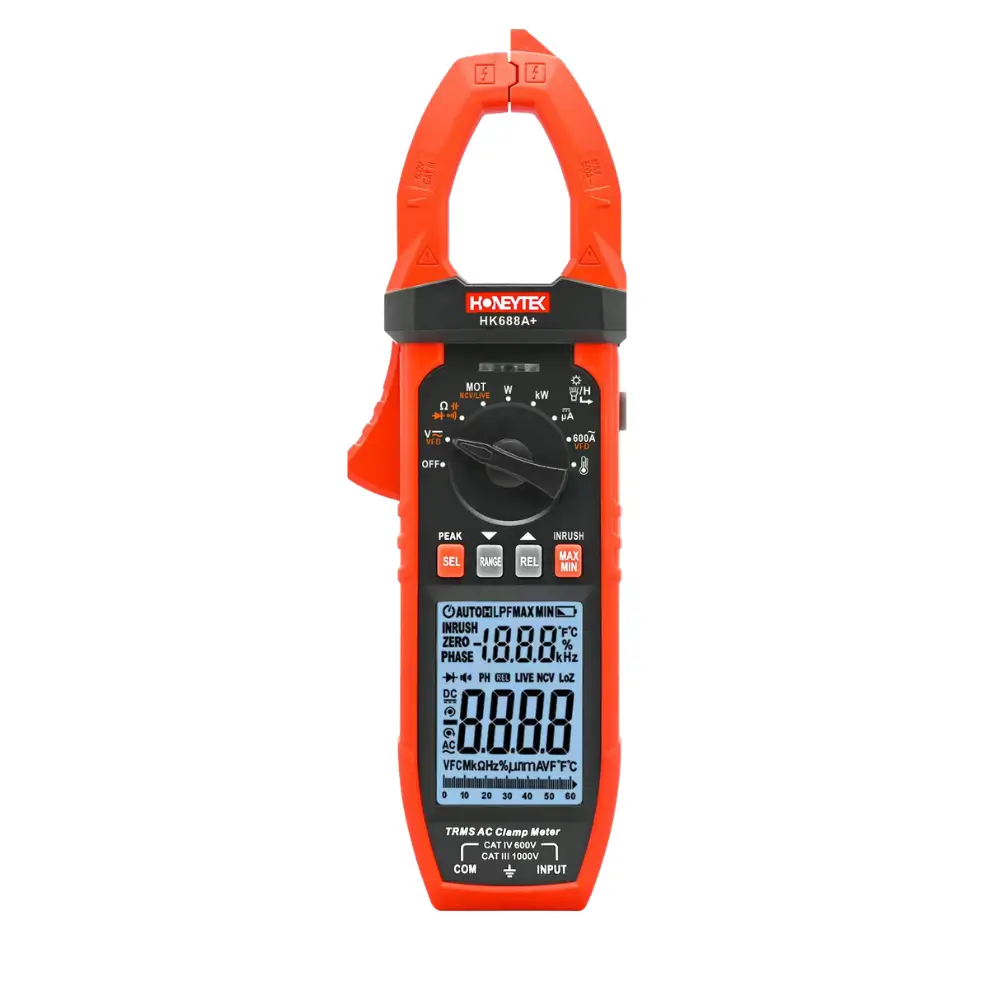
A Practical Recommendation: Honeytek HK688A+ TRMS AC Power Clamp Meter
For technicians who need a single, well-rounded instrument for power and electrical quality checks on individual circuits — rather than a multi-channel three-phase analyzer for simultaneous L1/L2/L3/N logging — the Honeytek HK688A+ TRMS AC Power Clamp Meter covers the core diagnostic bases well:
- Power measurement: Active power up to 4000W, apparent power up to 750kW, reactive power up to 750kVAR, and power factor (0.3–1), all with true-RMS accuracy.
- Harmonic analysis: Reports individual harmonic orders from the 1st through the 20th, with accuracy specifications that tighten at lower orders — useful for isolating VFD or drive-related distortion.
- Phase sequence and non-contact detection: Built-in phase sequence testing, plus NCV (non-contact voltage), LIVE line detection, and a VFD-safe measurement mode for drive-output diagnostics.
- Broad electrical range: AC/DC voltage to 1000V, AC current to 600A, DC current down to the µA range, resistance to 50MΩ, and capacitance to 99.99mF — enough coverage for combined electrical and power troubleshooting in one tool.
- Workflow features: Max/min capture, inrush current measurement, data hold, relative measurement, backlit display, and Bluetooth connectivity for exporting readings.
- Safety rating: CAT III 1000V / CAT IV 600V, appropriate for both panel-level and service-entrance work.
Where the HK688A+ fits best is single-circuit power and quality diagnostics — checking a motor feed, verifying phase rotation before energizing three-phase equipment, spotting harmonic distortion from a VFD, or doing a general electrical health check with one instrument in the truck. If your job specifically requires simultaneous four-channel three-phase power analysis with automatic phase-to-phase computation across L1/L2/L3/N in real time, that calls for a dedicated multi-channel power analyzer rather than any single clamp meter, including this one. For the majority of field service, maintenance, and troubleshooting tasks on three-phase equipment, though, the HK688A+’s combination of power parameters, harmonic breakdown, phase sequence detection, and CAT III/IV safety rating makes it a practical, cost-effective choice.
