
Two thermal cameras can show the same wall and reveal different amounts of useful information. One may separate small features more clearly. Another may show a faint temperature pattern with less noise.
Those capabilities depend on different specifications.
Infrared resolution describes how many detector pixels sample the scene. Thermal sensitivity, commonly expressed as NETD, describes how small a temperature difference the system can distinguish under specified test conditions.
For buying decisions, begin with two questions: How small is the feature you need to inspect, and how weak is its temperature contrast?
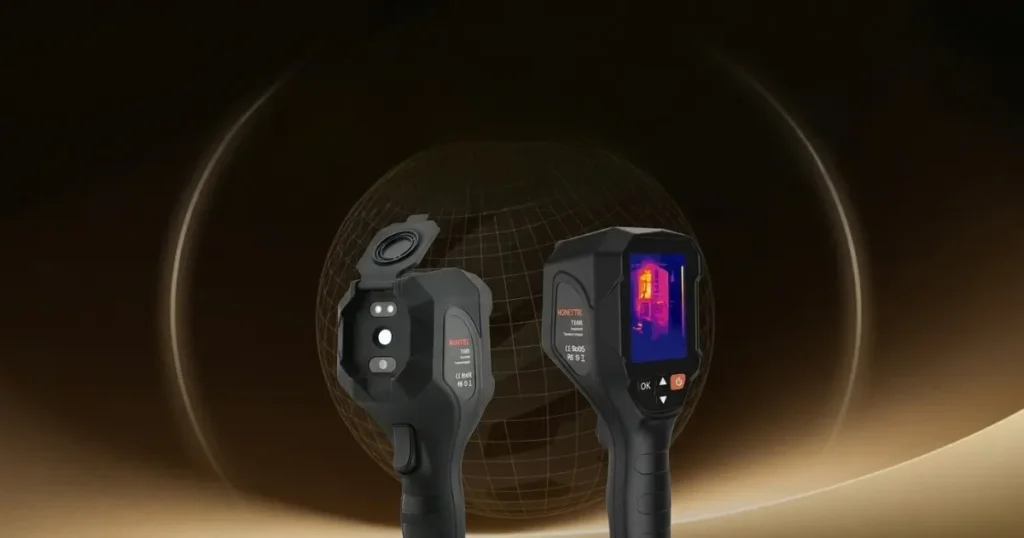
Infrared Resolution: How Much Spatial Information Do You Capture?
Infrared resolution is usually expressed as a detector width and height, such as 160 × 120 or 256 × 192.
| Native infrared resolution | Total detector pixels | Relative pixel count |
|---|---|---|
| 160 × 120 | 19,200 | 1.00× |
| 256 × 192 | 49,152 | 2.56× |
These totals are calculated by multiplying width by height.
With comparable optics and framing, more detector pixels help separate smaller features. They can make it easier to identify where a thermal pattern begins, ends, or crosses an asset boundary.
However, 156% more pixels does not mean 156% greater measurement accuracy. Pixel count and accuracy describe different aspects of performance.
Native Resolution Is Different From Display Resolution
A large phone screen does not increase the number of infrared detector pixels. Likewise, enlarging an exported image does not automatically add measured thermal information.
When comparing specifications, distinguish between:
- Native detector resolution.
- Display resolution.
- Saved image dimensions.
- Software-enhanced output resolution.
Image processing may improve presentation or interpretation. Ask how an enhanced image is produced and what native data supports it.
NETD Thermal Sensitivity: How Small a Difference Can You Distinguish?
NETD stands for Noise Equivalent Temperature Difference and is commonly listed in millikelvin, or mK.
For temperature differences:
40 mK = 0.040 K = 0.040°C
A lower NETD generally means less noise relative to a small thermal signal, assuming comparable measurement conditions. This can help reveal subtle variations across surfaces with little thermal contrast.
NETD becomes particularly relevant when the question is whether a faint pattern is present, rather than simply where a strongly contrasting hot object is located. FLIR’s explanation of thermal sensitivity describes how NETD influences low-contrast image clarity.
NETD Is Not Temperature Accuracy
A NETD specification of 40 mK does not mean absolute temperature measurements are accurate to ±0.040°C.
Sensitivity concerns small differences relative to noise. Accuracy concerns how closely a reported temperature matches the actual target temperature under specified conditions.
A useful purchase comparison therefore keeps three questions separate:
| Specification | Question it helps answer |
|---|---|
| Infrared resolution | Can I separate the feature from nearby objects? |
| NETD | Can I distinguish its weak thermal contrast? |
| Temperature accuracy | How closely can the reported value represent the actual temperature? |
Which Specification Matters Most for Your Work?
Small Features With Strong Thermal Contrast
Imagine a small warm component surrounded by cooler material. The contrast may be obvious, but the component may occupy too few pixels to isolate.
Prioritize spatial performance: detector resolution, lens, focus, and working distance. Better sensitivity cannot fully compensate for a target that is poorly resolved.
Broad Surfaces With Weak Thermal Contrast
Now consider a large wall with a faint temperature variation.
The area may cover many pixels already. Lower NETD can be more useful because the challenge is separating a weak thermal pattern from noise.
Inspection conditions still matter. Sun exposure, recent heating or cooling changes, and reflections can complicate interpretation. A visible pattern is evidence to investigate, not a diagnosis by itself.
Small Features With Weak Thermal Contrast
This is the more demanding case. You need enough spatial information to distinguish the target and enough sensitivity to reveal its contrast.
Request a demonstration at the actual inspection distance. A bright, close-up promotional image may not represent this task.
Working Distance Can Change the Buying Decision
As you move farther from a target, it occupies less of the image. A camera that performs well on a nearby asset may struggle with the same feature at a greater distance.
Field of view determines how much of the scene is captured. A wide view helps cover large surfaces; a narrower view can place more pixels on a distant target. Focus also affects usable detail. These relationships are outlined in FLIR’s guide to thermal camera specifications.
When requesting a demonstration, specify:
- The smallest feature you need to assess.
- The normal and maximum working distances.
- The expected temperature contrast.
- Whether you need to locate an anomaly or measure it quantitatively.
Seeing a small hot spot is not the same as measuring its temperature reliably. Ask the supplier for measurement spot-size guidance, not just a visually impressive image.
Applying the Comparison to Honeytek TP170 and TP175
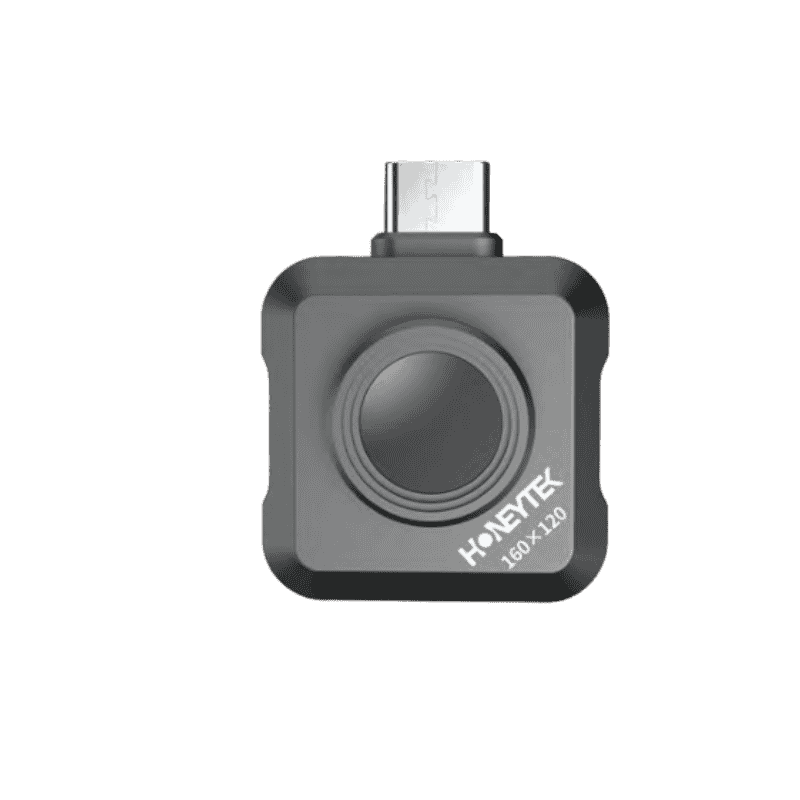
Honeytek’s published comparison lists the following:
| Published specification | TP170 | TP175 |
|---|---|---|
| Infrared resolution | 160 × 120 | 256 × 192 |
| Thermal sensitivity | ≤40 mK | ≤40 mK |
| Spatial resolution | 5.31 mrad | 3.43 mrad |
Sources: TP170 product specifications and TP175 product specifications.
The practical inference is that TP175 offers finer spatial sampling, while the published NETD rating is the same. Its higher resolution should not be described as a lower NETD or automatically better absolute temperature accuracy.
For buyers, TP170 may be sufficient when the relevant patterns occupy a substantial part of the image. TP175 provides more sampling detail when separating smaller features matters.
Ask Honeytek to confirm the NETD test conditions and demonstrate both models on your intended target. A specification comparison supports the shortlist; representative images support the final choice.
Why a Cost-Effective Thermal Imager Can Be Enough
A useful camera does not need to maximize every specification. It needs to answer the inspection question with adequate evidence.
Consider a hypothetical task: identifying which section of a large heating surface behaves differently from the rest. If the pattern is broad, repeatable, and clearly visible at the working distance, paying for substantially more pixels may offer limited additional value.
Change the task to measuring a small, distant connection, and the requirements change.
Budget for the complete inspection method: suitable equipment, operator training, repeatable capture conditions, and follow-up measurements. An affordable camera used within its limits can be more useful than a higher-specification device selected without regard to the job.
Compare Images Without Being Misled by Presentation
For a meaningful demonstration, ask suppliers to use the same target, distance, viewing angle, and operating conditions. Where possible, compare images using the same palette and temperature display span.
A dramatic color change does not necessarily represent a large temperature difference. Automatic scaling can make a narrow temperature range look visually strong.
Pair the thermal image with a visible-light photograph so readers can identify the inspected area. If fusion is available, it may help with orientation, but visible-light edges should not be mistaken for additional infrared measurements.
Hotspot and coldspot markers should retain their original recorded values and temperature scale. Their purpose is to document the scene, not to imply that the warmest or coldest point is automatically defective.
Explore Honeytek thermal imagers with your target size, working distance, and required measurement outcome in mind. Those details make a quotation request much more useful than asking for the highest resolution available.
Frequently Asked Questions
Is higher resolution always better in a thermal camera?
Higher native resolution generally provides more spatial information under comparable imaging conditions. It does not guarantee a better result when focus, sensitivity, optics, or working distance are unsuitable. Choose resolution around the smallest feature you need to assess.
What is a good NETD for a thermal camera?
There is no single value that suits every inspection. Lower NETD generally helps with weak thermal contrast, but compare ratings measured under equivalent conditions. Request representative images when subtle temperature patterns are important to your work.
Is 256 × 192 enough for building inspections?
It can be suitable for many building inspection tasks when relevant surface patterns are large enough and conditions create usable contrast. It is not a universal guarantee. Distance, optics, sensitivity, and the purpose of the inspection determine adequacy.
Does a NETD of 40 mK mean accuracy of ±0.04°C?
No. It describes thermal sensitivity under specified conditions, not absolute measurement accuracy. Check the separate accuracy specification and its operating limits when the numerical temperature reading matters.
