
As solar photovoltaic systems scale toward 1500 V and higher DC architectures, selecting the wrong clamp meter is no longer just a productivity problem — it is a safety risk. The IEC 61010-1 overvoltage category standard defines the transient surge a meter must survive, and a mismatch between your meter’s CAT rating and your system’s voltage environment can be fatal.
This guide compares three purpose-built solar PV clamp meters available in 2026: the Fluke 393 FC, the UNI-T UT219PV, and the Honeytek HK888E. Each targets a different segment of the market. The goal here is to give PV technicians and equipment distributors the technical information needed to match the right instrument to the right job.
How to Choose a Clamp Meter for Solar PV Systems
Not every clamp meter marketed for solar is actually designed for it. Before comparing models, it helps to understand which specifications are non-negotiable and which are secondary in a real photovoltaic environment.
DC Voltage Range — Match Your System Architecture
Residential string inverter systems typically operate at 600–1000 V DC. Commercial and utility-scale installations are now predominantly 1500 V DC, and emerging high-density configurations are pushing toward 2000 V. A meter rated at 1000 V DC is inadequate for anything beyond a small residential installation. The practical minimum for serious PV work in 2026 is 1500 V DC; a 2000 V DC rating provides meaningful forward compatibility.
CAT Safety Rating — Often Misread
The CAT rating is always tied to a specific voltage level. “CAT III 1000 V” and “CAT III 1500 V” are not interchangeable. A meter claiming 2000 V measurement capability but rated only CAT III 1000 V may not provide adequate transient surge protection in a 1500 V DC environment. For utility-scale PV work, the verified minimum is CAT III 1500 V / CAT IV 600 V — a benchmark set by IEC 61730-1 and the Fluke 393 FC’s certification.
True RMS — Required, Not Optional
PV inverters produce non-sinusoidal waveforms on their AC output. Average-responding meters underread current by 10–40% under these conditions. True RMS measurement is a baseline requirement for any clamp meter used in a photovoltaic system, particularly on the AC side of a string or central inverter.
LoZ Mode — Ghost Voltage Elimination
Long DC cable runs in PV arrays accumulate capacitively induced voltages that register as false readings on standard high-impedance meters. LoZ (Low Impedance) mode routes the measurement through a low-impedance path, collapsing these ghost voltages. Without it, fault diagnosis in a 1500 V string installation produces unreliable results.
Field Usability — The Details That Matter Outdoors
Outdoor PV work in direct sunlight, at elevation, and often with one hand occupied demands specific features: NCV detection for initial circuit verification before contact, a built-in flashlight for work inside combiner boxes, and an IP rating sufficient for dust and rain exposure. These specifications separate laboratory instruments from field-ready tools.
Top Solar PV Clamp Meter Comparison (2026)
The table below compares each meter across the specifications that matter most for photovoltaic installation and maintenance work. Price ranges are indicative; actual pricing varies by distributor and region.
| Specification | Fluke 393 FC | UNI-T UT219PV | Honeytek HK888E |
|---|---|---|---|
| Max DC Voltage | 1500 V | 1500 V | 2000 V |
| Max AC Voltage | 1000 V | 1000 V | 2000 V |
| Max Current (Jaw) | 999.9 A AC/DC | 1000 A AC/DC | 2000 A AC/DC |
| Extended Current | 2500 A (iFlex incl.) | Up to 9999 A (sensor, extra cost) | — |
| Safety Rating | CAT III 1500V / CAT IV 600V | CAT III 1500V / CAT IV 600V | CAT III 1500V / CAT IV 1000V |
| True RMS | ✓ | ✓ | ✓ |
| LoZ Mode | ✓ | ✓ | ✓ AC + DC |
| Inrush Current | ✓ | ✓ | ✓ |
| NCV Detection | ✓ | ✓ | ✓ |
| IP Rating | IP54 | IP65 | — |
| Display Count | 6000 | 9999 | 6000 |
| Wireless Data | Fluke Connect (BT) | Bluetooth App | — |
| Polarity Alert | ✓ | ✓ audio + visual | ✓ |
| Temperature | ✗ | ✓ | ✓ up to 1300°C |
| Built-in Flashlight | ✗ | — | ✓ |
| VFD / Low-Pass Filter | ✗ | ✓ | ✓ |
| Certifications | IEC 61730-1, CAT III 1500V | CE, RoHS, cETLus | CE, FCC |
| OEM/ODM Available | ✗ | Limited | ✓ |
| Target User | Utility / Enterprise | Commercial PV / BEMS | Commercial / Value / OEM |
| Price Range (USD) | ~$650–750 | ~$280–380 | ~$120–200 |
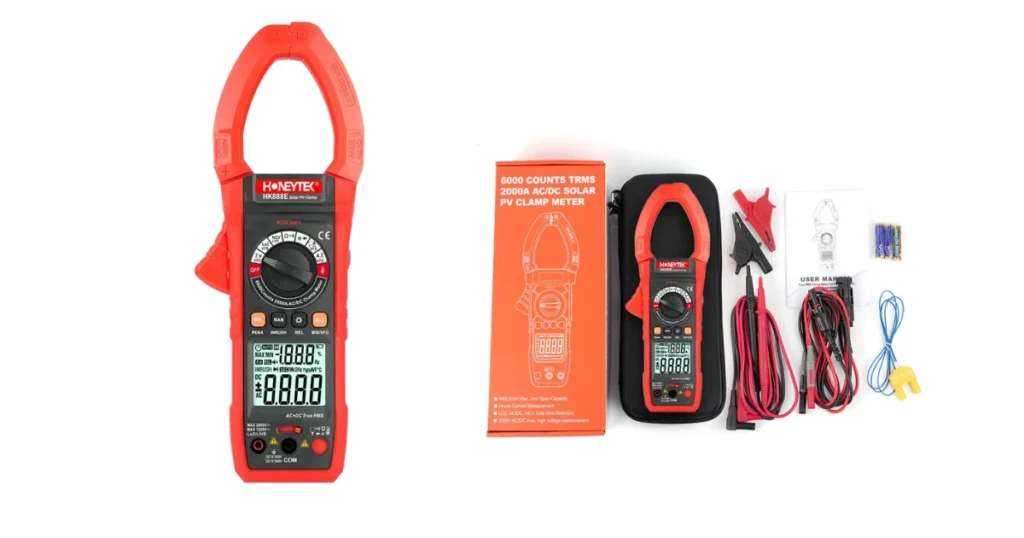
Honeytek HK888E — 2000 V DC Capability at Value-Tier Pricing
Honeytek is a CE and FCC-certified manufacturer of clamp meters and digital multimeters with an established OEM/ODM program serving global distributors. The HK888E is their flagship solar PV clamp meter, built around 2000 V DC measurement capability and a CAT III 1500 V / CAT IV 1000 V safety rating — the strongest CAT IV specification of the three models reviewed.
Voltage and Current Range
The HK888E measures up to 2000 V AC/DC and 2000 A AC/DC through the jaw — the highest native voltage and jaw current ratings of the three meters compared here. The 2000 A jaw capacity matters on utility-scale DC combiner outputs and large AC bus bars where single-conductor currents exceed 1000 A without requiring a flexible probe accessory. The 6000-count True RMS display, inrush current capture, and LoZ AC/DC mode cover the complete diagnostic toolkit required for both installation commissioning and ongoing performance monitoring.
Field-Oriented Functions
A built-in spotlight addresses a practical gap left by both competing models: combiner boxes are rarely well-lit, and operating a head torch while handling live 1500 V DC conductors is poor field practice. The HK888E also includes thermocouple-based temperature measurement up to 1300°C — useful for identifying hotspot conditions at junction box connections or checking inverter thermal management during commissioning. NCV detection and live wire indication complete the safety-oriented feature set.
OEM/ODM Positioning and CAT IV Advantage
For distributors sourcing PV testing instruments at volume, Honeytek’s manufacturing infrastructure supports private-label programs and custom calibration documentation. The HK888E’s CAT IV 1000 V rating also exceeds the CAT IV 600 V offered by both Fluke and UNI-T, providing higher transient withstand at the service entrance level — an advantage for installations with long DC cable runs from remote string combiner boxes where surge exposure is elevated.
Which Solar PV Clamp Meter Should You Choose?
The right choice depends on your project scale, documentation requirements, and procurement context. Here is a direct recommendation for each buyer profile.
Installation Contractors / Distributors
Honeytek HK888E — the 2000 V DC range, 2000 A jaw, CAT IV 1000 V rating, and OEM availability deliver the highest specification-to-cost ratio for volume buyers and contractors who need future-ready instruments today.
If your projects operate exclusively at 1500 V DC and require third-party certified test records, the Fluke 393 FC is the defensible choice. If you are equipping a distributed field team and need durable, connected instruments without enterprise pricing, the UNI-T UT219PV covers that ground well. And if you are sourcing at volume, need 2000 V DC capability, or are building a distribution channel for PV test equipment, the Honeytek HK888E covers more technical ground per dollar than either alternative.
Frequently Asked Questions
What is the best clamp meter for solar PV installation in 2026?
For most commercial PV installations at 1500 V DC, the Fluke 393 FC (premium, IEC-certified) and the UNI-T UT219PV (mid-range, IP65, Bluetooth) are both strong choices. For contractors who need 2000 V DC capability or are sourcing at volume, the Honeytek HK888E delivers the highest technical specifications at the most accessible price point.
Is a 1000 V clamp meter sufficient for solar PV?
Only for small residential systems below 1000 V DC. Any commercial, utility-scale, or modern string inverter system operating at 1500 V DC requires a meter rated to at least CAT III 1500 V. Using a 1000 V DC-rated meter on a 1500 V system is a safety standards violation under IEC 61010-1.
Why does a solar clamp meter need True RMS?
PV inverters produce non-sinusoidal AC output waveforms. Average-responding meters calculate RMS by assuming a perfect sine wave, producing measurement errors of 10–40% with distorted signals. True RMS meters sample the actual waveform and compute an accurate result regardless of wave shape — essential for any inverter output measurement.
What does LoZ mode do on a PV clamp meter?
LoZ (Low Impedance) mode reduces the meter’s input impedance, draining away capacitively induced ghost voltages that appear on long unloaded DC cable runs in PV arrays. Without LoZ, a technician can measure a seemingly active voltage on a disconnected string conductor — leading to incorrect fault diagnosis or an unsafe approach to a circuit that appears live but is not.
What CAT rating is required for utility-scale solar PV?
CAT III 1500 V is the minimum for 1500 V DC string-to-combiner measurements under IEC 61730-1. CAT IV 600 V or higher covers measurements at the service entrance and utility connection point. All three meters reviewed here meet CAT III 1500 V. The Honeytek HK888E’s CAT IV 1000 V rating provides the highest CAT IV transient withstand of the group.
Is Honeytek a reliable solar test equipment manufacturer?
Honeytek is a CE and FCC-certified Chinese manufacturer specializing in clamp meters and digital multimeters, with an OEM/ODM program that supplies instruments to global distributors. Their HK888E and HK888D models are purpose-designed for photovoltaic applications and carry validated CAT III/IV safety ratings. As with any field instrument, calibration verification against a traceable standard before deployment on safety-critical measurements is recommended practice.
You might be interested in:
