
Introduction
In solar PV systems, accurate measurement is not optional—it directly affects system performance, safety, and troubleshooting efficiency.
Many installers and technicians encounter situations where voltage readings appear unstable or incorrect. In most cases, this is caused by ghost voltage, a common issue in modern photovoltaic installations.
Understanding the LoZ (Low Impedance) function in a PV clamp meter is essential to avoid misdiagnosis and ensure reliable field measurements.
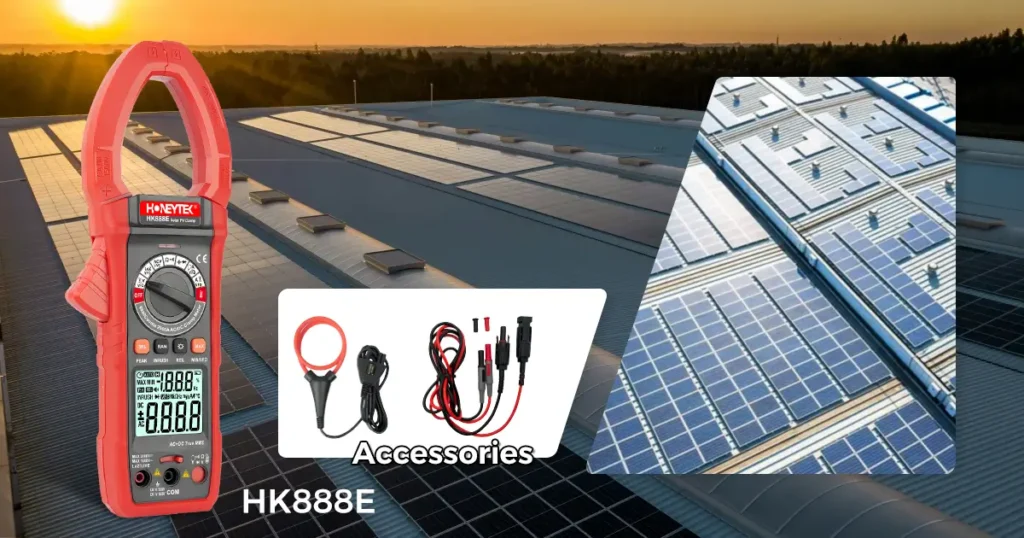
What is LoZ in a PV Clamp Meter?
LoZ (Low Impedance) is a measurement function that reduces the input impedance of the meter to eliminate induced or ghost voltage.
In standard measurement mode, meters detect even weak signals caused by electromagnetic interference. LoZ mode filters out these false readings, allowing the technician to measure only real, usable voltage.
How LoZ Works in Electrical Measurement
High Impedance vs Low Impedance
Most digital multimeters and clamp meters operate with high input impedance by default. This allows them to detect very small voltages, but it also introduces false readings.
These ghost voltages are typically caused by:
- Parallel cable routing
- Capacitive coupling between conductors
- Long cable runs in PV systems
When LoZ mode is activated, the meter lowers its impedance, effectively dissipating induced voltage and stabilizing the reading.

Why LoZ is Critical for PV Clamp Meter Applications
Real-World Impact in Solar Installations
Solar PV systems often involve:
- Long DC cable runs between panels and inverters
- High-voltage environments (1000V–2000V DC)
- Multiple parallel strings and MPPT inputs
These conditions increase the likelihood of ghost voltage. Without LoZ, technicians may:
- Detect voltage where no real power exists
- Misidentify faults in strings or wiring
- Make incorrect maintenance decisions
With a PV clamp meter equipped with LoZ:
- Measurements reflect actual system conditions
- Troubleshooting becomes faster and more reliable
- Safety risks caused by misinterpretation are reduced
LoZ vs Standard Measurement Mode
| Mode | Behavior | Result |
|---|---|---|
| High Impedance | Detects all signals | May include ghost voltage |
| LoZ Mode | Filters induced voltage | Displays real voltage only |
Common Misconceptions in PV Measurement
“Voltage detected means power exists”
Not necessarily. Induced voltage can appear even when no usable current is present.
“Standard mode is sufficient for all testing”
In complex PV systems, standard high-impedance mode often leads to inaccurate readings.
When Should You Use LoZ Mode?
LoZ mode is particularly useful in the following scenarios:
- When voltage readings fluctuate unexpectedly
- When testing long cable runs in solar systems
- When verifying whether a circuit is truly energized
- During troubleshooting of inverter inputs or combiner boxes
For PV installers and maintenance teams, using LoZ at the right time improves both accuracy and efficiency.

Choosing the Right PV Clamp Meter
A professional PV clamp meter should include:
- LoZ (Low Impedance) function
- True RMS measurement
- High DC voltage capability (1500V–2000V)
- Reliable safety rating (CAT III / CAT IV)
Manufacturers like Honeytek, specializing in clamp meters and digital multimeters, focus on integrating these features to meet real-world photovoltaic testing requirements.
FAQ
Is LoZ required for every measurement?
No. LoZ is mainly used when ghost voltage is suspected or when readings are unstable. For standard measurements, high-impedance mode is sufficient.
Does LoZ affect measurement accuracy?
LoZ improves accuracy by removing false voltage signals. It does not distort real voltage measurements.
Can LoZ be used safely in high-voltage PV systems?
Yes, as long as the clamp meter meets the required safety category (such as CAT III or CAT IV), LoZ can be safely used in high-voltage environments.
Is LoZ available in all clamp meters?
No. LoZ is typically found in more advanced clamp meters designed for professional or industrial use, especially those intended for PV systems.
Conclusion
In modern photovoltaic systems, where long cables and high voltages are standard, ghost voltage is not an exception—it is expected.
A PV clamp meter with LoZ function is no longer a premium feature but a practical requirement for accurate diagnosis and safe operation.
You might be interested in:
