
When you need to measure DC current without breaking a circuit, a Hall-effect AC/DC clamp meter is one of the safest and most efficient tools you can use. But accuracy and safety depend on understanding how these meters work — and using them correctly.
What Makes a Clamp Meter Capable of DC Measurement?
Not all clamp meters can measure DC.
A proper AC/DC clamp meter uses a Hall-effect sensor inside the jaw to detect the magnetic field produced by DC current. Many low-cost meters only measure AC current, so always confirm your model supports A⎓ / A DC.
Step-by-Step Guide: How to Measure DC Current Correctly
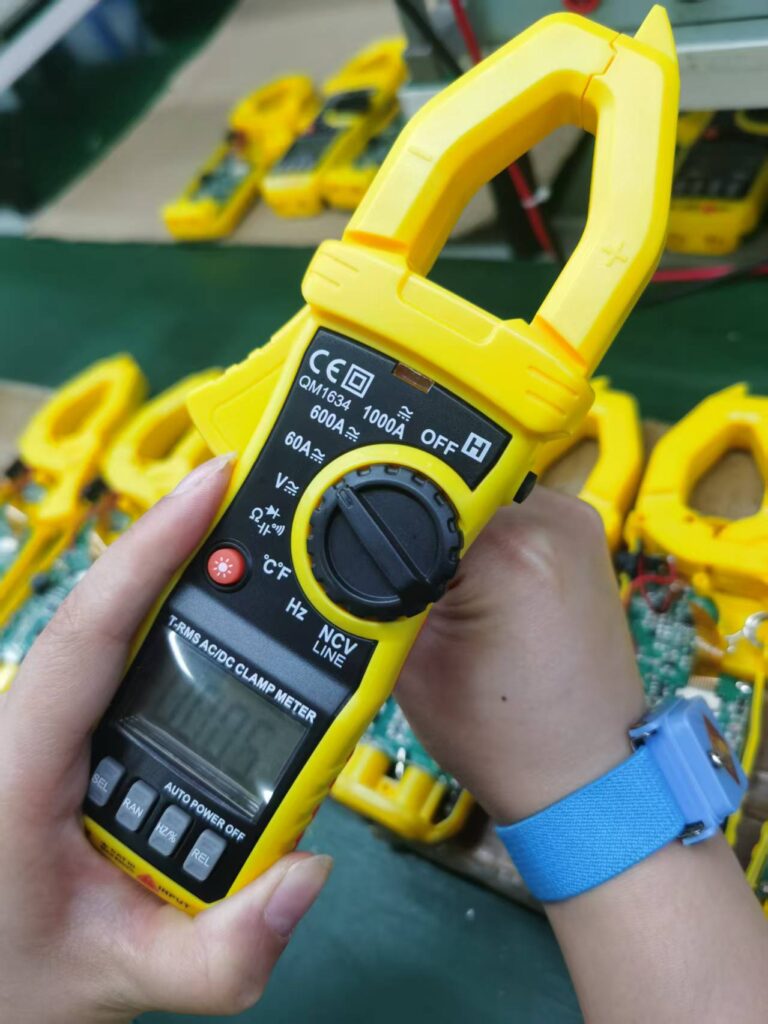
1. Prepare and Inspect the Meter
Before you begin:
- Ensure the expected current does not exceed the meter’s DC rating.
- Remove all test leads — clamp meters read current through the jaws, not the probes.
- Wear appropriate PPE when working on live circuits (gloves, glasses, etc.).
2. Set the Meter to DC Amps
Turn the selector dial to A⎓ / A DC.
Most modern meters will show a clamp icon, confirming that current will be measured through the jaw sensor.
3. Zero the Clamp (Critical for DC Accuracy)
Because Hall-effect sensors can drift, you must zero the clamp:
- Keep the jaws empty.
- Fully close the clamp.
- Press ZERO or REL.
This removes residual magnetic offset and ensures accurate low-current readings.
4. Clamp Around a Single Conductor
Open the jaw and clamp only one wire — never a full cable with both conductors.
Opposite currents cancel each other out, resulting in a near-zero reading.
For best accuracy:
- Center the conductor on the alignment marks.
- Ensure the jaws close completely.
5. Power the Circuit and Read the Measurement
After restoring power (if applicable), watch the reading stabilize and note the value in amps.
If the display is hard to see, use HOLD, MIN/MAX, or PEAK capture functions.

Tips for Better Accuracy & Common Mistakes to Avoid
- Keep the clamp away from neighboring current-carrying wires to reduce magnetic interference.
- Never clamp multiple conductors with opposing currents — readings will cancel.
- Always zero the meter again after changing ranges or measuring small DC currents.
- Use a meter with the correct CAT rating for panel or field work (CAT III / CAT IV).

When a Clamp Meter Isn’t the Best Tool
For very low DC currents (mA or µA levels) or applications requiring extremely high precision, inserting a standard multimeter in series is often more accurate than using a clamp meter. Clamp meters have noise floors and resolution limits that can affect small readings.
If you ever need a reliable AC/DC clamp meter for automotive work, solar installations, industrial maintenance, or field diagnostics, Honeytek offers a full range of high-accuracy Hall-effect clamp meters built for professional environments.
