
When you’re testing components, not all measurement tools are built the same. A portable capacitance meter and an LCR meter may look similar on your bench, but their purpose, depth of analysis, and overall capabilities fall into very different categories.
In simple terms:
A portable capacitance meter tells you “how big is this capacitor?”
An LCR meter tells you “how does this component really behave in a real circuit?”
Let’s break it down with a clear engineering perspective.
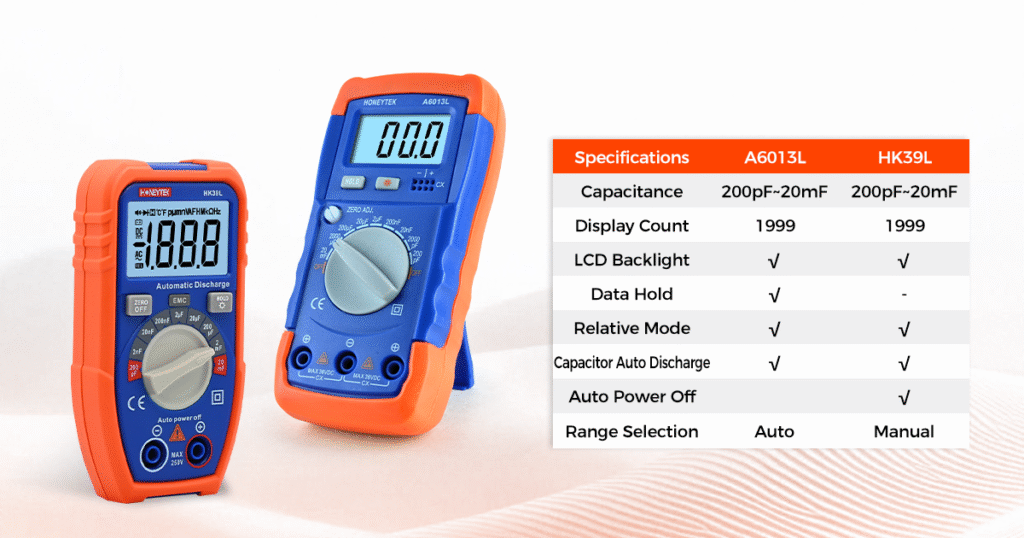
What They Measure: Different Levels of “Professional Depth”
Portable Capacitance Meter
A portable capacitance meter focuses on one primary job—measuring capacitance value.
It gives you a quick read in µF, nF, or pF to check:
- Whether a capacitor has drifted out of spec
- Whether a part is open, shorted, or degraded
- Whether two capacitors match for pairing or replacement
It typically does not measure ESR, Q, dissipation factor (D), impedance, or frequency-dependent behavior.
This tool is meant for fast judgment, not deep analysis.
LCR Meter
An LCR meter is essentially a component parameter analyzer.
It measures:
- L (inductance)
- C (capacitance)
- R (resistance)
…plus a long list of secondary parameters: - ESR, Q, D
- Equivalent series or parallel models
- Impedance / admittance
- Frequency-dependent characteristics
This is the tool engineers rely on for R&D, quality inspection, production testing, and component modeling.
It answers the question:
“How does this device behave electrically at the frequency my circuit actually uses?”
Precision, Test Frequency, and Measurement Conditions
Portable Capacitance Meter: Practical Accuracy
Portable meters generally operate at a fixed, low test frequency, and their accuracy is perfectly adequate for:
- Power electronics
- Motor run capacitors
- General repair and troubleshooting
However, for very small capacitors or high-frequency components, the results may not reflect actual in-circuit performance.
LCR Meter: High-Accuracy, Multi-Frequency Analysis

LCR meters deliver high precision (0.1% or even 0.01%) and allow you to test at multiple frequencies—
100 Hz, 120 Hz, 1 kHz, 10 kHz, 100 kHz, and more.
That means you can measure components under conditions that mirror their real operating environment, which is critical for:
- High-frequency power supplies
- RF circuits
- Precision sensors
- Advanced filter design
This is the difference between “checking a part” and “characterizing a component.”
Real-World Usage: Tool vs. Instrument
Portable Capacitance Meter → A Practical Field Tool
Common use cases:
- Quick diagnosis during repair
- Screening electrolytic capacitors
- Matching parts in DIY or hobby projects
- On-site electrical maintenance
Strengths:
✔ Pocket-sized
✔ Easy to use
✔ Fast measurement
✔ Affordable
LCR Meter → A Professional Measurement Instrument
Common use cases:
- Incoming QC for components
- Production line sampling and sorting
- R&D verification for power electronics, filters, RF modules
- Reliability and aging studies
LCR meters are available in handheld and benchtop formats; the latter offers the highest precision and automation capabilities.
Complexity and Cost
Portable Capacitance Meter
- Simple interface
- Minimal settings
- Low learning curve
- Budget-friendly
Ideal for technicians and field engineers who need “measure and move on.”
LCR Meter
- Requires selection of test frequency, parameter mode, series/parallel model, voltage level, and more
- Menus are deeper and more technical
- Cost ranges from a few hundred to several thousand dollars
It’s a true laboratory instrument, and its value depends on understanding circuit behavior.
Which One Should You Choose?
Choose a Portable Capacitance Meter if you:
- Are doing repairs or quick troubleshooting
- Only need the capacitance value
- Want something pocketable and simple
- Work with general-purpose capacitors (power supplies, motors, HVAC, household electronics)
Choose an LCR Meter if you:
- Need to evaluate ESR, Q, D, impedance, or frequency effects
- Are validating components for R&D or production
- Work in high-frequency or precision applications
- Require multi-frequency, high-accuracy measurement
Need portability and deeper insight?
A handheld LCR meter is the best hybrid option—more advanced than a simple capacitance meter, easier to carry than a benchtop unit.
