
Capacitor measurement is one of the most common tasks in electronics repair, component evaluation, R&D testing, and field diagnostics. Yet the accuracy you can realistically expect differs dramatically depending on whether you use a digital multimeter (DMM), a portable capacitance meter, or a professional LCR meter.
Understanding these differences is essential—especially when deciding whether basic troubleshooting, precision screening, or detailed parameter characterization is required.
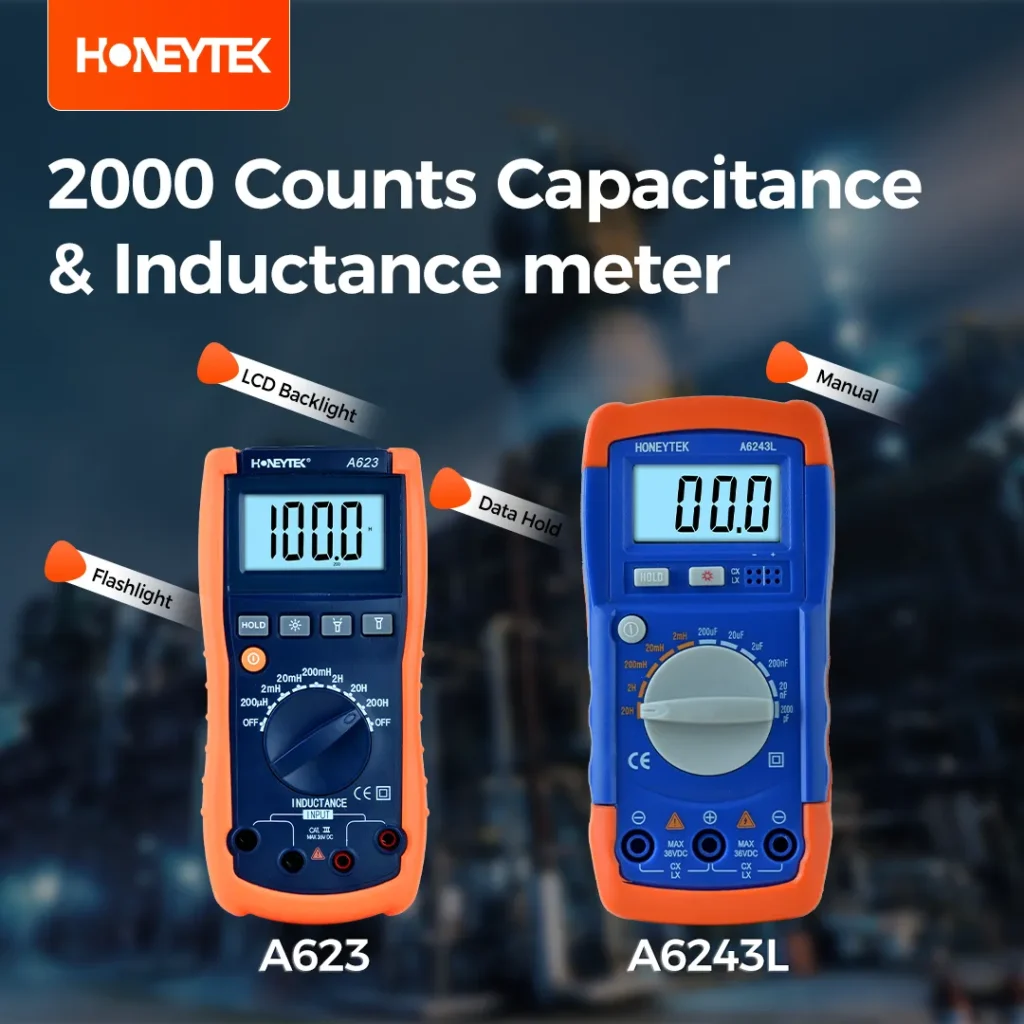
In this guide, we break down the typical accuracy ranges, the reasons behind them, and how these instruments behave in real-world applications. We also reference typical product categories such as the Honeytek HK78LCR True RMS multimeter and A6013L / HK39L portable capacitance meters, which represent common accuracy ranges in field instruments.
Why Accuracy Expectations Differ
All three instruments may “measure capacitance,” but they operate under different design constraints:
- Digital multimeters treat capacitance as a convenience function.
- Portable capacitance meters focus on one job—measuring C value—more precisely.
- LCR meters analyze how a component behaves under controlled test frequency and voltage.
This creates a natural hierarchy of measurement precision.
Summary Comparison: Typical Accuracy Levels
Below is a practical, engineering-oriented comparison based on widely accepted industry ranges.
Digital Multimeter (Capacitance Range)
Typical accuracy: ±(1%–5% of reading + digits)
This varies widely based on price, range, and component type. Entry and mid-range models usually fall in the 2%–5% bracket. Multimeters such as the Honeytek HK78LCR include capacitance ranges for field diagnostics, but they remain general-purpose instruments.
Intended use:
- Repair work
- Determining whether a capacitor has failed or drifted significantly
- Non-critical measurements
Portable Capacitance Meter

Typical accuracy: ±(0.5%–2% of reading + digits)
Because these instruments focus solely on capacitors, they achieve better performance. Models like the Honeytek A6013L or HK39L typically fall within this range and offer faster settling time, more stable readings, and improved low-capacitance performance.
Intended use:
- Screening components
- Incoming material spot checks
- Matching capacitors for filters or audio applications
- Field testing with moderate precision needs
Handheld LCR Meter
Typical accuracy: ±(0.25%–0.5% of reading)
A handheld LCR meter already enters the domain of professional component analysis. These devices also test capacitance under selectable frequencies, often at 100 Hz, 120 Hz, 1 kHz, or 10 kHz, making them far more suitable for design work or evaluating high-frequency capacitors.
Intended use:
- Engineering development
- Performance verification
- High-precision component matching
Benchtop LCR Bridge
Typical accuracy: ±(0.1%–0.25% of reading), high-end models down to 0.05%
These instruments are used in R&D labs, QA departments, and calibration environments. Because they support open/short/load correction and stable test levels, their long-term accuracy and consistency surpass handheld equipment.
Intended use:
- Laboratory characterization
- Detailed technical reports
- Precision quality certification
- Frequency-dependent parameter modeling
Accuracy Table for Quick Reference
| Instrument Type | Typical Capacitance Accuracy | Practical Use Cases |
|---|---|---|
| Digital Multimeter (DMM) | ±1% to ±5% (common mid-range at ±2–5%) | Repair, fault diagnosis, basic evaluation |
| Portable Capacitance Meter | ±0.5% to ±2% | Screening, simple QC, capacitor matching |
| Handheld LCR Meter | ±0.25% to ±0.5% | Engineering testing, R&D support |
| Benchtop LCR Bridge | ±0.1% to ±0.25% (or better) | Precision measurement, certification, lab testing |
Why DMMs Are the Least Accurate for Capacitance
Digital multimeters are designed as general-purpose electrical tools. Their primary mission is to measure voltage, current, and resistance with good accuracy and stability. Capacitance measurement, on the other hand, is a secondary feature, added for convenience rather than precision testing.
Below are the core engineering reasons that make DMMs inherently less accurate for capacitance measurements than dedicated capacitance meters and LCR meters.
Limited Measurement Architecture
A digital multimeter typically uses a simplified RC charging method or a low-frequency AC injection technique. These circuits are compact, cost-optimized, and designed for robustness rather than scientific measurement accuracy.
This results in:
- More noise sensitivity
- Slower settling time for large electrolytic capacitors
- Reduced sensitivity for small-value capacitors
- Higher uncertainty across wide capacitance ranges
Multimeters like the Honeytek HK78LCR integrate capacitance measurement for field technicians, but they still inherit these inherent limitations.
Fixed and Low Test Frequency
Unlike an LCR meter, which may offer 100 Hz / 120 Hz / 1 kHz / 10 kHz / 100 kHz, a multimeter’s test frequency is typically:
- Fixed
- Low
- Not optimized for high-frequency capacitors
This means the reading reflects a static capacitance value, not the capacitor’s behavior in the actual operating circuit. For high-frequency MLCCs or low-ESR designs, DMM values can deviate substantially from real-world performance.
No ESR, Q, or D Measurement
A large portion of capacitor behavior is linked not to capacitance itself, but to:
- ESR (Equivalent Series Resistance)
- Q factor
- D (Dissipation factor)
- Impedance vs. frequency
DMMs cannot measure any of these.
Thus, a capacitor that appears “normal” on a multimeter may still fail under ripple, heat, or switching frequency load—common in power supplies and LED drivers.
Wider Component Tolerances and Internal Drift
DMMs are built as durable work tools, not precision analyzers. Their internal reference components—especially those used for capacitance—tend to:
- Drift more with temperature
- Age faster
- Show non-linear error characteristics
Portable capacitance meters handle this better, and LCR meters outperform both due to:
- Tighter component tolerances
- Active compensation
- Calibration modes (open / short / load)
Reduced Accuracy at Range Extremes
A DMM’s capacitance accuracy is best only around its “middle” ranges. Errors increase when:
- Measuring very small capacitances (pF range)
- Measuring very large electrolytics (thousands of µF)
- The ambient temperature deviates from the reference 23°C
Because portable capacitance meters are tailored for these measurement extremes, they deliver far more consistent results.
Why Portable Capacitance Meters Outperform DMMs
Portable meters like Honeytek A6013L and HK39L dedicate all hardware resources to one purpose: measuring capacitance accurately.
They use:
- Better integration timing circuits
- More stable charge/discharge paths
- Higher resolution ADCs for this specific task
- Faster response algorithms for electrolytic capacitors
This is why they typically fall into the ±0.5%–2% accuracy range—excellent for screening, pairing, field maintenance, and QC testing.
Why LCR Meters Deliver the Highest Accuracy
The reasons LCR meters dominate precision measurement are fundamental:
1. They Control Test Frequency
A capacitor behaves differently at 100 Hz versus 10 kHz.
Only LCR meters allow you to measure under application-realistic conditions.
2. They Measure Multiple Parameters
LCR meters characterize:
- Capacitance (C)
- ESR
- Q factor
- Dissipation factor (D)
- Equivalent series/parallel models
- Impedance / admittance
This gives engineers a complete picture of component behavior.
3. They Support Calibration Routines
Professional LCR equipment includes:
- Open correction
- Short correction
- Load correction
These cancel parasitic effects from cables and fixtures, improving both accuracy and repeatability.
4. They Use Precision Analog Front Ends
High-end meters employ:
- Low-distortion AC sources
- High-resolution ADCs
- Temperature-stable components
This lets benchtop LCR bridges reach ±0.1% or even ±0.05% accuracy—more than an order of magnitude better than a multimeter.
Choosing the Right Tool for Your Accuracy Requirements
For repair, HVAC, DIY, general troubleshooting
A digital multimeter or portable capacitance meter is sufficient.
You only need to know whether the capacitor has failed or drifted significantly.
For matching capacitors or simple QC work
Choose a portable capacitance meter or an entry-level LCR meter.
Ideal accuracy: ±1–2%
For engineering, R&D, power electronics, RF, and precision filters
Use a handheld or benchtop LCR meter.
You need ESR, Q, frequency control, and repeatability.
For laboratory reporting, certification, and component modeling
A benchtop LCR bridge is the only correct choice.
Frequently Asked Questions (FAQ)
Why do my DMM and LCR meter show different capacitance values?
They measure at different frequencies. Capacitor values change with frequency, so the readings naturally differ.
Is ESR measurement important?
Yes. In switching power supplies and LED drivers, ESR is often more important than capacitance itself.
Why does a portable capacitance meter settle faster on large electrolytics?
Its measurement engine is optimized for electrolytic charge/discharge characteristics.
Can a multimeter replace an LCR meter in R&D?
No. You need ESR, Q, and frequency-dependent data to validate designs.
How often should I calibrate an LCR meter?
For consistent accuracy, perform open/short/load calibration each time you change test fixtures or frequency.
Honeytek provides a complete portfolio of accurate, reliable, and field-proven measurement tools, from True RMS multimeters like HK78LCR, to portable capacitance meters such as A6013L / HK39L, and advanced LCR testing solutions for engineering teams.
Related articles:
How Students, Vocational Schools, Home Users, and Hobbyists Should Choose a Digital Clamp Meter
